
The Fool, What Beginnings Actually Ask of Us
Starting before you're ready isn't recklessness. It's the only way some things begin.

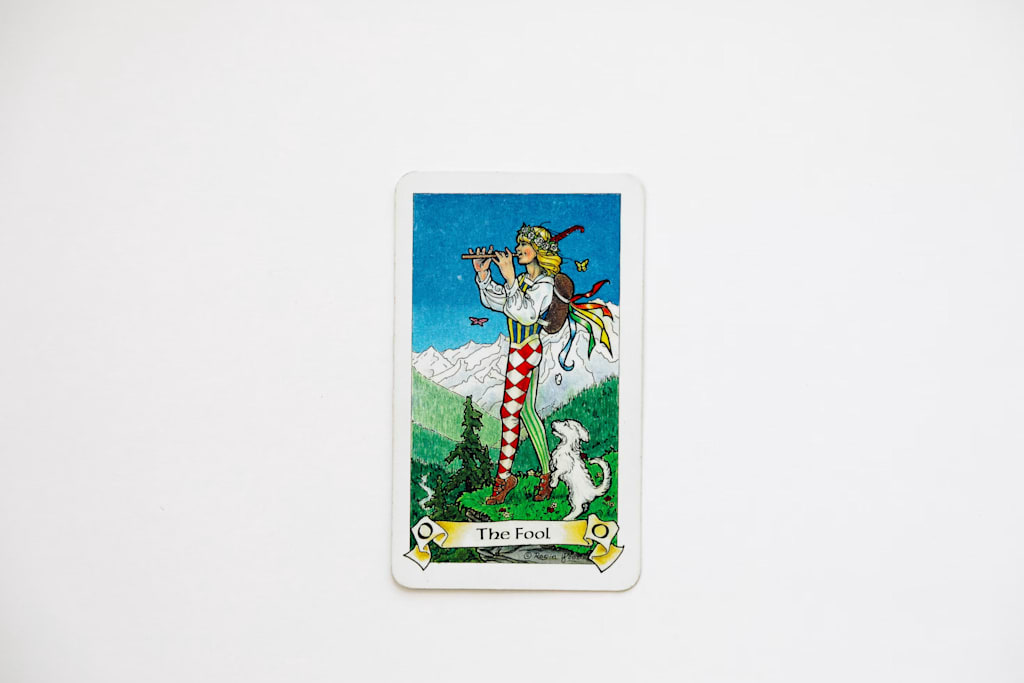
The Fool is card zero. Not card one. Zero.
That number is the first thing about The Fool that changed how I see beginnings. Zero isn't a starting point on a numbered scale. It's the moment before the scale begins. The space where something exists but hasn't taken form yet.
Most people approach new beginnings by trying to eliminate uncertainty first. Research the path. Reduce the unknowns. Build confidence before moving. The Fool does none of that. The Fool steps off the cliff with a small bag, a flower, and a dog at his heels, and doesn't look down.
That's either courage or foolishness. The card refuses to tell you which. That ambiguity is the point.
What the Image Is Actually Saying
Look at the traditional imagery: a young figure at the edge of a cliff, face turned toward the sky, about to step into empty air. He's not looking at where he's going. He's looking up, at possibility, at openness, at something the viewer can't see.
The small bag he carries is almost insulting in its inadequacy. He has almost nothing. And he's stepping off a cliff.
The way I've come to read this at Celesties: The Fool isn't naive. He's making a specific choice, to begin before he's ready, because waiting until you're ready is often just another name for not beginning.
That's a psychological observation as much as a tarot interpretation. We confuse preparation with readiness. We confuse gathering information with actually knowing what we need to know. The Fool suggests that some things can only be learned by stepping off the edge.
The Psychology of Starting
There's a concept in psychology called the "readiness trap", the tendency to postpone action until conditions feel optimal. The problem is that conditions rarely feel optimal, and waiting for them usually means the conditions never arrive.
The Fool is the tarot's answer to that trap.
When this card appears in a reading, it's usually addressing a specific hesitation. Not "you're not ready" (which is often how people interpret it when they're nervous about the card). More often it's pointing at something the reader already knows, has been circling around, has been gathering courage for, and the card is simply reflecting back: the information you're waiting for doesn't arrive before the step. It arrives because of it.
This doesn't mean recklessness is wisdom. The Fool carries a bag, not nothing. He has some provisions. He has a companion. He's not completely unprepared, he's just not waiting for complete preparation.
What The Fool Changed For Me
I used to think this card was about optimism. About enthusiasm, about youthful energy, about starting things with excitement.
I don't think that anymore.
I think The Fool is about tolerance for uncertainty. The ability to begin something knowing full well that you don't know how it ends, that you might fail, that the cliff might not have a landing, and to begin anyway, not because you've suppressed that knowledge, but because you've decided the alternative is worse.
The alternative being: never starting. Staying at the edge, gathering information, waiting for a sign that it's safe.
The Fool doesn't wait for the sign. The step is the sign.
When This Card Appears
The Fool tends to show up at genuine inflection points. A decision that's been delayed. A direction that's been considered but not taken. A moment where the theoretical has to become actual.
It also appears, sometimes, when someone has been in "preparation mode" for so long that the preparation has become the thing itself, a way of staying close to the idea of change without having to change.
In those readings, The Fool asks a quiet question: what would you do if you knew that more preparation wouldn't make you more ready?
That question tends to land differently depending on where you are. For some people it's a relief. For others it's confronting. Both responses are useful.
The Zero at the Beginning
I keep coming back to that zero. In numerology, in most counting systems, we start at one. Zero is what precedes counting. It's potential without form.
The Fool is potential without form. The story before the story starts. Everything that exists between the thought and the first step.
Most of the major arcana cards represent states, experiences, archetypes that have already taken shape. The Fool is the only one that represents the moment before shaping begins.
That makes it, in a strange way, the most important card in the deck. Not because beginnings matter more than middles or endings. But because everything that follows depends on whether you take that step at all.
The cliff is always there. The question is always the same: are you looking down, or are you looking up?
About the Creator
Celestia Rivers
Tarot writer. I explore cards as a mirror for self-reflection, not prediction. Psychology first, mysticism as an accent. Writing about tarot reading at https://celesties.org/
Enjoyed the story? Support the Creator.
Subscribe for free to receive all their stories in your feed.
Comments
There are no comments for this story
Be the first to respond and start the conversation.