social media
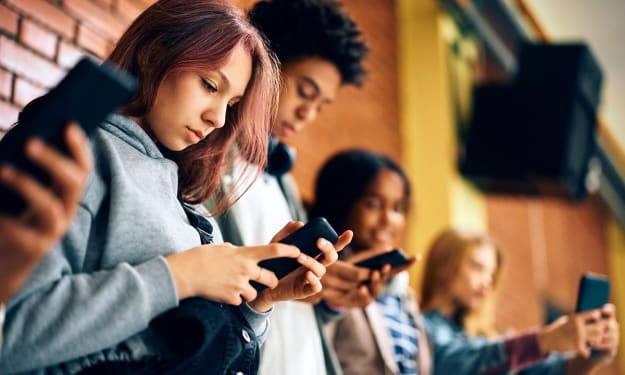
Social media dramatically impacts our offline lives and mental well-being; examine its benefits, risks and controversies through scientific studies, real-life anecdotes and more.
Bare Branches
As I was driving home from town earlier this month, I suddenly noticed that the trees had no leaves on them. It struck me in surprise, because the last time I had noticed them, the trees were just beginning to turn colors. Time had slipped right past me, and I had flowed right along for the ride, never once paying attention to where I was going - not even lifting my head one time from what I was doing to look at the beauty of my surroundings and my favorite season. Looking back, I realize that the social media/internet break I had planned had turned into a walking fugue state.
By Mother Combs10 months ago in Psyche
How Your Behavior Shapes How People Treat You—and Why Your Life Path Follows You
Whitman Drake Abstract Ideas about “positive thinking” are often rejected because they are framed as motivational platitudes rather than analytically grounded claims. This article advances a different argument. Drawing on pragmatist philosophy, social psychology, expectancy theory, and sociology, it contends that stable cognitive orientations regulate behavior, behavior structures reciprocal social response, and repeated social responses accumulate into recognizable life trajectories. From this perspective, individuals do not primarily design a path and then follow it. Instead, paths emerge through interactional processes that reward, constrain, and reinforce consistent ways of thinking and acting. The article situates positive cognitive orientation not as wishful thinking, but as a mechanism that shapes conduct, reputation, and opportunity over time.
By Whitman Drake10 months ago in Psyche
The Science of Solitude: Why Being Alone Is Beneficial for the Mind
Introduction Being alone in the modern world carries a subtle stigma. We are in an age of hyperconnectivity: smartphones chirp constantly, social media beckons continually, and the cadence of life rarely permits meditative quiet. Being alone is mistakenly equated by many with loneliness, a sense of isolation and disconnection. Solitude and loneliness are quite different. While loneliness is painful and involuntary, solitude is voluntary behavior—a conscious stepping away from external stimuli to re-engage with oneself, reflect, and regenerate.
By The Chaos Cabinet11 months ago in Psyche
The Emotional Echo: How Micro-Rejections Shape Our Inner World. AI-Generated.
Most people understand the sting of major rejection. A breakup, a job denial, a falling-out with a friend—these events leave marks that are easy to recognize. But psychology has begun paying increasing attention to something far quieter: micro-rejections. These are small, often fleeting moments of social dismissal that many of us overlook or brush aside. A text left unanswered, a slightly cold tone from someone we care about, a subtle exclusion from a group conversation, a joke that doesn’t land the way we hoped—it’s easy to dismiss these experiences as trivial. Yet they leave emotional echoes that can meaningfully influence our behavior, self-perception, and overall psychological health.
By Kyle Butler11 months ago in Psyche
Dialogues Across Time. AI-Generated.
I feel we are at the corner of something revolutionary and yet evolutionarily necessitated. Some psychologists acknowledge only the past century as a time for our field when it has been alive and well, but giving credit to the late Charles Darwin means first acknowledging the agencies that formed out of novel curiosity, which would eventually call the field home. Psychology evolves, sometimes quickly, but the questions at its core remain the same.
By Inner Terrain w/ Daniel Chapman11 months ago in Psyche