social media
Social media dramatically impacts our offline lives and mental well-being; examine its benefits, risks and controversies through scientific studies, real-life anecdotes and more.
My Experience on Silencing Autism
I wanted to do an educational article on something that has recently come up in my attention. I was having lunch with some of my peers - and one of the ladies spoke briefly about someone she provides care for: "You know, so-and-so still is so loud and needs to learn to not make everyone miserable just because she is miserable." The so-and-so is an autistic individual and I wanted to say something then, but bit my tongue.
By Adora Hooper10 months ago in Psyche
The Psychology of Overthinking at Night
Every night, the same ritual: I turn off the lights, close my eyes, and within minutes, my mind transforms into a courtroom where I'm simultaneously the defendant, prosecutor, and judge—and I'm always found guilty.It's 2:47 AM, and I'm mentally replaying a conversation from three days ago.Not an important conversation. Not a fight or a confrontation. Just a casual exchange with a coworker where I said something that might have sounded stupid. Probably didn't. But might have.My mind dissects every word, every pause, every facial expression I can remember. What did she mean when she said "interesting"? Was that genuine interest or polite dismissal? Did I talk too much? Did I sound arrogant? Should I have asked more questions?Round and round the thoughts spiral, each loop adding new layers of anxiety, new evidence of my social incompetence, new reasons why everyone probably thinks I'm insufferable.By 3:30 AM, I've catastrophized that one unremarkable conversation into proof that I'm about to be fired, that I have no real friends, that I'm fundamentally unlikeable and everyone's just been too polite to tell me.By 4:00 AM, I'm mentally composing an apology email for something that probably didn't even register as awkward to anyone but me.This is my nightly reality. And I know I'm not alone.The Midnight CourtThere's something uniquely cruel about the thoughts that arrive after midnight. They're not the same thoughts that visit during daylight hours. They're darker, meaner, more convincing.During the day, I can recognize irrational anxiety for what it is. I can talk myself down, use coping strategies, distract myself with work or conversation or movement.But at night, alone in the dark with nothing but my thoughts, those same anxieties become undeniable truths. The rational part of my brain goes offline, and suddenly every fear seems valid, every worst-case scenario seems inevitable, every mistake I've ever made seems unforgivable.I've replayed conversations from twenty years ago. I've worried about things that haven't happened yet and probably never will. I've mentally prepared for catastrophes that exist only in my imagination. I've solved problems that don't need solving and created problems that don't exist.My husband sleeps peacefully beside me while I lie awake, convinced that some minor misstep I made during the day has irreparably damaged my entire life."Why do you do this?" he asked once, after finding me crying at 3 AM about something I couldn't even articulate. "Why do you torture yourself like this?"I didn't have an answer then. But I do now.The Science of the SpiralOur brains are fundamentally different at night. This isn't just psychological—it's biological.As my therapist explained it, the prefrontal cortex—the part of your brain responsible for rational thinking, perspective, and emotional regulation—starts to power down as you get tired. Meanwhile, the amygdala, your brain's fear center, stays wide awake.It's like the adult supervisor leaving a room full of anxious children. Without the rational brain to provide context and perspective, your anxieties run wild, unchecked by logic or reason.Add to this the fact that nighttime naturally triggers our evolutionary threat-detection systems. For thousands of years, darkness meant vulnerability. Our ancestors who stayed alert at night, scanning for predators and dangers, were more likely to survive.We've inherited those vigilant, worried nighttime brains. But instead of scanning for predators, we scan our memories for social threats, professional failures, relationship problems, and existential fears.The isolation of night amplifies everything. During the day, we're distracted by a thousand stimuli—work, conversations, movement, light, noise. At night, there's just you and your thoughts. No distractions, no escape, nowhere to hide from the anxieties you've been outrunning all day.The Anxiety I've CarriedI can trace my nighttime overthinking back to childhood, to nights spent lying awake listening to my parents fight, trying to predict whether the argument would escalate, rehearsing what I'd do if things got worse.I learned to be hypervigilant at night. To problem-solve in the dark. To mentally prepare for catastrophes while everyone else slept peacefully.That hypervigilance never left. Even though I'm safe now, even though there's no real threat, my brain still performs the same nightly ritual: scan for dangers, replay interactions for hidden meanings, prepare for worst-case scenarios.By the time I was thirty, nighttime overthinking had become so routine I barely questioned it. I thought everyone spent hours awake analyzing their day, worrying about tomorrow, catastrophizing about everything that could go wrong.It wasn't until my doctor suggested my chronic insomnia might be anxiety-related that I realized: this wasn't normal. This was my nervous system stuck in a loop, treating everyday life like a constant threat.The Topics That Haunt UsThe content of nighttime overthinking follows predictable patterns. We don't lie awake thinking about our successes or the things that went well. We fixate on:Social interactions. Every conversation becomes evidence of our inadequacy. "Why did I say that? What did they think? Did I sound stupid? Do they hate me now?"Past mistakes. Things we did years ago, mistakes we've already apologized for, embarrassments that probably no one else even remembers—they all resurface at 2 AM with fresh urgency.Future catastrophes. Our minds spin elaborate disaster scenarios. What if I lose my job? What if my partner leaves? What if I get sick? What if everything falls apart?Existential dread. Who am I? What's the point? Am I wasting my life? Have I made all the wrong choices?Physical symptoms. A headache becomes a brain tumor. Fatigue becomes a serious illness. Every bodily sensation becomes potential evidence of imminent death.The darkness amplifies everything, stripping away the perspective and proportion that daylight provides. A minor awkwardness becomes social catastrophe. A small worry becomes existential crisis.The Exhausting PerformanceWhat makes nighttime overthinking so damaging isn't just the lost sleep—it's the way it bleeds into the next day.I'd wake up exhausted, my mind still heavy with the previous night's anxieties. I'd drag myself through the day, caffeine-fueled and barely present, already dreading the moment I'd have to go to bed again and face another night of mental torture.The overthinking created a vicious cycle. The anxiety kept me awake, which made me more tired, which made my prefrontal cortex even less effective the next night, which led to even worse overthinking.I started avoiding sleep. I'd stay up late scrolling my phone, watching TV, doing anything to delay the moment I'd have to turn off the lights and face my thoughts. Which of course made everything worse.My relationships suffered. I'd be irritable and withdrawn, too exhausted to be present. My work suffered—it's hard to focus during the day when you've spent the night catastrophizing about everything that could go wrong.But the worst part was the shame. I felt weak for not being able to control my own thoughts. I felt ridiculous for losing sleep over things that seemed so trivial in the morning. I felt alone, convinced that everyone else had figured out how to turn off their brains at night while I remained broken.The Breaking PointThe crisis came during a particularly bad week when I'd averaged maybe three hours of sleep a night. I was sitting in a meeting at work, and my boss asked me a direct question. My mind went completely blank. I couldn't remember where I was or what we were discussing.I excused myself, went to the bathroom, and had a panic attack in a stall. This couldn't continue. The nighttime overthinking wasn't just stealing my sleep—it was stealing my life.That afternoon, I called a therapist who specialized in anxiety and insomnia. "Tell me about your nights," she said.I described the spiral—the replaying of conversations, the catastrophizing, the inability to shut my brain off, the shame of lying awake while everyone else slept peacefully."You're not broken," she said. "Your brain is doing exactly what anxious brains do at night. But we can teach it something different."The Work of Quieting the MindHealing nighttime overthinking wasn't about thinking my way out of it—it was about changing my relationship with my thoughts.My therapist taught me that thoughts at 3 AM aren't truth—they're just thoughts, colored by fatigue, darkness, and an offline prefrontal cortex. I didn't need to believe them or solve them. I just needed to acknowledge them and let them pass.We practiced cognitive defusion—learning to observe my thoughts without getting caught in them. Instead of "I'm going to get fired," I'd think "I'm having the thought that I'm going to get fired." Small shift, massive difference. It created space between me and the anxiety.I learned the "worry window" technique—setting aside 15 minutes during the day to deliberately worry about everything on my mind. When nighttime anxieties appeared, I could tell myself, "Already addressed this during worry time. Moving on."I established a wind-down routine that signaled to my nervous system that it was safe to sleep. No screens for an hour before bed. Gentle stretching. Reading something light. Making my bedroom a sanctuary rather than a courtroom.I practiced grounding techniques when the spiral started. Five things I could see, four I could touch, three I could hear. Counting breaths. Anything to bring me back to the present moment instead of the catastrophic future my mind was creating.The Unexpected DiscoveriesAs I worked on the nighttime overthinking, I started noticing patterns. The spiral was worst on days when I'd ignored my feelings, when I'd pushed through stress without acknowledging it, when I'd said yes when I meant no.The nighttime overthinking wasn't random. It was my psyche's way of processing things I hadn't dealt with during the day. All the feelings I'd stuffed down, all the concerns I'd dismissed, all the stress I'd tried to outrun—it all surfaced at night when my defenses were down.I started addressing things in real-time instead of stockpiling them for the 3 AM review. If a conversation bothered me, I'd process it during the day instead of waiting for my exhausted nighttime brain to catastrophize it. If I was stressed, I'd acknowledge it instead of pretending I was fine.The less I suppressed during the day, the less my brain had to process at night.
By Ameer Moavia10 months ago in Psyche
Youth in the Digital Age
Whitman Drake You don’t usually notice when it happens. You open TikTok or Instagram Reels for a minute — maybe while you’re sitting in the car, lying in bed, or waiting for something else to start. A video plays, then another, and then another. The pace feels natural at first. You swipe, laugh, react a little, and keep going. Before you’ve even fully processed one clip, the next one has already begun. Time doesn’t feel like it moves in hours or minutes anymore. It moves in swipes. Eventually you look up and realize that half an hour — sometimes an hour — is just gone.For many young people today, that isn’t an occasional experience. It is the background rhythm of daily life.
By Whitman Drake10 months ago in Psyche
The Night I Understood Football
I didn’t go to the game expecting hope. It was a cold November Thursday. My brother had just lost his job. My nephew hadn’t spoken in days after a school incident. The world felt heavy, and the last thing I wanted was to watch a mismatch—our hometown team facing a dynasty that hadn’t lost in months.
By KAMRAN AHMAD10 months ago in Psyche
The Year She Forgot How to Be Around People
Emma had been alone for 347 days when she realized she'd forgotten how to have a conversation.It wasn't intentional isolation. It started with the pandemic—everyone retreated into their separate spaces, and Emma's one-bedroom apartment became the entire universe. Then her remote job eliminated the casual water cooler chats. Her best friend moved across the country. Her weekly book club dissolved. One by one, the threads connecting her to other humans frayed and snapped.And Emma told herself she was fine. She had video calls sometimes. She texted people. She scrolled through social media seeing everyone else's lives. She wasn't truly alone.But when her neighbor knocked on her door to ask about a package delivery, Emma opened her mouth to respond and the words came out wrong. Stilted. Like she'd forgotten the rhythm of human speech."I... yes. The package. It's... I haven't..." She couldn't form a complete sentence. Her neighbor looked at her with concern, and Emma felt a wave of panic. What was happening to her?After he left, Emma sat on her couch and tried to remember the last real conversation she'd had. Not a transactional exchange with a delivery person or a scripted work call, but an actual spontaneous human interaction.She couldn't remember. And when she tried to imagine having one now, her brain short-circuited. The social scripts she'd once known automatically—how to read facial expressions, when to laugh, how to know when it was her turn to talk—felt like a foreign language she'd once been fluent in but had somehow forgotten.Emma wasn't just lonely anymore. Loneliness had physically changed her brain. And she had no idea how to change it back.The Neuroscience of IsolationHere's what Emma didn't know: her brain had been rewiring itself during those 347 days, adapting to a world without human connection. And those adaptations, while meant to protect her, were actually making social connection harder.Dr. John Cacioppo, who spent his career studying the neuroscience of loneliness, discovered that chronic loneliness doesn't just hurt emotionally—it fundamentally alters brain structure and function. After months of isolation, the brain begins operating in what he called "self-preservation mode."When Emma was socially connected, her brain's default mode network—the regions active during social cognition—stayed well-exercised. She could easily read facial expressions, interpret tone, predict others' responses. Her mirror neurons fired constantly, helping her empathize and connect.But during 347 days of isolation, those neural pathways had atrophied from disuse. Meanwhile, other pathways had strengthened: the ones associated with threat detection, hypervigilance, and social anxiety.Research using fMRI scans shows that after prolonged loneliness, the brain starts interpreting social situations as threats rather than rewards. The amygdala—Emma's threat-detection system—had become hyperactive. When her neighbor knocked, her brain didn't register "potential connection." It registered "danger."This is why Emma's words came out wrong. Her nervous system was in fight-or-flight mode during what should have been a casual interaction. Her prefrontal cortex—the region that helps with language and social cognition—was being hijacked by her amygdala's panic response.Dr. Stephanie Cacioppo's continuation of this research revealed something even more concerning: lonely brains show increased activity in regions associated with vigilance for social threats and decreased activity in regions associated with reward and pleasure from social contact.Emma's brain had literally forgotten that human connection feels good. It now registered other people as potential threats to be managed rather than sources of joy to be approached.She wasn't losing her mind. Her mind was adapting to the reality she'd been living. The problem was that those adaptations were now making it nearly impossible to escape that reality.The Physical Pain of Social HungerTwo weeks after the awkward conversation with her neighbor, Emma forced herself to go to a coffee shop. Just to be around people. She didn't even need to talk to anyone—just being in proximity to human activity would help. Or so she thought.She ordered her coffee—that transaction went fine, she'd practiced it—and sat down with her laptop. Around her, people chatted, laughed, lived their normal social lives.And Emma felt physical pain.Not metaphorical emotional pain. Actual, physical pain in her chest. Her heart rate spiked. Her hands shook. She felt nauseated. After twenty minutes, she had to leave, her coffee barely touched.Walking home, Emma felt like she was losing her mind. How could being around people—something she desperately wanted—cause physical pain?Dr. Naomi Eisenberger's research on social pain reveals why: the brain processes social pain using the same neural circuits as physical pain. When Emma sat in that coffee shop after months of isolation, watching connection she couldn't access, her anterior cingulate cortex—the region that processes physical pain—was lighting up intensely.Her brain was experiencing "social hunger"—a state where you're simultaneously desperate for connection and terrified of it. Like being starving but finding all food nauseating. The thing you need most becomes the thing that triggers the most intense threat response.Research on prolonged isolation shows that after months of loneliness, the brain's stress response system becomes chronically activated. Cortisol levels remain elevated. Inflammation increases throughout the body and brain. The hippocampus—crucial for memory and emotion regulation—actually shrinks.Emma wasn't imagining the difficulty. Her brain's architecture had changed. Regions associated with social reward had weakened. Regions associated with threat and anxiety had strengthened. She'd developed what neuroscientists call a "lonely brain"—one that desperately needs connection but has been rewired to find connection threatening.The Paranoia That Grows in SilenceEmma started noticing something disturbing: she was becoming suspicious of everyone.When a coworker sent a friendly email, Emma spent an hour analyzing it for hidden criticism. When her sister called to check in, Emma was convinced she was calling out of obligation, not genuine care. When someone smiled at her in the grocery store, Emma assumed they were judging her or laughing at something wrong with her appearance.She'd never been paranoid before. But now, every social interaction felt loaded with potential rejection.Dr. Cacioppo's research explains this phenomenon: chronic loneliness increases activity in brain regions associated with social threat detection while decreasing activity in regions that process social rewards. The result is a cognitive bias called "hypervigilance to social threats."Emma's brain was scanning every interaction for signs of rejection, criticism, or danger. And because the human brain has a negativity bias—we notice threats more readily than rewards—she found what she was looking for.A neutral facial expression looked like disapproval. A delayed text response felt like abandonment. An ambiguous comment was interpreted as an insult. Her brain, trying to protect her from further social pain, was interpreting everything through a lens of threat.This created a vicious cycle: Emma's hypervigilance made her interpret neutral or positive social cues as negative. She'd respond defensively or withdraw. Others, confused by her reactions, would pull back. Emma would interpret their pullback as confirmation that people didn't like her. The cycle would repeat.Neuroscience research shows that this isn't paranoia in the clinical sense—it's the brain's threat-detection system working overtime after prolonged social deprivation. Like how starvation makes you hyperfocused on food, loneliness makes you hyperfocused on social threats.But knowing the neuroscience didn't help Emma feel less crazy. She was trapped inside a brain that had been rewired by isolation to make connection nearly impossible.
By Ameer Moavia10 months ago in Psyche
The Psychology of Emotional Neglect
Sophie was eight years old when she stopped crying.Not because she stopped hurting. But because she'd finally learned what her parents had been teaching her all along: her pain was an inconvenience they didn't want to deal with.She'd fallen off her bike that afternoon, scraped her knee badly enough that blood soaked through her jeans. She'd run inside, tears streaming, looking for comfort.Her mother was on a work call. She'd glanced at Sophie, held up one finger—wait—and continued talking. Sophie stood there, bleeding and crying, while her mother discussed quarterly projections as if her daughter wasn't falling apart three feet away.After twenty minutes, her mother finally hung up. "What happened?""I fell. It really hurts."Her mother barely looked at the wound. "You're fine. Go clean it up. I have another call in five minutes."Sophie went to the bathroom alone. Cleaned the wound alone. Bandaged it alone. And something inside her went quiet.My pain doesn't matter. My needs are a burden. If I want to be loved, I need to stop needing things.She didn't think those words consciously. She was eight. But her nervous system absorbed the lesson completely: To be acceptable, I must need nothing.By the time Sophie was ten, she'd perfected the art of emotional self-sufficiency. She stopped running to her parents when she was hurt, scared, or sad. Stopped sharing her excitement because they seemed annoyed by her enthusiasm. Stopped asking for help because they were always too busy.She became the "easy child." The one who didn't cause problems. The one who took care of herself.Her parents praised this. "Sophie is so independent," they'd tell relatives. "She never needs anything from us."They said it like it was a good thing. Like self-sufficiency at ten years old was maturity instead of survival.What they didn't see—what they never asked about—was the little girl inside who'd learned that her emotional needs were unwelcome. Who'd concluded that love was conditional on not requiring emotional support. Who'd started building walls around her heart to protect herself from the pain of reaching out and being ignored.Sophie wasn't independent. She was neglected. And she'd learned to call it strength.The Invisible WoundDr. Jonice Webb, who has spent her career studying emotional neglect, explains that it's not about what happened—it's about what didn't happen. There's no dramatic abuse to point to. No clear perpetrator. Just an absence. A void where attunement and emotional responsiveness should have been.Emotional neglect is the failure of parents to notice, validate, and respond to a child's emotional needs. It's not intentionally cruel. Sophie's parents weren't monsters. They provided food, shelter, education. They just didn't provide emotional presence.They were physically there but emotionally absent. Going through the motions of parenting while never actually seeing their daughter's inner world. Never asking how she felt. Never validating her emotions. Never teaching her that feelings were important information worth paying attention to.And children don't think: My parents are emotionally neglectful. They think: Something is wrong with me. My feelings are too much. I need to stop having needs.By adolescence, Sophie had internalized the neglect so completely she couldn't even identify it. When friends complained about their parents, Sophie would say, "My parents are fine. They leave me alone, which is nice."She'd reframed abandonment as freedom. Told herself she preferred the distance. Convinced herself she didn't need what she'd never been given.But her body kept the score. Sophie struggled with anxiety she couldn't explain. Had panic attacks that seemed to come from nowhere. Felt a persistent emptiness she couldn't name. And she had no idea these symptoms were her nervous system screaming about unmet childhood needs.Research by Dr. Bessel van der Kolk reveals that emotional neglect can be as damaging as overt abuse because it teaches children that their internal experience doesn't matter. They learn to disconnect from their own emotions, to ignore their own needs, to believe they're fundamentally unworthy of care.Sophie had learned all of this. And she'd carried it into adulthood like invisible baggage she didn't even know she was holding.The Relationship That Replicated the PatternAt twenty-seven, Sophie met David. He was charming, successful, emotionally unavailable. Perfect.She didn't recognize the pattern. Didn't see that she'd chosen someone who replicated her parents' emotional absence. She just knew he felt familiar. Comfortable. Like home.David was affectionate in the beginning—the way emotionally unavailable people often are before they feel secure. But once the relationship was established, he pulled back. Became distant. Stopped asking how she was. Stopped being curious about her inner life.Sophie told herself it was fine. She didn't need constant attention. She was independent. Low-maintenance. Cool about everything.But inside, the little girl who'd learned not to need anything was screaming.One evening, Sophie had a terrible day at work. Her project had been rejected. Her boss had humiliated her in front of colleagues. She came home shaking, on the verge of tears.David was watching TV. "Hey. How was work?""Really bad, actually. I—""That sucks. I had a rough day too." And he launched into his own story without asking for details about hers.Sophie felt something familiar: the ache of reaching out and finding no one there. The shame of having needs. The automatic shutdown of her own emotions to make room for someone else's.She swallowed her pain, listened to David's story, offered support. And hated herself for needing something he couldn't give.Dr. Harville Hendrix's research on relationship patterns reveals that we unconsciously choose partners who replicate our childhood wounds—not because we're masochistic, but because we're trying to heal them. We're hoping this time, we'll be seen. This time, our needs will matter.But without awareness and intentionality, we just recreate the same dynamic. Sophie had found someone who emotionally neglected her exactly the way her parents had. And she was trying to earn his attention the same way she'd tried to earn theirs: by needing nothing, asking for nothing, being effortlessly easy.It wasn't working. It never had.
By Ameer Moavia10 months ago in Psyche
Consent in Photos
Some images rattle around your body. You catch it for a second. A fraction of a breath. And in that moment you know that it will stay with you forever. I just saw an image like that. It's an image I didn't agree to see. And I'll bet my life that the man in it didn't agree for it to be taken either.
By Kirstyn Brook10 months ago in Psyche
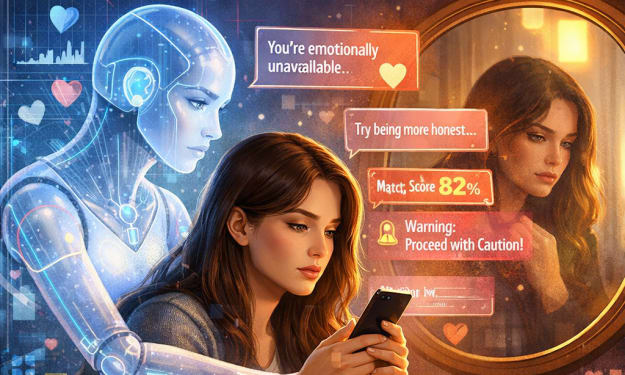
I Let AI Help Run My Love Life in 2025 — And It Got a Little Too Honest
If you’ve been single in 2025, you already know: the dating apps are starting to feel less like apps and more like ecosystems. Profiles are written by AI, photos are filtered by AI, and now, if you want, your whole “compatibility journey” can be guided by an algorithm that claims to understand you better than you understand yourself.��
By The Insight Ledger 10 months ago in Psyche
I Tried Living Like It Was 2010 Again — And It Quietly Broke Me
Nostalgia is sneaky. It doesn’t just show you the past; it edits it for you. It cuts out the awkward silences, the cheap shampoo, the bad phone cameras, and leaves you with sunsets, inside jokes, and a version of yourself who always seemed a little lighter.
By The Insight Ledger 10 months ago in Psyche
The Digital Divide: How Access to Technology Is Redefining Social Inequality
Introduction: The Promise of Technology vs. the Reality of Access In the 21st century, technology promises to bring people together, bridge distances, open doors to opportunity, and enable us to be more connected, better-informed lives. But while technology has really transformed much of modern life, the reality is that access to the digital machinery and the web remains unequal, creating a broad gap between those who are connected and those who are not. The "digital divide" is not an issue of technology—it is social, and it most heavily impacts marginalized populations and widens existing disparities.
By The Chaos Cabinet10 months ago in Psyche