selfcare
The importance of self-care is paramount; enhance your health and wellbeing, manage your stress, and maintain control under pressure.
10 Signs You're Winning in Life (Even If It Doesn’t Feel Like It)
We live in a world that constantly equates success with numbers — how much you earn, how many followers you have, how perfect your life looks online. But real success? Real progress? It’s often invisible to the outside world. The truth is, you might be doing *far better* than you think. You just don’t see it yet — because you’re busy comparing your quiet growth to someone else’s highlight reel. So take a moment to breathe. If these 10 signs sound like your current reality, you’re not losing — you’re actually *winning* in the most important ways. --- **1. You’ve Outgrown What Once Broke You** You’re not the same person you were a year ago. You’ve healed from things that once shattered you. The memories still sting, but they no longer control you. That’s not just survival. *(...)* That’s power. Winning doesn’t always look like a big comeback. Sometimes, it looks like no longer crying over the same thing. --- **2. You Choose Peace Over Proving a Point** You used to argue just to be heard. Now, you walk away from pointless battles. Not because you're weak, but because peace has become more important than pride. *(. . .)* Choosing peace over ego is emotional intelligence in motion. --- **3. You’re Learning to Say “No” Without Explaining** You protect your time. You set boundaries. You’re realizing that saying “no” to others is sometimes a “yes” to yourself — your rest, your values, your energy. You no longer apologize for prioritizing your well-being. That’s not selfish. *(...)* That’s self-respect. --- **4. You’re Comfortable With Silence** You don’t fear being alone anymore. You can sit in stillness without reaching for noise, drama, or distraction. You’ve made peace with your own company. That’s a quiet kind of strength most people never master. *(...)* Solitude is a superpower when it doesn’t feel like punishment. --- **5. You’re Healing Generational Patterns** You’ve started to break cycles — emotional neglect, people-pleasing, overworking, avoiding emotions. You’re doing the hard work your family never could. And yes, it’s exhausting. But it’s also revolutionary. *(. . .)* Healing yourself is healing your future children — and that’s bigger than you think. --- **6. You’re No Longer Addicted to Approval** You used to chase validation. Now, you know your worth without needing others to constantly confirm it. You post less to impress and live more to *express*. You’ve stopped performing. *(...)* That’s freedom. --- **7. You’re Still Trying — Even on the Hard Days** You don’t quit when it’s tough. You rest, cry, scream — but you keep going. You haven’t given up on yourself. Most people never talk about how *trying again* is a win in itself. *(. . .)* Every step forward, even when you're exhausted, is a victory. --- **8. You Have People Who Feel Like Home** Even if it’s just one person — someone who checks on you, laughs with you, reminds you who you are when you forget. That person is proof you’re loved, seen, and not alone. *(...)* Winning isn’t about having a crowd — it’s about having someone who truly shows up. --- **9. You Let Go of What You Can’t Control** You no longer obsess over things you can't fix. You’ve learned to release, to surrender. You focus on what you *can* do — and that’s where your peace comes from. Control used to consume you. Now, acceptance empowers you. *(. . .)* Letting go is a silent kind of strength. --- **10. You’re Becoming Someone You’re Proud Of** You're not perfect — but you’re more patient, kind, mindful, and authentic. You’re slowly becoming the version of you your younger self needed. And even if no one else sees it, *you* know how far you've come. *(...)* That’s real success. --- ### Final Thoughts You may not have the flashy job, the dream car, or the "perfect" body. But if you have inner peace, real friends, self-awareness, boundaries, and hope — you're winning. Don’t let society’s shallow definition of success steal your joy. Your silent victories count. So next time you feel behind in life, remember: the fact that you’re healing, choosing growth, showing up, and staying kind in a broken world? *(. . .)* That’s not just progress. That’s proof you’re already ahead.
By SHADOW-WRITESabout a year ago in Psyche
The Last Dreamcatcher
In a dim-lit room cluttered with dream journals and incense, Dr. Kael Mora prepared his mind for another descent into someone else’s hell. “Next,” he called, voice flat but practiced. His assistant ushered in a trembling teenager with hollowed eyes and a sketchpad clutched to her chest. Her name was Miri, and for the last three weeks, she hadn’t slept longer than an hour. Her nightmares weren't just vivid; they were aggressive. Monsters with her father’s voice. Floods with her mother’s face. Unrelenting guilt in symbolic, surreal terror. Kael gestured to the dreambed. “You understand the rules?” Miri nodded silently. Her mother, waiting by the door, pleaded with her eyes. Everyone who came to Kael’s dream practice had tried everything else: meds, meditations, shamans, science. All had failed. Kael was their final gamble, their last dreamcatcher. Once she was settled in, Kael attached the neural web to her temples and slipped on his own. Inhaling the minty-vinegar scent of lucid root—a substance banned in most countries—he activated the DreamSync. The world around him evaporated. --- He landed in Miri’s nightmare like stepping into a storm mid-howl. The walls bled ink. The sky burned paper. She was already there, age-shifted to a child, cornered by a giant marionette version of her father. “You never said sorry!” the puppet boomed, arms flailing. “You let it happen! You watched her die!” Kael whispered a command. A shield materialized in his hand—a relic from his own trauma, forged over years of nightmare-trading. He ran between Miri and the puppet. “I’m taking this,” he said, pushing her behind him. “You don’t need it anymore.” The marionette shrieked as Kael absorbed its essence through the neural link, storing it inside a mental vault built brick by agonizing brick from other people’s pain. As the puppet crumbled to dust, Miri's dreamscape softened. The ink turned to rain. The flames gave way to dawn. She opened her mouth to thank him, but the dream evaporated before she could. --- Back in the waking world, Miri sobbed into her mother’s arms, and Kael stumbled to his chair, ashen and sweating. His assistant offered water. He waved it away. “How much longer can you keep doing this?” she asked. Kael stared at the ceiling. “As long as they need me.” What he didn’t say: each nightmare he stole became a whisper in his own mind. Some, he could lock away. Others... not so much. --- Kael lived alone in a fourth-story apartment above an abandoned bookstore. His walls were lined with dreamcatchers—not traditional ones, but digital memory drives designed to trap synthetic dream code. Each one hummed faintly, like bees in glass jars. That night, one of them burst. Kael bolted upright in bed, drenched in sweat, lungs clawing for air. The room spun. He heard Miri’s father’s voice again—louder, angrier, inside his head now. You think you’re saving them? You’re just borrowing their demons. Kael hurled the broken drive against the wall. It shattered. The room fell silent. But inside, the noise grew. --- The next day, a woman came in clutching a worn photo of her son. “He hanged himself after three weeks of night terrors,” she said. “I’ve been having his dreams ever since. Please. Take them.” Kael agreed. Her dream was a mosaic of unbearable sorrow. The boy’s silhouette leaped from a thousand cliffs. In one loop, he tried to climb out of a coffin. In another, he simply dissolved into ash. Kael couldn’t even find the source—just echoes, metaphors, recursive loops. After an hour inside, he surfaced weeping. “You didn’t just lose your son,” he whispered. “He lost himself.” The mother sobbed with gratitude. Kael added another nightmare to his collection. Another voice in his head. Another crack in the dam. --- A week later, Kael collapsed mid-session. He awoke in a hospital bed, the nurse calling him a miracle. “You flatlined,” she said. “But your brain never stopped... dreaming.” He didn’t respond. He could still hear them—every voice, every monster, every tear-soaked scream. His mind had become a museum of horrors. A psychiatrist visited later, suggesting a break. Maybe even retirement. Kael asked, “And when the next Miri walks in? What happens to her?” “You’re not God, Dr. Mora.” Kael smiled sadly. “Tell that to the parents.” --- That night, Kael returned to his office, alone. He stared at the remaining dreamcatchers, half of them blinking erratically. He chose one. Then another. Then five. Plugging in, he did what he swore he never would: he entered his own vault. It was worse than he imagined. Hundreds of nightmares swirled like a psychic storm. He saw Miri again, older now, thanking him. He saw the boy who hanged himself—this time sitting by Kael’s side, whispering, You carry us so we don’t fall again. He saw a mirror—and in it, himself, eyes red, hands shaking, asking why. “I’m not your savior,” Kael said aloud. “I’m just tired.” But the ghosts inside whispered, You’re more than tired. You’re proof that empathy isn’t weakness. It’s the only power left. He stood for hours in that dreamscape, one final time, confronting every voice, naming every fear. Then he let go. --- Kael’s office never reopened. But months later, people began reporting strange dreams—dreams of a quiet man with tired eyes, walking calmly through their nightmares, touching monsters and turning them to mist. They woke lighter, freer. None of them ever met Kael. But they spoke of him like legend. The Last Dreamcatcher.
By Syed Kashif about a year ago in Psyche
10 Signs of People You Should Never Let Go
In life, we often talk about who to walk away from — toxic people, fake friends, emotional vampires. But we don’t talk enough about who to keep close. The rare, gentle souls who bring out the best in you. The ones who stand by you without conditions. These people are not loud about their love — but their presence heals. Here are 10 signs of people you should never let go. Because finding someone real in a world full of masks is a kind of miracle. --- **1. They Celebrate You Without Competing With You** You tell them good news, and their eyes light up — not with envy, but with joy. They don’t try to one-up you. They don’t compare. They just clap for you like your win is theirs too. *(...)* Keep these people close. In a world obsessed with comparison, pure joy for someone else’s success is rare and precious. --- **2. They’re Honest — Without Being Harsh** They don’t sugarcoat, but they also don’t destroy. They tell you the truth with compassion. They call you out when you’re wrong, but never to belittle — only to help you grow. *(...)* Honesty with a soft heart is a rare combo. When you find it, hold on. --- **3. They Stay When It’s Hard** These are the people who don’t run when the mood shifts, or when you’re not your best self. They check on you when you go quiet. They stay through the storm, not just the sunshine. *(. . .)* Real love is proven in dark seasons. Those who stay through your mess deserve a seat in your peace. --- **4. They Respect Your Boundaries** They understand that “no” means “no.” They don’t guilt-trip you for needing space. They don’t push you past your comfort zone. They honor your pace and your healing. *(...)* Respect is deeper than affection. If they give you both — you’ve found someone rare. --- **5. They Listen — Truly Listen** They hear more than just your words. They catch the emotion in your silence. They remember the details you didn’t think anyone noticed. *(. . .)* Listening is an act of love. If someone really hears you — they’re showing you they care in the deepest way. --- **6. They Help You Evolve, Without Changing You** They encourage you to grow, to heal, to aim higher — but they never make you feel unworthy as you are. They see your potential without erasing your essence. *(...)* Growth should feel inspiring, not shaming. Keep those who fuel your becoming. --- **7. They Apologize and Mean It** They don’t gaslight. They don’t justify bad behavior. When they mess up, they own it. Their apology isn’t just words — it comes with changed behavior. *(...)* Accountability is maturity in motion. It builds trust brick by brick. --- **8. They Defend You Behind Your Back** You’ll never have to wonder if they stand up for you. They speak your name with respect, even when you're not in the room. *(. . .)* Loyalty isn’t just presence — it’s protection. That kind of faithfulness is sacred. --- **9. They Recharge You — Not Drain You** You don’t have to perform. You don’t feel exhausted after being around them. Your soul breathes easier in their presence. *(. . .)* Energy never lies. People who calm your chaos are rare medicine. --- **10. They Let You Be Fully You** No masks. No filters. Just you — messy, real, loud, quiet, broken, healing. They don’t just accept you — they *cherish* the real version of you. *(...)* That’s not just love. That’s freedom. --- ### Final Thoughts In a world where people leave as fast as they show up, treasure the ones who stay — who care, listen, support, and love without keeping score. The right people don’t just make life easier. They make life *deeper*. So if you have someone like this — call them. Hug them. Thank them. And never let them go.
By SHADOW-WRITESabout a year ago in Psyche
When I Finally Faced the Pain I Pretended Didn’t Exist
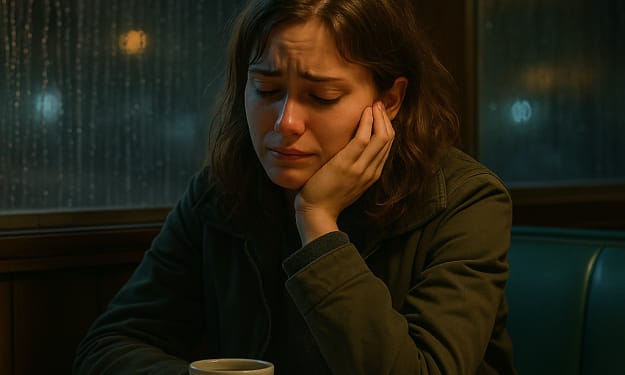
I was the person everyone turned to for advice, the one who had it “all together.” Friends called me the strong one. I wore that badge with pride—and with fear. Because if I ever let it slip, if I ever showed a crack, the whole illusion would shatter. And I wasn’t ready to admit that the illusion was all I had. For most of my life, I avoided my pain by being useful to others. I made myself indispensable, reliable, steady. My pain had no place in the narrative I built. It didn’t belong at the dinner table. It didn’t belong in the group chat. It didn’t even belong in my mirror. I kept it buried beneath productivity, jokes, and perfectly timed “I’m fine”s. But pain has a funny way of seeping through, even when you seal every crack. It started with little things. Forgetting to answer texts. Waking up exhausted. Dreading the sound of my own phone. Then came the panic attacks I pretended were just “bad days.” The sleepless nights I blamed on caffeine. The tear-stained pillows no one knew about. I told myself I was just tired. Overworked. Maybe a little burnt out. I didn’t use words like “depressed.” I didn’t let myself wonder if I was broken. I didn’t allow the question: What if I’m not okay? Until everything fell apart. It was a Tuesday—ordinary, forgettable. But something in me broke. I remember sitting in my car after work, staring at the steering wheel like it was a stranger. I couldn’t move. I couldn’t think. I just sat there as the sun set, and I felt nothing. Not sadness. Not fear. Just an unbearable weight in my chest and the numbness of having nothing left to hide behind. That night, I didn’t go home. I drove around for hours, ending up in a 24-hour diner on the edge of town. I sat in a booth, ordered coffee, and stared at the cracked Formica table until the waitress brought my cup. She gave me a look—not judgmental, not pitying. Just... human. “You okay, hon?” she asked. I could have lied. I wanted to lie. But something about her voice cracked the shell I had spent years hardening. “No,” I whispered. “I don’t think I am.” And just like that, the dam broke. Tears came without permission. I cried in that diner for what felt like an hour. The waitress didn’t say much, just refilled my cup and handed me tissues. It wasn’t what she did that saved me—it was the space she gave me to finally fall apart. That was the beginning. In the days that followed, I started admitting the truth—to myself, then to others. I told my closest friend that I was struggling. She didn’t try to fix it. She just listened. I told my boss I needed time off. I expected judgment, maybe even job loss. Instead, I got support. I started therapy. I remember sitting on that couch the first time, feeling like an imposter. I almost walked out. But something in me—some quiet, desperate part—knew I had to stay. Unpacking my pain was like unpeeling old wallpaper, revealing layers I didn’t even know existed. Childhood grief I never named. Relationships that drained me. The deep-rooted belief that my worth was tied to how much I could help others. One session, my therapist asked, “Who takes care of you?” I didn’t have an answer. No one had ever asked me that before—not even me. It was a slow journey. Some days, progress looked like getting out of bed. Other days, it meant finally saying no without guilt. I learned to cry without shame, to rest without earning it, to speak without filtering every word through the lens of others’ expectations. I began reconnecting with parts of myself I had long abandoned. I started writing again. Painting. Sitting in the park without checking my phone. I learned to be present—with myself, with my emotions, with the world. The biggest shift came the day I looked in the mirror and didn’t feel the need to smile for it. I just looked. And that was enough. I used to think healing meant returning to the person I was before the pain. I now know that healing is becoming someone new—someone honest, whole, and unafraid to feel. I am not the “strong one” anymore—not in the way I used to be. My strength now is in my softness, my boundaries, my vulnerability. I don’t hide my pain. I hold it. I learn from it. I let it teach me how to love myself, not despite the scars, but because of them. And if you’re reading this, holding it all together, telling yourself you’re fine—I see you. I know how heavy that mask can get. You don’t have to carry it forever. It’s okay to not be okay. It’s okay to fall apart. Sometimes falling apart is how we finally come home to ourselves. ---
By Zeeshan Khanabout a year ago in Psyche
Social Anxiety Explained Simply: What to Do When Your Heart Races Too Fast
Social Anxiety Explained Simply: What to Do When Your Heart Races Too Fast Imagine this: You’re about to speak in front of a small group, or maybe just enter a room full of acquaintances. Your chest tightens. Your heart begins to pound—not gently, but like a drum echoing in your ears. Your mouth goes dry, your hands tremble, and your thoughts scatter. This is not just nervousness. This is social anxiety.
By Siria De Simoneabout a year ago in Psyche
The Worst Thing in This World: Depression — And How to Break Free
There’s a kind of pain the world doesn’t understand. It doesn’t leave bruises. It doesn’t cry out in public. It doesn’t always look like sadness. Sometimes, it looks like silence. Like sleeping too much. Like staring at the ceiling at 3AM feeling nothing at all. That pain is called depression — and it’s the worst kind of suffering because it makes you believe the lie that you’re alone in it. But here’s the truth: you’re not. - - - - - ### Depression Is Not Just Sadness Sadness has a cause. It comes, and eventually, it goes. But depression? Depression is like fog inside your brain. You forget who you were before it arrived. You stop feeling joy in things that used to make you smile. Even getting out of bed becomes a victory. You look okay on the outside. You might still go to work, post online, or laugh at someone’s joke. But inside? It’s a daily battle to stay afloat. - - - - - ### The Lies Depression Tells You Depression has a voice — and it’s cruel. It whispers: - “You’re not good enough.” - “You’re a burden.” - “Nothing will ever get better.” And the worst part? You start to believe it. But those thoughts are symptoms — not truths. Depression lies. Every single time. - - - - - ### How to Break Free — Slowly, Gently, Relentlessly There’s no magic button. No perfect formula. But there *are* steps. Tiny ones. That lead to something real. - - - - - ** 1. Speak the Words: “I’m Not Okay”** The hardest part of healing is admitting you need help. But silence is depression’s best friend. Break the silence. Even if it’s just to one person. Even if it’s in a whisper. Talk to a friend. A therapist. A support group. A journal. Speak — and let someone hear you. - - - - - ** 2. Choose Progress Over Perfection** Don’t aim to be instantly “happy.” Just aim to **move**. - Open the window. - Drink a glass of water. - Take a walk, even for 5 minutes. - Take a shower even if it feels pointless. Small actions matter. They remind your brain you’re still in control — even when it doesn’t feel like it. - - - - - ** 3. Stop Romanticizing Isolation** Depression wants you alone. It wants you to pull away. But healing often begins in connection. Reach out, even when you don’t feel like it. Message someone. Sit in a room with people, even silently. Just let yourself be around *life* again. - - - - - ** 4. Write a Letter to Yourself From the Future** Imagine a version of you who survived this — because many do. What would they tell you now? Maybe this: > “I know it feels like the end. But it isn’t. I’m you — just a little further down the road. I still struggle sometimes. But I also laugh again. I feel things again. And you will too. Just hold on a little longer.” Write it. Reread it when things get dark. - - - - - ** 5. Understand That Healing Isn’t Linear** Some days you’ll feel okay. Others will knock the air out of you. That’s normal. That’s progress. You’re not failing — you’re learning to swim in deeper waters. - - - - - ### Final Thought: You Are Still Here — And That Is Enough If you’re reading this, it means you’ve survived 100% of your darkest days so far. That’s not weakness. That’s strength of a kind most people will never understand. Depression doesn’t define you. You are not your lowest moment. You are not your thoughts. You are not broken. You are human. Healing. Becoming. And that is more than enough. Keep going. Because somewhere in the future, there’s a version of you that’s proud you didn’t give up today.
By SHADOW-WRITESabout a year ago in Psyche
Focus Isn't About Trying Harder: It's About Friction
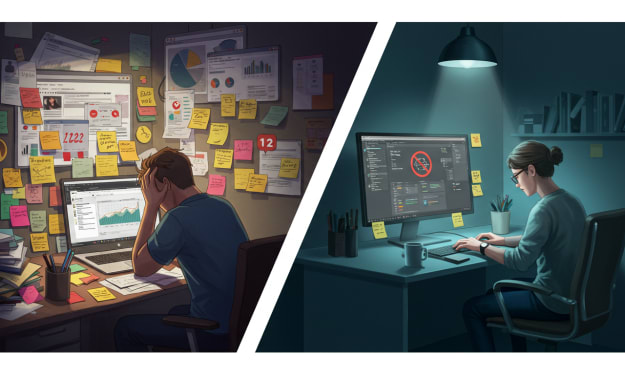
In the age of constant notifications, open tabs, background noise, and infinite scrolling, we've come to believe that focus is a matter of willpower. If we just tried a little harder, eliminated laziness, and summoned more discipline, we could finally sit down and get things done. But what if this assumption is wrong?
By Nikesh Lagunabout a year ago in Psyche
The Second Floor Needs to Be Submerged
In a world where we often think about rising above challenges, what if sometimes the solution lies beneath the surface—literally? The phrase “The second floor needs to be submerged” may sound like a strange directive, but it can be unpacked on multiple levels—literal, metaphorical, and even philosophical. Whether taken as a literal architectural challenge or as a symbol for transformation, submerging the second floor invites us to rethink stability, change, and adaptation.
By Anees Kaleemabout a year ago in Psyche
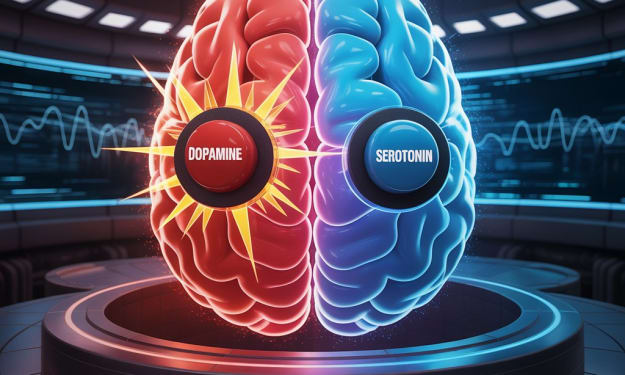
Dopamine vs. Serotonin: The Secret Dance That Runs Your Brain (And Life)
Let me tell you a story about Jake. Jake wakes up exhausted, grabs his phone immediately, and doom scrolls for 30 minutes. He knows he should work out, but "just can't find the motivation." By afternoon, he's binged on snacks while putting off important work. At night, he's wired but exhausted, mind racing about everything he didn't accomplish.
By shoaib khanabout a year ago in Psyche
10 Signs of Toxic People — And How to Protect Your Peace
They might be charming. They might even call you their best friend, partner, or “ride or die.” But something feels off. You leave every interaction with them feeling tired, small, or strangely guilty — and you can’t explain why. That’s the silent damage toxic people cause. They don’t always scream or slam doors. Sometimes, they just chip away at your peace, bit by bit, until you forget what life felt like without walking on eggshells. ### Here Are 10 Classic Signs of Toxic People — And How To Handle Them: --- **1. They Make Everything About Themselves** No matter what you’re going through, the conversation circles back to *them*. You could be grieving or celebrating, and somehow they’ll make themselves the main character. 🛡️ *Protect Yourself:* Limit how much you share. Notice if your feelings are constantly invalidated — and stop expecting support where none exists. --- **2. They Guilt Trip You Constantly** They say things like: - “After all I’ve done for you…” - “Wow, so you don’t care anymore?” - “You’re really going to act like that?” Guilt becomes their weapon of control. 🛡️ *Protect Yourself:* Recognize emotional manipulation. You are not responsible for anyone else’s happiness, especially when it comes at the cost of your own. --- **3. They Only Come Around When They Need Something** When things are good for you, they’re silent. But the moment they want attention, money, support, or drama — they show up fast. 🛡️ *Protect Yourself:* Watch for patterns. Healthy relationships go *both* ways. You’re not an emotional ATM. --- **4. They Subtly Tear You Down** Toxic people disguise cruelty as humor or “honesty.” - “You’re cute, but not *model* cute.” - “I’m just saying what everyone else is thinking.” 🛡️ *Protect Yourself:* Don’t laugh along. If someone constantly makes you feel smaller — it’s intentional. --- **5. They Compete With You Instead of Supporting You** Your wins make them uncomfortable. Your growth makes them insecure. And instead of cheering you on, they try to outdo you. 🛡️ *Protect Yourself:* Real friends don’t treat life like a scoreboard. Distance yourself from those who treat your success as a threat. --- **6. They Never Apologize — Or Weaponize Their Apology** If they ever say sorry, it comes with strings attached. - “I’m sorry *you* feel that way.” - “I said sorry, what more do you want?” 🛡️ *Protect Yourself:* Watch for apologies that shift blame. A real apology includes change — not just words. --- **7. You Feel Drained After Talking to Them** This is one of the clearest signs. You dread their texts. You feel anxious before seeing them. And afterward? Exhausted. 🛡️ *Protect Yourself:* Your energy is valuable. If someone constantly drains it, that’s not friendship — it’s emotional theft. --- **8. They Disrespect Your Boundaries** Whether it’s your time, space, or emotional needs, toxic people don’t care. They push, test, and cross lines repeatedly. 🛡️ *Protect Yourself:* Say “no” and mean it. If they get angry when you set a boundary — that’s exactly why you need one. --- **9. They Play the Victim Every Time** Nothing is ever their fault. Even if they hurt you, somehow they become the wounded one. It’s exhausting and manipulative. 🛡️ *Protect Yourself:* You can’t heal someone who refuses to see their own damage. Don’t let guilt keep you stuck in their cycle. --- **10. They Make You Question Yourself** The most dangerous thing? They make you doubt your own reality. You start asking: - “Was it really that bad?” - “Maybe I’m just too sensitive?” - “Am I overreacting?” That’s not self-reflection. That’s **gaslighting**. 🛡️ *Protect Yourself:* Trust your gut. If someone constantly makes you question your worth, it's not your insecurity — it’s their manipulation. --- ### Final Thought: Peace Is a Choice Toxic people thrive where boundaries are weak. The hard truth? You can’t change them. But you *can* change how much access they have to you. You’re allowed to walk away. You’re allowed to cut ties. You’re allowed to protect your peace — even if they call you cold, dramatic, or selfish. Let them talk. Because the people who truly love you won’t make you suffer for saying, “Enough.”
By SHADOW-WRITESabout a year ago in Psyche