depression
It is not just a matter of feeling sad; discover an honest view of the mental, emotional and physical toll of clinical depression.
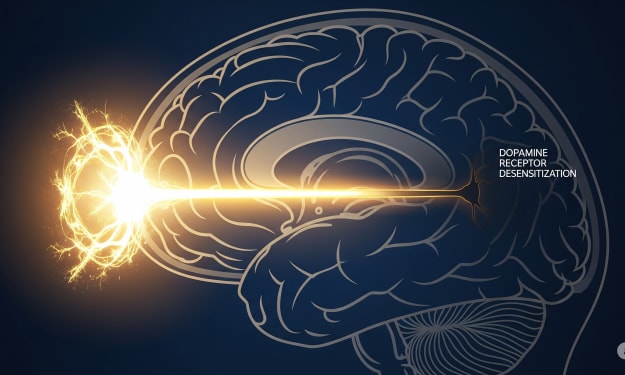
The Digital Mirage: How Pornography Rewires Our Brains, Erodes Our Confidence, and How to Reclaim Your Life
In the vast landscape of the internet, pornography has become a titan. Its websites attract more visitors than Netflix, Amazon, and Twitter combined, often dismissed as a harmless form of entertainment or a normal part of modern sexuality. But behind this veneer of normalcy, a growing body of scientific research reveals a much darker picture. While "pornography addiction" is not yet an official diagnosis in psychiatry's main diagnostic manual, the World Health Organization has recently added "Compulsive Sexual Behavior Disorder" to its own manual, a condition largely driven by problematic pornography use. This acknowledges a clinical reality: for many, pornography use evolves into a compulsive behavior with devastating consequences.
By Kaleem Ullahabout a year ago in Psyche
The Silent Link: How Your Gut Talks to Your Brain. AI-Generated.
A Fog That Wouldn't Lift Sarah had everything most people dream of: a stable career in marketing, a warm circle of friends, and a small but cozy apartment in the heart of the city. She went to yoga twice a week, drank green smoothies, and always remembered to take her multivitamins.
By DR. Allama iqbalabout a year ago in Psyche
“Dating With Anxiety: A Love Story With My Mind”
Dating With Anxiety: A Love Story With My Mind --- Our first date was perfect—on paper. He picked me up right on time, wore a soft smile and a button-down shirt that smelled like cedarwood. The restaurant was small and dimly lit, my favorite kind. The conversation flowed like we’d known each other in another life. He laughed at my jokes, asked thoughtful questions, and told stories with the kind of calm that made the world feel less loud. And the entire time, I was screaming—inside my head. “Your laugh is weird. Don’t laugh so loud.” “Don’t fidget with your hands. He’ll notice.” “Did you talk too much? Not enough? Are you making eye contact? Is your eye twitching?” I excused myself to the bathroom halfway through the appetizers and stared at myself in the mirror, willing my heart to slow down. This wasn’t about him. It never is. It was about the third wheel in every relationship I’ve ever had: Anxiety. --- Anxiety and I have been together far longer than any man. We’ve had our ups and downs, our silent wars and loud breakdowns. I know its voice better than I know my own. It's always there—on dates, in texts, in the quiet before a kiss. It critiques me mercilessly, measures my worth in imagined faults, and reminds me I’m too much and never enough, sometimes in the same breath. But that night—after the dinner, after the goodbye hug, after I replayed every second of the evening on loop—I realized something strange. He texted me. He said he had a great time. That he’d love to see me again. That he liked my laugh. Cue panic. “He’s just being polite.” “He feels bad for you.” “He’s going to ghost you in three days.” Still, I agreed to a second date. --- Falling for someone when you live with anxiety is like building a house during an earthquake. You try to set foundations, to trust, to believe. But your brain keeps shaking everything loose. Every silence becomes rejection. Every delayed reply becomes proof that they’re leaving. You want to be vulnerable, but vulnerability feels like standing naked in a storm. I tried to explain it to him once, early on. I said, “Sometimes I’ll pull away. Not because I want to, but because I’m afraid.” He nodded. “I get that. Just... promise me you’ll let me sit with you through it?” That’s when I cried. Not because he fixed it—no one can. But because he didn’t run. --- Anxiety doesn’t disappear when someone loves you. It doesn’t soften with compliments or vanish with affection. But love—real love—can make room for it. He learned how to tell when I was spiraling. He’d send a “Thinking of you” text when I pulled away. He never said I was being dramatic when I asked if he still liked me three times in a row. He’d hold my hand gently and whisper, “You’re okay. We’re okay,” like a grounding mantra. And I, in return, started learning to separate his voice from the one in my head. --- Dating with anxiety isn’t just hard on me. It’s hard on the person who chooses to love me, too. There are days when I cancel plans last minute because I can’t get out of bed. Days when I need reassurance I’m not a burden. Days when I spiral from one sentence he said two days ago and ask if he meant it exactly how he said it. But we made a deal—me, him, and my anxiety. He gives me patience. I give him honesty. And my anxiety? It learns to take the back seat sometimes. --- The first time he said “I love you,” I froze. Not because I didn’t feel it. But because my anxiety whispered, He doesn’t mean it. He’ll take it back. You’ll ruin this. But I looked at him—at his steady hands and soft eyes—and I decided to answer out loud, not in my head. “I love you too.” It wasn’t just a declaration to him. It was a message to myself. That I deserve this. That I am lovable—even with my shaky voice, racing thoughts, and overthinking heart. --- We’re still learning. There are good days and hard ones. But now, I know I don’t have to pretend to be okay to be loved. And my anxiety? It’s still here. Still chatty. Still obnoxious. But it’s not driving anymore. Sometimes, I think the real love story isn’t just between him and me. It’s between me and my mind. Learning to live together, to trust again, to love—softly, slowly, fearfully, and still, fully. And maybe that’s what real love looks like. Not perfect. But present.
By ANAS AFRIDIabout a year ago in Psyche
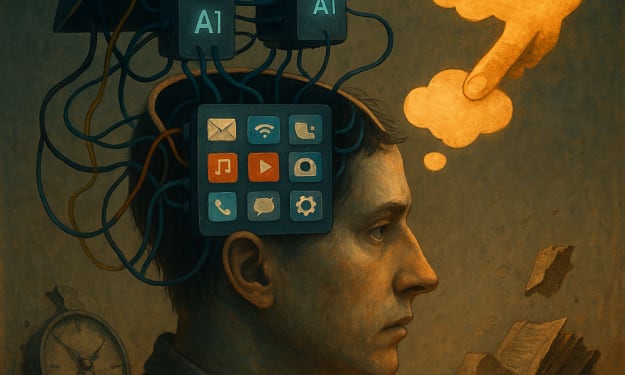
The Dimming Mind: How Convenience Culture Is Making Us Forget How to Think. AI-Generated.
We live in an age of astonishing ease. With a few taps, we summon dinner, diagnose a rash, translate a foreign text, or generate an entire business plan. Algorithms anticipate our desires before we consciously register them. The idea that technology should do the thinking for us has become not only accepted—but celebrated.
By Ahmet Kıvanç Demirkıranabout a year ago in Psyche
“Beneath the Shadows”
Beneath the Shadows A Journey Through Darkness Toward the Light Aisha sat in her dimly lit bedroom, knees pulled close to her chest, surrounded by the quiet hum of evening. Outside the window, the world moved on — cars passing, birds settling into nests, children calling one another home. But for her, the world had grown distant, trapped behind a thick glass of sadness that refused to shatter. She couldn’t remember the last time she had truly felt joy. Every morning was a struggle to rise, every task felt heavier than the one before, and every bright color seemed to drain into a murky gray. Beneath her brave face, something deep and unrelenting had taken root — a weight she could hardly describe, let alone escape. Her friends would call, her parents would check in, and she would smile politely — a fragile smile that disappeared the moment they left the room. She had learned to hide the aching emptiness in her heart because trying to explain it felt impossible. Who could understand the way every breath felt like dragging a mountain up a hill? Who could make sense of why the world appeared so muted and far away? Aisha thought often of the days when life had been lighter. Back then, she had loved painting, losing herself in strokes of bright orange, blue, and green. Music had moved her — rhythmic beats lifting her soul, making her dance like a carefree breeze. But as months passed, those passions began to lose their light. Now her paints dried up, and her speakers stayed silent. Even the sound of her own heartbeat felt like a burden. And so, she moved like a shadow through her days — present but hardly alive. There were nights she stared up at the ceiling until dawn, tired but unable to sleep. Thoughts tumbled like stones in her mind, heavy with self-doubt and sadness. “Why can’t I just snap out of it?” she would wonder, frustrated with herself. “Why can’t I just be… normal again?” But depression is not a switch to flip or a mood to conquer with willpower. It is deeper and darker than most people realize — a fog that settles into every thought until light feels like a distant dream. One morning, after a restless night, Aisha sat at the edge of her bed, feeling more tired than ever. It was then that something in her shifted — a tiny, fragile thought that spoke softly amid all the noise: You don’t have to go through this alone. That thought led her to do something she hadn’t considered before — reaching out for help. It was hard at first. Her hands trembled as she searched for a therapist's number online. Making the call took every ounce of strength she could summon. “Hello,” she managed, voice trembling. “I… I need help.” That first appointment wasn’t easy. Talking about her sadness was like walking through tangled woods, searching for a trail that had long disappeared. But with gentle patience, her therapist helped her begin to untangle the dense knots of pain and fear that had been tied up inside her. Each week, they met. Slowly, carefully, like tiny sparks catching in a dark forest, she began to feel a little lighter. It wasn’t sudden — healing never is — but it was real. And alongside therapy, she began reaching out to people who cared. Her parents held her close without questions. A close friend started visiting every weekend, bringing warm food and sharing quiet company that needed no words. Sometimes Aisha painted again — small, gentle strokes, one color at a time. Music returned too, in tiny, careful doses. Every small step toward these familiar joys felt like reclaiming a piece of herself. There were days when the sadness still surged, of course. Healing was never a straight path, and some days, the shadows fell long. On those days, she learned to treat herself with gentleness — to acknowledge the pain and hold on to the thought that even this would pass. And as the months turned into a year, light slowly began to seep back into her life. It didn’t come in one glorious burst but in tiny moments — the laughter of a friend, the taste of a favorite dish, the softness of rain on her hands. With time and compassion, she was climbing back up — not to the person she had been before, but to someone new and wiser. Someone who had survived the darkness and emerged stronger. Aisha still had shadows, but she was no longer beneath them. And in this way, she learned that depression was not her fault, nor her forever. The light had never truly left — it had only been waiting for her to find her way home. And so, one gentle day at a time, she continued onward. Beneath the shadows, she had found her light again.
By Taimur Ahmadabout a year ago in Psyche
“I Quit Social Media for 30 Days — It Changed My Brain, My Routine, and My Reality”
Introduction: Let me be honest—I didn’t plan on quitting social media. Like most people, I’d scroll through Instagram the second I opened my eyes in the morning, check WhatsApp before I even brushed my teeth, and fall asleep with TikTok sounds in the background. I wasn’t even enjoying it anymore. It was just... a reflex.
By huzaifa Khanabout a year ago in Psyche