
I Tried to Distract Myself From a Panic Attack. It Made Everything Worse.
What actually helped when my nervous system went into full alarm—and why the obvious solution backfired.

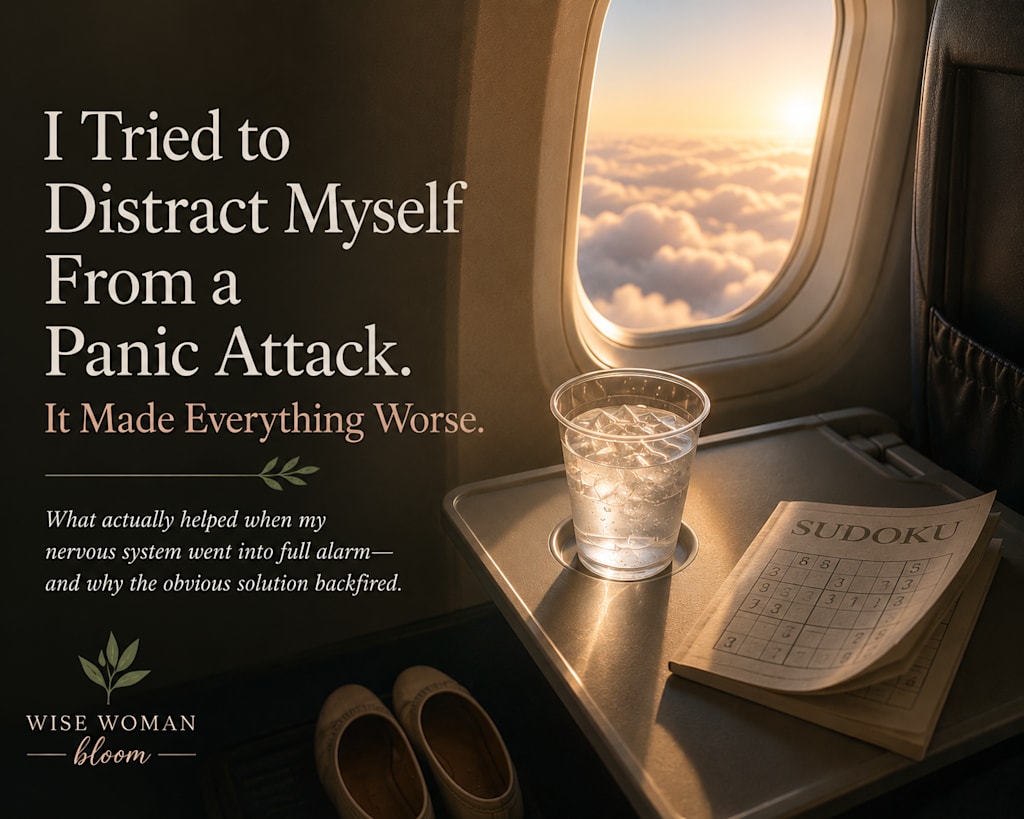
I was sitting on a plane at Eugene Airport when it happened.
We hadn't even left the ground.
The plane was much smaller than I expected. The kind of small that changes the feeling of the air around you before your mind has time to process it.
I found my seat and instinctively reached for my phone.
I opened Sudoku.
I wanted to distract myself.
It seemed like the obvious thing to do.
Instead, it made everything worse.
Within minutes, my thoughts became louder.
The walls felt closer.
My breathing changed.
We were still sitting on the runway.
What surprised me most wasn't the panic itself.
It was the voice inside my head.
It wasn't asking whether I was okay.
It was asking,
What will people think?
My mind instantly imagined the worst.
Losing control.
Making a scene.
Everyone staring.
I wasn't only afraid of the panic.
I was afraid of what the panic might look like.
That fear became almost as overwhelming as the panic itself.
A few weeks earlier, I had been talking with someone close to me.
They had been experiencing panic attacks and were trying to explain what they felt like.
I listened carefully.
I asked questions.
I genuinely wanted to understand—not just intellectually, but from the inside—so I could better support them and others who experienced the same thing.
I never imagined that a few weeks later, life would answer my curiosity in such a personal way.
For a brief moment, I considered getting off the plane.
That's when something became very clear.
No one outside of me was going to solve this.
Not the flight attendants.
Not the passengers.
Not even getting off the plane.
The only way out was to go in.
Not deeper into the fear.
Deeper into myself.
Instead of waiting to be rescued, I realized I had to begin helping myself.
What Helped
My heart was racing.
My hands and feet were sweating.
Even breathing felt difficult.
There wasn't room for a complicated strategy.
So I started with what was right in front of me.
I took off my shoes.
I picked up the cup of ice water and took a sip.
Then I held one of the ice cubes in my hand.
For a moment, I even placed it against my foot.
The cold sensation gently pulled my attention away from my racing thoughts and back into my body.
Just a little.
That little bit was enough.
From there, I could begin to breathe.
I remembered something I had once heard about claustrophobia—that even in the smallest space, you can still breathe.
The air is always there.
Panic tells you otherwise.
Panic isn't always telling the truth.
I breathed slowly.
In through my nose.
Out through my mouth.
Then I zoomed out.
Not physically, but in my mind.
I expanded my awareness beyond my seat...
beyond the plane...
beyond the airport...
until I was holding a wide, open view of everything.
From that perspective, the little matchbox I was sitting in became very small.
The stillness behind everything was still there.
It always is.
Something softened.
I stopped fighting the movement of the plane.
I let the seat support me.
The plane was carrying me whether I resisted it or not.
If it moved, I moved with it.
The struggle eased the moment I stopped resisting what was already happening.
Then I began touching my fingers.
Thumb to index finger.
A mantra.
Thumb to middle finger.
Another mantra.
A rhythm my hands already knew from years of practice.
Love.
Peace.
Harmony.
Om Namaha Shivaya.
I stayed with the rhythm.
I breathed.
I watched the discomfort the way I might watch water flowing down a stream.
Present.
Real.
But not permanent.
Not me.
By the time the plane took off, I had settled into a deep meditative state.
The rest of the flight passed peacefully.
What I Learned
Looking back, I realized something important.
I didn't begin with meditation.
I began with my body.
The cold water.
The ice.
My feet on the floor.
The slow breath.
Only then could I return to my mantra.
Only then could I meditate.
That experience taught me something I had never fully understood before.
When emotions become overwhelming, the body is often the doorway back to the mind—not the other way around.
Trying to distract myself had pulled me farther away from the present moment and deeper into my thoughts.
The practices that helped did exactly the opposite.
They gently brought me back...
to my body...
to my breath...
to this moment.
Not away from the feeling—
through it.
After we landed, a woman came over to me.
"I was watching you from across the aisle," she said.
"You did very well. You looked so calm."
I smiled and thanked her.
She had no idea what had been happening inside me.
I wasn't calm.
I was practicing.
And after years of returning to these practices on the easy days...
they were there for me on the hard one.
That is what practice is for.
About the Creator
Inbar Shahar
Life coach & author. Writing about inner peace, spiritual practice & finding your way back to yourself. Founder of Wise Woman Bloom. wisewoman.love
Enjoyed the story? Support the Creator.
Subscribe for free to receive all their stories in your feed.
Comments
There are no comments for this story
Be the first to respond and start the conversation.