
I Fall From the Sky Every Night — And Wake Up Just Before I Hit the Ground
Every night I fall. Every night I wake up just before I hit the ground.


It always starts the same way.
I am somewhere high. A rooftop, a cliff, a place with no name that exists only in the logic of dreams. The air is thin. The ground is impossibly far below. And then — without warning, without reason — I fall.
Not slowly. Not gracefully. A sudden, violent drop. Wind rushing past. The ground rising toward me at a speed that feels final.
And then I wake up.
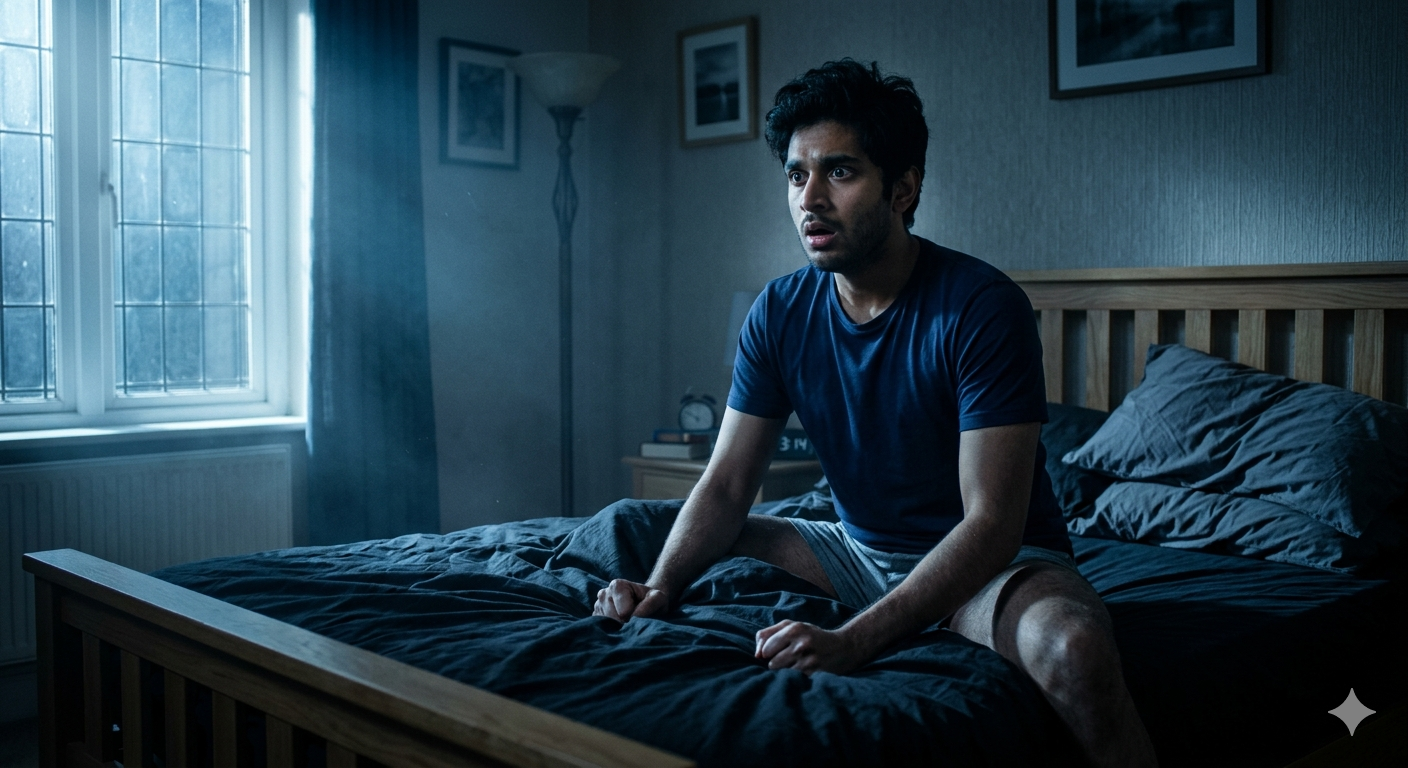
Heart pounding. Hands gripping the sheets. Body completely convinced, for one terrifying second, that it just survived something real.
But I am in my bed. I have always been in my bed. Safe, still, horizontal — exactly where I left myself when I closed my eyes.
I have been falling like this for years.
The First Time It Happened
I was maybe fifteen or sixteen. I had fallen asleep reading, which meant I went under quickly — the deep, sudden sleep that comes when your eyes give out before your mind does.
The fall in that dream was short. I was standing on something — a wall, I think — and then I simply stepped off. The drop lasted maybe two seconds in dream-time. But when I hit the ground and jolted awake, I was off my bed, one foot on the floor, completely disoriented.
I sat there for a full minute trying to understand what my body thought had just happened.
It felt embarrassingly real. Like my skeleton had believed it.
What Science Says — And Why It's Fascinating
For a long time I thought this was just me. Some strange habit of my sleeping brain, a personal quirk, something slightly wrong in the wiring.
Then I learned it has a name.
Hypnic Jerk.
It is one of the most common human experiences — studies suggest that up to 70% of people have felt it at least once. That sudden muscle spasm at the edge of sleep. That involuntary full-body flinch that snaps you back to consciousness just as you were beginning to drift.
But why does it happen?

Here is where it gets interesting.
As your body moves from wakefulness into sleep, your muscles begin to relax — deeply, systematically, in a way they almost never do while you are awake. Your brain, which has been monitoring your body all day, registers this sudden loss of muscle tension.
And in some people, in some moments, the brain misreads it.
It interprets the relaxation as falling.
So it does what any good emergency system would do: it fires a signal to your muscles — grab something, catch yourself, you're going down — and your whole body jerks awake in response to a danger that was never there.
Your brain tried to save you from your own sleep.
But What About the Dream?
The science explains the jerk. The muscle spasm. The sudden awakening.
It does not fully explain the dream.
Because in my experience — and in the experience of almost everyone I have talked to about this — the falling is not just a sensation. It is a story. There is a place. There is a height. There is a moment of standing before the fall that feels like a choice, or like the absence of one.
Why does the brain construct a narrative around a muscle spasm?
Some researchers believe the brain works backwards. The jerk happens first — the dream is built in the milliseconds after, a story assembled at impossible speed to explain the physical sensation. Your brain, even half-asleep, cannot accept a random event. It needs a reason. So it invents one: you were falling because you were on a cliff. You were on a cliff because you were dreaming. The dream was real.
The whole story — the height, the wind, the ground rushing up — may be created in less time than it takes to blink.
This, to me, is one of the most extraordinary things about being human. Even unconscious, even in the half-second between sleep and waking, we are storytelling creatures. We cannot experience something without immediately building a narrative to contain it.
The Versions of the Fall
Not every hypnic jerk comes with the same dream. Over the years, I have noticed patterns in mine.
Some nights the fall is from a great height — a building, a mountain, a place that seems to exist at the edge of the atmosphere. These are the ones that wake me most completely, heart loud in my chest, the room taking a moment to resolve itself back into familiarity.
Other nights it is shorter. A stumble off a curb. A missed step on a staircase. These ones I almost sleep through — a small jolt, a breath, and then back under.
And occasionally — rarely — the fall in the dream does not feel like terror. It feels like release. Like something letting go. Like the moment before impact is actually the most peaceful part, and the waking up is the interruption.
Those are the ones that stay with me longest.
What Triggers It
I have noticed, over years of falling, that it does not happen randomly.
It happens more on nights when I am exhausted — when I fall asleep quickly and deeply, when my body drops into unconsciousness rather than easing into it.
It happens more when I am stressed. When something is unresolved. When I have been carrying a weight through the day that I did not put down before closing my eyes.
It happens more when I sleep on my back, arms at my sides, body perfectly still — as if the stillness itself confuses my nervous system.
Sleep scientists confirm this. Hypnic jerks increase with sleep deprivation, anxiety, caffeine, and irregular sleep schedules. The more disrupted your relationship with rest, the more likely your brain is to misfire at the threshold.
In other words: the falling is a symptom. Not of something wrong, exactly. But of something unquiet.
A Metaphor I Cannot Shake
I have started to think of the falling dream as a kind of signal.
Not supernatural. Not prophetic. Just honest.
On the nights when I fall, I have almost always been running from something during the day. A conversation I avoided. A decision I postponed. A feeling I pushed down and covered with activity and noise.
And then at night, when all the noise stops, my body says: you have been tense all day. You have been bracing for impact all day. Here — I will show you what that feels like.
And I fall.
And I wake up.
And sometimes — not always, but sometimes — the waking up feels less like interruption and more like reminder.
You are still here. You are still in your bed. Whatever you were bracing for has not landed yet.
Get some rest. You will need it.
The Ground That Never Comes
Here is the thing about the hypnic jerk that I find most quietly remarkable:
You never actually hit the ground.
In thousands of falling dreams across millions of people, the impact almost never arrives. The brain pulls you back before it does. Some instinct, some protective reflex, refuses to let the dream complete itself.
I have read theories about why. Some say the brain avoids simulating death even in sleep. Some say the jerk itself interrupts the dream before it can finish. Some say the impact would be too destabilizing — that waking up having "experienced" a fatal fall would be genuinely traumatic in a way the brain wants to prevent.
Whatever the reason: you fall. You fall completely, fully, convincingly.
And then you are saved. Every time. By the same brain that let you fall in the first place.
I still fall most nights when I am tired enough.
I still wake up with my hands gripping the sheets, one foot sometimes already on the floor, my body briefly certain that it has just survived something.
And then the room reassembles itself — the familiar darkness, the familiar ceiling, the familiar weight of the blanket — and I remember.
I am here. I am fine. I was always fine.
I close my eyes again.
And I wonder, just for a moment, what height I will fall from next.
If you fall in your dreams — you are not alone. Seventy percent of us are falling right beside you, every night, and waking up just in time.
The ground never comes. It never has.
Sleep well.
About the Creator
saif ullah
Content writer on different niches, specially on finance.
Enjoyed the story? Support the Creator.
Subscribe for free to receive all their stories in your feed.
Comments
There are no comments for this story
Be the first to respond and start the conversation.