
Do I Need a Psychiatrist or a Therapist? Understanding the Difference — and Why It Matters for Your Treatment
Understanding the Difference — and Why Choosing the Right Provider Can Transform Your Mental Health Journey

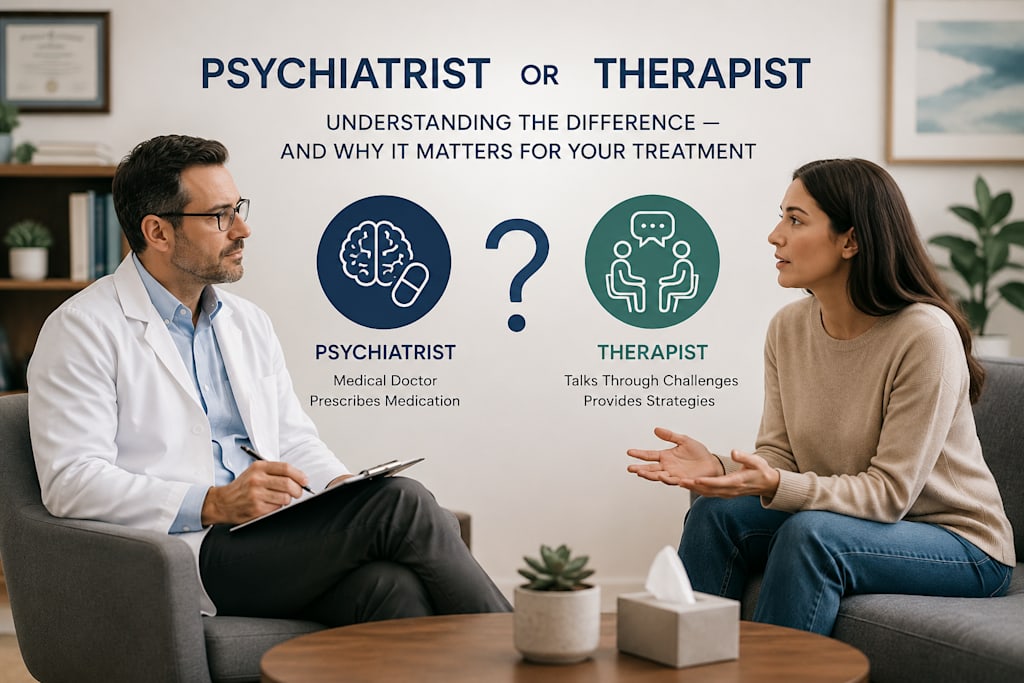
When you finally decide to reach out for mental health support, the next question can feel just as overwhelming: Who do I actually call? A therapist? A psychiatrist? A counselor? A psychologist?
You're not alone in the confusion. Most people use these terms interchangeably — but they refer to very different types of care. And choosing the right provider from the start can mean the difference between months of trial-and-error and getting on a path that truly works.
This guide breaks it all down in plain language — so you can walk into your first appointment with clarity and confidence.
The Simple Answer: Two Different Roles, One Goal
Both psychiatrists and therapists want the same thing: to help you feel better. But they approach that goal in very different ways.
Psychiatrist or PMHNP:
A medical professional who specializes in diagnosing mental health conditions and managing treatment, primarily through medication. They evaluate your symptoms, your medical history, and your overall health to find the right medication and dosage for you.
Therapist or Counselor:
A licensed mental health professional who uses talk therapy — techniques like Cognitive Behavioral Therapy (CBT), EMDR, or psychodynamic therapy — to help you work through thoughts, behaviors, and emotional patterns.
One prescribes. One listens. Both matter. And often, you may benefit from both working together.
Psychiatrist vs. Therapist: A Side-by-Side Comparison
Psychiatrist or PMHNP — What they do:
Diagnose mental health conditions and prescribe and manage medication.
Therapist — What they do:
Provide talk therapy and emotional counseling.
Psychiatrist or PMHNP — Appointments:
30 to 60 minutes, focused on medication evaluation and management.
Therapist — Appointments:
45 to 60 minutes, focused on therapy sessions.
Psychiatrist or PMHNP — Prescribes medication:
Yes.
Therapist — Prescribes medication:
No, in most states.
Psychiatrist or PMHNP — Sees children:
Yes, age 6 and above.
Therapist — Sees children:
Varies by provider and specialty.
What Does a Psychiatric Nurse Practitioner (PMHNP) Do?
You may have heard the term PMHNP — Psychiatric Mental Health Nurse Practitioner. This is a board-certified advanced practice nurse with specialized training in psychiatric care, and they can do almost everything a psychiatrist does, including:
- Evaluate and diagnose mental health conditions
- Prescribe and manage psychiatric medications
- Provide medication adjustments and ongoing monitoring
- Coordinate care with therapists, primary care physicians, and specialists
When Should You See a Psychiatrist or PMHNP?
You may benefit most from seeing a psychiatric provider if:
- You have been experiencing symptoms of depression, anxiety, bipolar disorder, schizophrenia, ADHD, OCD, or PTSD
- You have tried therapy but feel like something more is needed
- A previous provider has suggested medication but you want expert guidance
- Your symptoms are significantly affecting your ability to work, sleep, or maintain relationships
- You or your child age 6 or above needs a formal psychiatric evaluation
- You are already on psychiatric medication but need better management or a second opinion
When Should You See a Therapist?
A therapist may be your best first step if:
- You want to work through relationship issues, grief, trauma, or life transitions
- You prefer a talk-based approach before exploring medication
- You are managing mild-to-moderate stress or anxiety with no prior psychiatric diagnosis
- You have been prescribed medication and want complementary therapy support
Do I Need Both?
For many people — especially those managing conditions like bipolar disorder, PTSD, OCD, or treatment-resistant depression — the answer is yes. Research consistently shows that the most effective outcomes come from combining psychiatric medication management with ongoing therapy.
This is called a collaborative care model, and it is considered the gold standard in modern mental health treatment. Your psychiatrist handles the biological side. Your therapist handles the behavioral and emotional side. Together, they address the whole person.
Frequently Asked Questions
Can a PMHNP prescribe medication?
Yes. Board-certified PMHNPs have full prescriptive authority and can prescribe psychiatric medications, including controlled substances, with the appropriate in-person oversight.
Can I see a psychiatrist without a referral?
In most cases, yes. You can reach out to a psychiatric provider directly without needing a referral from your primary care doctor, though some insurance plans may require one. It is always worth checking with your insurance beforehand.
How do I know if my symptoms need medication or just therapy?
There is no one-size-fits-all answer. Generally, if your symptoms are significantly disrupting your daily life — your sleep, work, relationships, or ability to function — a psychiatric evaluation is a good starting point. A qualified provider will assess your situation and recommend the most appropriate path.
What should I expect at my first psychiatric appointment?
Your first visit is typically longer than follow-ups — usually around 60 minutes. The provider will ask about your symptoms, personal and family medical history, current medications, lifestyle, and goals. It is a conversation, not a test. The more openly you can share, the better your provider can help.
Can children see a psychiatrist?
Yes. Child and adolescent psychiatry is a specialized area that addresses conditions like ADHD, anxiety, OCD, and mood disorders in younger patients. Most psychiatric providers who see children begin with patients around age 6 and above.
About the Creator
JP Psychiatry
JP Psychiatry provides expert psychiatric care for children (6+) and adults in Chicago, the Chicagoland area and the state of Illinois. We offer personalized psychiatry, medication management, and telepsychiatry services.
Enjoyed the story? Support the Creator.
Subscribe for free to receive all their stories in your feed.
Comments
There are no comments for this story
Be the first to respond and start the conversation.