how to
The vital how-to's for photography enthusiasts: how to create the perfect camera setup, capture the perfect picture, edit your photos and beyond.
How to Plan a Newborn Photoshoot Without the Stress
Your baby is a few days old, asleep on your chest, and you notice how tiny their fingers are, how their whole hand barely wraps around one of yours. You'd love photos to capture these tiny details, but you're running on very little sleep and have no idea where to start. When should you book? What does a newborn session involve? Is it safe? What do you wear?
By HelloBABY Photography7 days ago in Photography
How to Plan a Maternity Photoshoot Without the Stress. AI-Generated.
There's a moment most expecting parents describe in almost the same words. You catch a glimpse of yourself in a mirror, or a friend snaps a candid photo, and something clicks. The bump is here. It's real. And it won't be here forever.
By HelloBABY Photography7 days ago in Photography
Chasing the Perfect Angle: My Week of Beach Photography in the Caribbean
Chasing the Perfect Angle: My Week of Beach Photography in the Caribbean How slowing down at the shoreline taught me to see color, light, and even an uninvited iguana through a completely different lens
By Zohan Khanabout a month ago in Photography
How to Photograph Glass Display Cases Without Getting Reflections and Glare
Some photos you plan. Some photos plan you. I did not plan to photograph my own face that afternoon. And yet, there I was, at the National Museum of Scotland, in front of a small silver brooch that had clearly been minding its own business under glass for a very long time — and my camera, ever the comedian, handed me a portrait of myself instead.
By Zohan Khan2 months ago in Photography
Photography during pre-lunch hits different, you know?
Photography during prelunch hits different, you know? For me, prelunch is that sweet spot — around 11:30 to 12:30 — when the kitchen light is still soft but bright, and everything looks a little more alive. I usually pull out whatever I’m cooking, set it down without overthinking it, and snap a few pics before the first bite.
By Zohan Khan2 months ago in Photography
How to Photograph Museum Architecture and Interiors Like a Pro
I was standing in the middle of a museum rotunda, neck craned all the way back, spinning slowly in a circle like a man who had lost something on the ceiling. Which, in a way, I had. A shot. The right shot. My uncle stood a few feet away, watching me spin, and said nothing for a solid minute before finally offering, “You look like you’re trying to summon something.”
By Zohan Khan2 months ago in Photography
WATERFALL PHOTOS. 5 TIPS!
Learn tips for mesmerizing waterfall photos with perfect time a..... Waterfalls are stunning natural phenomena, and many of them have become popular tourist destinations. They are formed through the process of river erosion, where continuous narrowing of the river channel increases the speed of the water and the height of the cliffs the water flows over. The result is the creation of a waterfall. Many people are eager to learn how to photograph waterfalls, as these natural landscapes offer unique and captivating beauty. Understanding how to capture waterfalls is essential, especially for photographers involved in landscape photography. Photographing waterfalls can be tricky—sometimes the fast-moving water can cause blurry or misty images. The challenges faced when photographing waterfalls make it a particularly interesting subject to capture. To help you capture stunning waterfall photographs, here are some helpful tips on how to photograph waterfalls! 1. Adjusting Shutter Speed Waterfalls vary greatly in speed, and accordingly, shutter speed settings will differ depending on the waterfall you're photographing. To capture the movement of the water, use a fast shutter speed, such as 0.3 seconds. It’s also beneficial to use the continuous shot mode, so multiple frames are captured with a single press of the shutter. This allows you to choose the best shot from several frames. If 0.3 seconds doesn't produce the desired effect, you can experiment with longer shutter speeds, such as 1 second or more, to get the right look. 2. Use a Tripod Using a tripod is essential for minimizing blur or mist in your photos. Why is a tripod important? Holding the camera by hand often results in slight movements, either vertical or horizontal, making the image unstable. This instability can lead to blurry or misty effects in the photo. While some people avoid using a tripod because of its size and the hassle of carrying it around, it is an important tool for ensuring sharp and steady shots. If you don't have a tripod or prefer not to carry one, look for a stable surface, such as stacked rocks, to rest your camera on. 3. Use Filters In addition to a tripod, using filters can greatly improve your waterfall photography. If you have them, a neutral density (ND) filter can help adjust the color effects of the waterfall, making your images more visually appealing. Another useful filter is a Circular Polarizer, which reduces light reflection, thus enhancing the quality of the shot. This filter helps reduce reflections off wet rocks, water surfaces, and foliage. It also boosts color saturation, making the image clearer and more vibrant. 4. Set the ISO When photographing waterfalls during the daytime, it's essential to set the ISO as low as possible, typically around ISO 100 or lower if your camera allows it. A low ISO reduces the camera's sensitivity, which allows for slower shutter speeds. Avoid using high ISO settings, as this can introduce noise, which can degrade the quality of your waterfall photos. 5. Adjust the Aperture Setting the aperture correctly is crucial for capturing high-quality waterfall images. For the best results, use a small aperture setting, which will lengthen the exposure time and create a greater depth of field. A narrow aperture allows for more of the scene to be in focus, from the closest water droplets to the distant landscape, ensuring a detailed and sharp photograph. Ideal Timing for Waterfall Photography The best times to photograph waterfalls are either early in the morning, just after sunrise, or during the late afternoon or evening, as the lighting during these times is softer and more flattering. You should also take time to find interesting compositions and experiment with different angles and perspectives. Creativity plays a significant role in achieving beautiful and unique waterfall photographs. Lykkers, to capture stunning waterfall photographs, it's important to understand how to adjust settings such as shutter speed, aperture, and ISO, while also considering the use of a tripod and filters. Moreover, choosing the right time and location to photograph, and experimenting with composition and angles, will help you create visually striking images. Always plan your photography session in advance for the best possible results!
By Muhammad Talha4 months ago in Photography
UNIQUE PHOTOGRAPHY VI.....
Here is the complete transcription of the text from the provided images, stitched together in order: Photography isn't just about capturing what we see—it's about capturing how we see the world. Every photographer has a unique perspective, influenced by their experiences, emotions, and environment.
By Muhammad Talha4 months ago in Photography
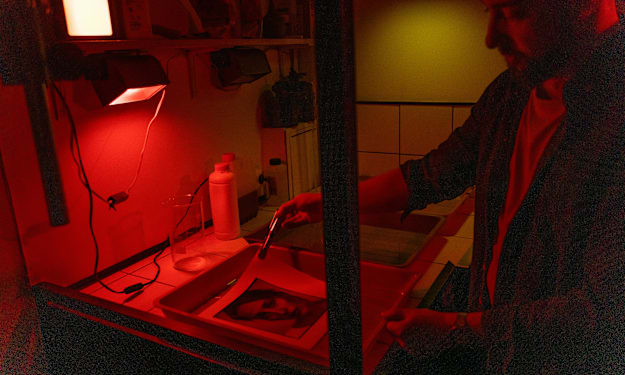
The Waiting Room: How Film Taught Us to Hold Our Breath. AI-Generated.
The Silence of the Darkroom There's a particular kind of silence that belongs only to darkrooms. Not the empty quiet of an unused space, but a living hush, thick with chemistry and possibility. I remember standing in my father's makeshift darkroom as a child, watching him work under the amber glow of the safelight, his hands moving through trays of solution with the practiced grace of someone performing a ritual. The air smelled sharp and sweet at once, metallic and alive, like breathing in secrets. He never spoke much during those hours. There was nothing to say. We were both waiting for the same small miracle.
By The Icon4 months ago in Photography
The Prudhoe Badger And Things You Miss On Trains And Buses
Introduction I suppose this is just a piece on photographs that we take when things are moving at speed. Sometimes it is because you are on a bus or train, or because you see something and you have seconds to capture that picture.
By Mike Singleton 💜 Mikeydred 5 months ago in Photography
How Professional Product Photography Shapes Brand Trust in E-Commerce
When a customer lands on your product page, they don’t start by reading the descriptions or checking the specifications. Their first real interaction is always with the images. Within seconds, they decide if your brand feels dependable or not, and honestly sometimes it happens even faster.
By Impression Photography5 months ago in Photography