
The Waiting Room: How Film Taught Us to Hold Our Breath
Between Silence and Suspense: Why Every Unseen Frame Carries Emotion, Memory, and Anticipation
The Silence of the Darkroom
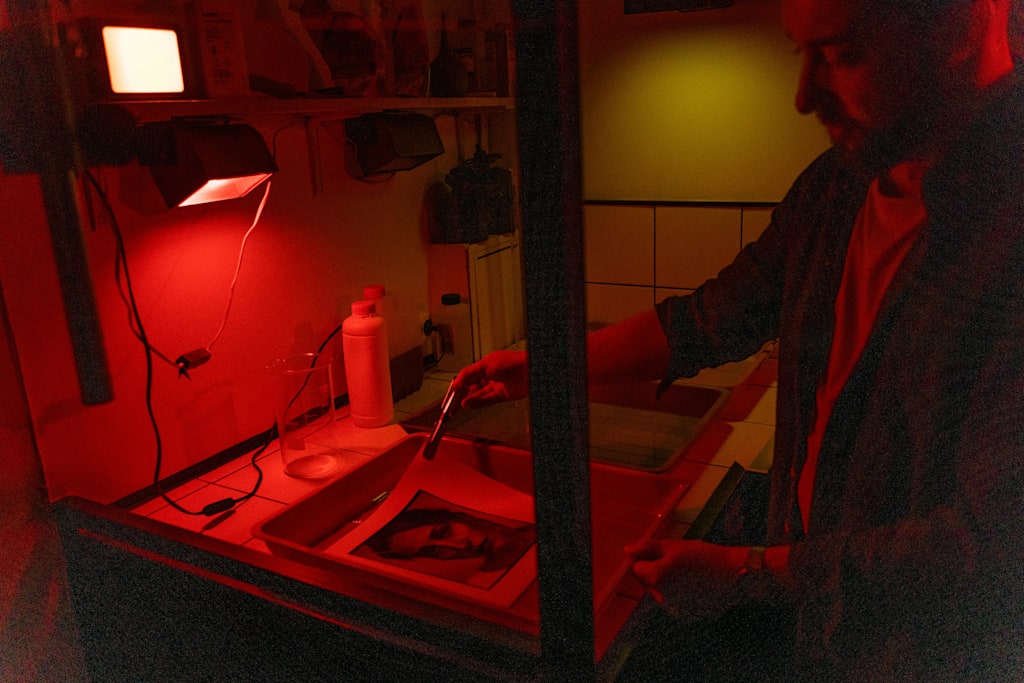
There's a particular kind of silence that belongs only to darkrooms. Not the empty quiet of an unused space, but a living hush, thick with chemistry and possibility. I remember standing in my father's makeshift darkroom as a child, watching him work under the amber glow of the safelight, his hands moving through trays of solution with the practiced grace of someone performing a ritual. The air smelled sharp and sweet at once, metallic and alive, like breathing in secrets. He never spoke much during those hours. There was nothing to say. We were both waiting for the same small miracle.
The Art of Waiting
That waiting is what I miss most about film photography. Not just the process itself, but the way it forced us to exist differently in time. When you pressed the shutter on an old Pentax or Nikon, you weren't just taking a picture. You were making a promise to a future version of yourself, one who would stand in a dim room days or weeks later, watching ghosts rise from blank paper. Every frame was an act of faith.
Cameras as Collaborators
My father kept his cameras on a shelf in the living room, each one a different weight in your hands, each with its own temperament. The Leica that clicked like a whisper. The Rolleiflex that made you look down instead of forward, changing not just what you saw but how you saw it. He taught me that cameras weren't just tools. They were collaborators. You had to learn their language, respect their limits, understand that they saw the world differently than you did. And maybe that's what made the photographs feel so honest. They weren't just your vision. They were a conversation between you, the machine, and the light itself.
Twenty-Four Frames of Faith
I think about the way we used to shoot back then. Twenty-four frames, maybe thirty-six if you were feeling extravagant. You couldn't waste a single one. So you waited. You watched. You let the moment build until you were certain, until your finger on the shutter release felt less like a decision and more like an inevitability. My father once spent an entire afternoon photographing my mother in the garden, and when the film came back, there were only eight frames. Eight images from five hours. But every single one held something true.
The Ritual of Revelation
The anticipation was its own kind of pleasure. Loading the film into the developing tank in complete darkness, your hands reading the shapes by touch alone. The careful measuring of chemicals, temperatures checked and rechecked. Then the waiting. Agitation at precise intervals, the liquid sloshing against the metal walls, and you had no idea what was happening inside. You just had to trust. Trust the film, trust the process, trust that the light had written something worth keeping.
When Time Becomes Visible
When I finally built my own darkroom years later, I realized I wasn't just trying to develop photographs. I was trying to recreate that feeling of being suspended between moments, between the world as it was and the world as it might be revealed. The first time I watched an image appear in the developer, swimming up from nothing like something remembered, I understood why my father had been so quiet all those years. What is there to say when you're watching time made visible?
The Weight of Silver
The photographs that emerged from those hours carried a different weight than anything that's appeared on my phone screen. Maybe it was knowing how much had gone into their existence. The careful composition, the single chance to get it right, the patience required at every stage. Or maybe it was something more fundamental, something about the physicality of the process. These weren't pixels. They were silver halide crystals transformed by light, fixed by chemistry, held in your hands as tangible proof that this moment had happened, that someone had been there, had seen this, had thought it worth saving.
Evidence of Looking
I remember finding a box of my grandfather's photographs after he passed. Prints from the 1950s, most of them slightly soft, some overexposed, a few with light leaks bleeding across the corners. By modern standards, they were imperfect. But they were also completely alive. You could feel him behind the camera, feel his attention in the way he'd framed his children playing in the yard, in the way the light fell across my grandmother's face as she looked away from the lens. These weren't just documents. They were evidence of looking, of caring enough to capture something and then caring enough to bring it into being through film developing and all the careful work that followed.
The Spaces Between
The platforms that celebrate this kind of work today, spaces like Analog.Cafe where photographers share not just images but the stories and struggles behind them, understand something essential. They know that film photography was never really about the photographs. It was about what happened in the spaces between. The conversation you had with a stranger while waiting for the light to change. The hours spent in the darkroom, alone with your thoughts and your mistakes. The way a single roll of film could stretch across months, accumulating moments like a diary written in silver and light.
What Digital Gave and Took Away
Digital photography gave us many gifts. The ability to see our work immediately, to iterate and learn at speeds my father could never have imagined, to share our vision with people across the world before the light has even finished changing. But it also took something away. It took the weight. Not the weight of the cameras themselves, though I miss that too, the way a mechanical Nikon felt substantial in your hands, like holding a small piece of precision engineering. But the weight of consequence, the understanding that every frame mattered because there were so few of them, and once they were gone, they were gone.
Returning to the Slower Rhythm
I still shoot film sometimes, though less than I used to. Loading a roll of Tri-X into an old FM2 feels like visiting a childhood home. Familiar, bittersweet, never quite the same as memory promises. But when I do it, when I force myself back into that slower rhythm, something shifts. I stop hunting for moments and start letting them find me. I wait. I watch. I remember that photography, at its best, isn't about capturing what's in front of you. It's about capturing what it felt like to be there, in that light, in that particular configuration of time and attention.
The Smell of Magic
The darkroom smell is harder to find now. Most of the chemistry has changed, and the few labs that remain have moved toward cleaner, safer processes. But sometimes, passing a certain kind of building, catching a whiff of something sharp and chemical on the air, I'm back in my father's darkroom. Eight years old, watching paper come alive in the developer, learning that some kinds of magic require darkness, patience, and a willingness to wait for something you can't see yet but somehow know is there.
Lessons in Trust
That's what film taught us, in the end. Not how to take better pictures, though many of us did. It taught us how to wait. How to trust. How to understand that the best things often require time and darkness and a little bit of faith. Every photograph was a small act of hope, a belief that this moment, this light, this particular arrangement of the world was worth preserving. And then the further hope that your hands would be steady enough, your chemistry precise enough, your patience sufficient enough to bring that moment back into being.
The Age of Instant Everything
We live in an age of instant gratification, where every image appears immediately, where we take more photographs in a week than our grandparents took in a lifetime. And that's not wrong. But I wonder sometimes if we've lost something in the translation. Not the photographs themselves, but the relationship we had with them. The way they used to ask more of us. The way we used to have to earn them.
The Honest Craft
Film photography was never efficient. It was never convenient. It was messy and unpredictable and full of small failures that felt, in the moment, like enormous disasters. But it was also honest. It made us show up completely. It made us pay attention. And in return, it gave us more than just images. It gave us those hours in the darkroom, that particular quality of anticipation, those prints that smell faintly of fixer and feel slightly cool to the touch. It gave us something to wait for, and in a world that moves as quickly as ours does, that waiting was its own kind of gift.
The Promise We Keep
The cameras are still out there, of course. Sitting in thrift stores and attic boxes, waiting for someone to pick them up again, to load them with film, to remember how it feels to shoot without seeing. And the darkrooms, the few that remain, still smell the way they always did. Still offer that same dim sanctuary where time moves differently and ghosts rise from water and silver and light.
Maybe that's why film will never really disappear. Because some of us remember what it felt like to wait. To trust. To believe that the best images were worth working for. And every time we pick up one of those old cameras, every time we stand in that amber light and watch an image swim into being, we're not just making photographs. We're keeping a promise to a slower, more attentive version of ourselves. We're remembering that some kinds of magic can't be rushed, only revealed.
And that revelation, that quiet moment when the image finally appears, when the waiting is over and you can see what you've made: that feeling is timeless
About the Creator
The Icon
The Icon offers top-quality film developing, film scanning, and photo printing services. Film developing requires precision, attention to detail, and an understanding of the chemical processes involved. Minor variations in temperature
Enjoyed the story? Support the Creator.
Subscribe for free to receive all their stories in your feed.
Comments
There are no comments for this story
Be the first to respond and start the conversation.