
Is This Really Living? Notes from Inside the Velvet Cage
The architecture of modern Western life is shaping people in ways they didn't choose. From a rush-hour drive home to a flush toilet installed in a village in Indonesia, the same pattern keeps surfacing — and a quiet exit is starting to take shape.

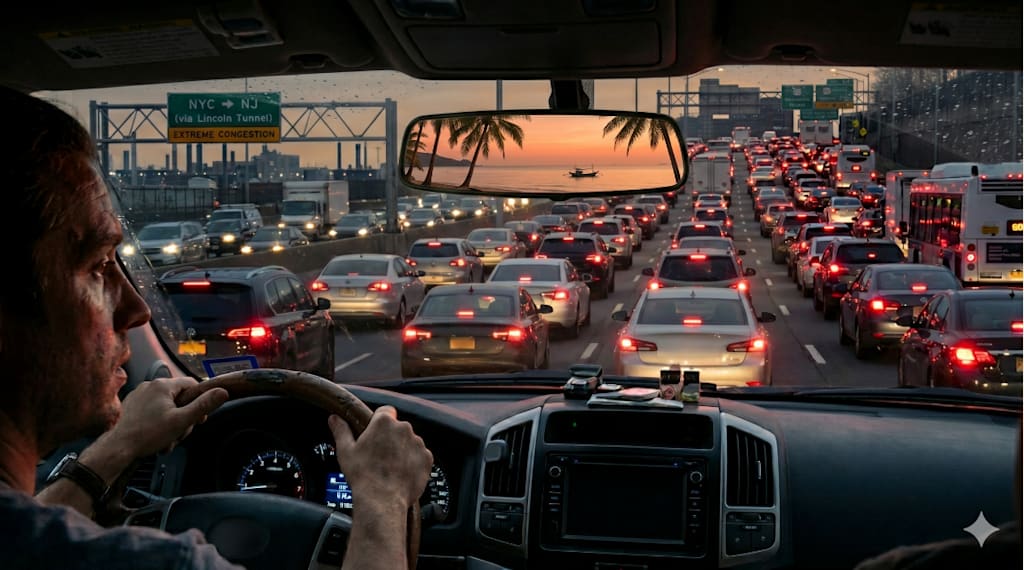
There's a quiet realization spreading among people in the West — a sense that something has slipped out of sync, even as everything keeps speeding up. The pace accelerates. The costs climb. The technology demands more attention, more upgrades, more dependency. And somewhere underneath all of it, a question keeps surfacing:
Is this really living?
The cage I keep coming back to isn't just financial or political — it's structural. It exists at every level. It's in the rent, the commute, the neighborhood, the calendar. And lately, it's in the volume of voices noticing.
The Diagnosis
There's an off-grid nomad I've been watching who lives out of a tent and a bicycle. His framing is simple: everyone's drinking the same "juice." A steady stream of media and ambient pressure that people consume without questioning what it's actually doing to them. Nobody feels good. They keep drinking it anyway. Step away from it long enough, he says, and the signal clears.
A Norwegian novelist who builds his work around Viking-era values frames the same diagnosis more sharply. The modern world, in his view, benefits from people who feel weak, frustrated, and resentful of their neighbors. His prescription is what he calls the Viking code: integrity, tribe, and the long memory of one's deeds. Translated for our context: take responsibility for your life, build a real community in person, and live in a way worth remembering. He calls this the greatest act of rebellion available to a modern person.
Different vantage points. Same observation. The architecture you live inside is shaping you more than you realize.
The Cost at Eye Level
I felt this recently driving home from New Jersey during evening rush hour. By the time I pulled into my driveway, I wasn't tired — I was psychologically disturbed. And I've spent more than fifteen years driving tractor trailers professionally. The issue isn't driving. The issue is the atmosphere people now live inside.
A modest apartment in New York City runs over $3,000 a month before utilities, insurance, taxes, parking, and the dozen other line items no one talks about. Health insurance can rival rent. And what does all of it buy? Stress. Aggression. A culture more digitally connected than at any point in history — and lonelier than ever inside that connection.
A traveler in his sixties — someone who's spent decades crossing continents — names the deeper trap. You can travel across continents, he says, and still be standing still inside. Movement isn't growth. The expensive zip code isn't safety. The full calendar isn't a life. His line that stayed with me: don't go looking for something. Go ready to lose something.
What People Are Choosing Instead
My wife grew up in Indonesia. She lived part of her childhood without electricity. Last year, her parents installed a Western-style flush toilet in their home — primarily because they wanted our son to feel comfortable when visiting. That gesture carried more humanity than most luxury purchases people make here. The people with less, in my experience, often understand connection more deeply than the people with more.
What modern life has done isn't steal connection — it's made disconnection frictionless. People who live in the same house can go entire days without acknowledging each other. Location-sharing exists; it just doesn't get used. Texts go unanswered not because anyone's incapable of replying but because the architecture has made not replying the path of least resistance. That's the quieter cost of the cage: the things that used to require effort to break now require effort to maintain.
There's a Canadian man in his forties who left a corporate job and moved to Central America. He puts the trade-off in numbers: salary cut in half, quality of life quadrupled. Off antidepressants. Anxiety gone. Long hikes instead of long commutes. The point isn't that any country is paradise — none is. The point is that environment is upstream of your nervous system more often than people admit.
The Reframe
The puzzle isn't how do I cope better with modern Western life? The puzzle is what am I actually optimizing for, and is the environment I've chosen compatible with that? Those are different questions, and they produce very different answers.
A redefined version of success is quietly emerging across these voices: time freedom over status. Geographic flexibility over equity in a thirty-year mortgage. Real relationships over notifications. Lower stress over higher accumulation. It's not luxury people are after. Many simply want their lives back.
For those willing to look, the doors are also more accessible than most people realize. Indonesia offers a long-stay visa for those fifty-five and older — multi-year, with the freedom to come and go without the constant "visa runs" that younger travelers have to plan around. Malaysia runs a similar program. Several other countries do too. None of these are escape hatches from yourself — but they are real, legal, structured pathways for people whose only remaining barrier was assuming the door wasn't there.
What Comes Next
Real change usually requires letting go before it allows arriving — letting go of the version of success you inherited, the consumption you stopped questioning, the proximity to people whose presence has been replaced by their notifications.
Whether the way out for you is a different country, a different city, a different income model, or simply a different relationship with the screen in your pocket — the work starts with seeing the cage clearly. Four people, in four very different lives, are independently describing the same one. That's not coincidence. That's a signal worth listening to.
About the Creator
Rez Man
Founder of Digital Startup Lifestyle, a community for Lifestylers building freedom businesses. Certified business and primal health coach. Fifteen years behind the wheel of a tractor trailer. digitalstartuplifestyle.com
Enjoyed the story? Support the Creator.
Subscribe for free to receive all their stories in your feed.
Comments
There are no comments for this story
Be the first to respond and start the conversation.