
I Can’t Run 200 Meters. I’m Going to Walk a Marathon in 15 Months.
A 104 kg beginner’s four-phase plan to finish 42.195 km at 8:30/km before the 6-hour cutoff.
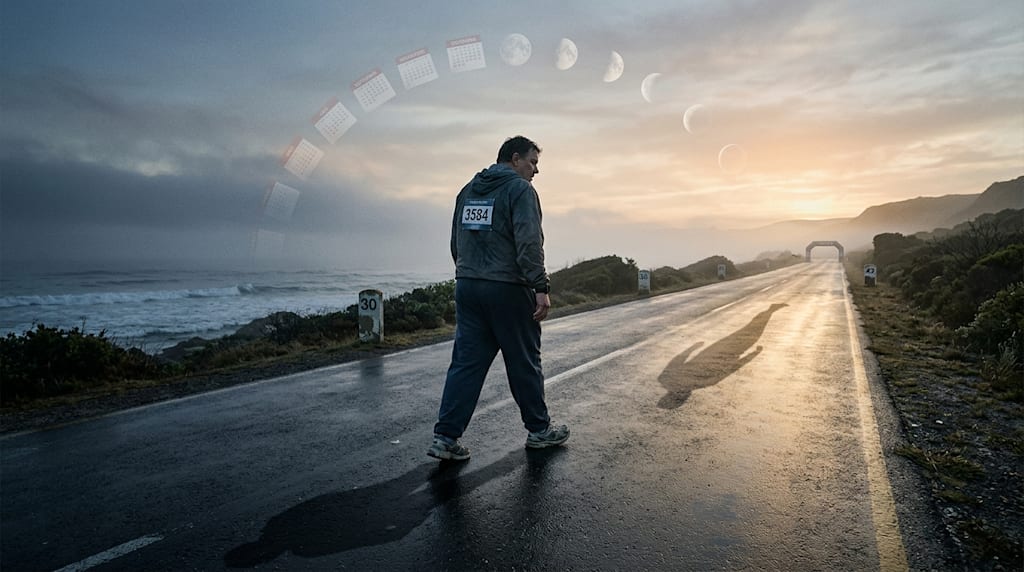
From 104 kg to 42.195 km: how a person who cannot run can walk a marathon in 15 months
You went from 124 kg to 104 kg.
That is a number. It also means you won a battle many people never win. You lost 20 kg. That took execution and patience.
You now ask a direct question. Can you walk a marathon in 15 months if you cannot run 200 meters but can walk 6 to 8 km at a time? The answer is yes, with conditions. You have to redefine walking.
Walking a marathon is not a casual stroll. It requires endurance, pace control, joint tolerance, fueling, and willpower. You have 15 months to go from walking 8 km to walking 42.195 km at an 8:30/km pace. That is a hard goal. It is doable.
The time math
Most full marathons in China close at 6 hours. Some allow 6 hours 15 minutes. 42.195 km in 6 hours requires 8:32/km. Add water, bathroom stops, stretching, shoe tying, photos, cramps, and daydreaming. Your walking pace must stay between 8:00 and 8:20/km to finish safely.
You can walk 8 km at 9:00/km. That is brisk. It shows you have a base. But 8 km and 42 km are different events. 8 km tests fitness. 42 km tests your system. 8 km depends on a good day. 42 km depends on every training day for 15 months. After 8 km, you can post on social media. After 42 km, you may not want to pick up your phone.
Do not ask if you can finish. Ask if you can complete the training every week for 15 months.
Advantages and gaps
Advantages:
You lost 20 kg. You can execute and persist. Marathon training needs boring persistence more than talent.
You can walk 8 km at 9:00/km. This is not zero base. Zero base is breathless at 3 km or knee pain at 5 km. You have a cardiovascular foundation.
You have a clear goal: 75 kg, walk a marathon, 15 months. Specific numbers give direction.
Gaps:
At 104 kg, walking 42 km stresses knees, ankles, and plantar fascia. At 75 kg, that stress is lower. Every step carries debt.
A 9:00/km pace for 8 km and an 8:30/km pace for 42 km are far apart. You need speed and endurance.
Your longest walk is 8 km. A marathon is more than five times that. Glycogen, fat oxidation, and muscle fatigue resistance need training.
You cannot run 200 meters, so run-walk is not available. You must rely on brisk-walking technique, strength training, and weight loss.
15 months, four phases
Break 15 months into monthly targets.
Phase one: base and weight loss, months 1 to 4
Goal: make brisk walking a training habit.
Weight: 104 kg to 95 kg.
Walking: 10 km at 8:45/km.
Do three things:
Walk every other day, 40 to 60 minutes. Push one walk to 8:45/km.
Strength train twice a week: core, glute bridges, squats, calf raises, single-leg balance. Knees need muscle.
Keep losing weight. Moderate deficit, enough protein. Lose 2 to 4 kg per month.
At the end, if you can walk 10 km at 8:45/km without ongoing knee pain, you have a base.
Phase two: endurance and speed, months 5 to 9
Goal: longer walks, stable pace.
Weight: 95 kg to 85 kg.
Walking: 25 km at 8:30/km.
Do one long brisk walk each week.
Month 5: 12 km
Month 6: 15 km
Month 7: 18 km
Month 8: 22 km
Month 9: 25 km
Walk close to race pace. Stretch, rehydrate, eat carbs. Rest or walk easy the next day. You will feel heavy legs, a racing heart, irritability, and the urge to quit. That is your body learning to fuel itself.
Phase three: race simulation, months 10 to 13
Goal: test fueling and build confidence.
Weight: 85 kg to 80 kg.
Walking: 35 km at 8:30/km.
Schedule two or three walks of 30 km or more.
Month 10: 28 km
Month 11: 32 km
Month 12: 35 km
Month 13: 30 km and recovery
The last 7 km are the real marathon. If you never walk 35 km, you cannot know how km 36 feels.
Test shoes, socks, blisters, energy gels, bananas, salt tablets, electrolyte drink, pace, cramps, and the mental moment when you want to stop.
Phase four: taper and race, months 14 to 15
Goal: taper, recover, finish.
Weight: 80 kg to 75 kg.
Race: under 6 hours at 8:20 to 8:30/km.
Taper for 3 weeks. Cut volume by half in the last two weeks. Only short easy walks in the last week.
Race strategy:
First 5 km: hold back, 10 seconds per km slower than target.
10 to 30 km: steady at 8:30/km.
30 to 35 km: fuel with salt tablets, gels, water.
35 to 42 km: do not stop. Keep walking. Sitting down makes it hard to restart.
Drink at every aid station in small amounts.
Leave 15 minutes of buffer at each cutoff.
Weekly training template
Monday: rest or stretch
Tuesday: brisk walk 8 to 10 km at 8:45/km
Wednesday: strength: core, glutes, legs, calf raises
Thursday: brisk walk 10 to 12 km at 8:30/km
Friday: rest or easy 5 km walk
Saturday: long brisk walk, 15 to 35 km at 8:40/km
Sunday: easy walk, stretching, foam roller
Principles:
Do not strength train the day before a long walk.
The day after a long walk is recovery.
Weekly distance rises from 20 km to 50 or 60 km.
One month before the race, peak then taper.
Eating and recovery
At 104 kg, goal 75 kg. The 29 kg you lose reduces knee stress, improves pace, and raises your finish odds. But do not starve. Eat enough to train.
Protein: 1.6 g per kg per day. At 100 kg, 160 g.
Carbs: enough on training days, especially before long walks. Do not walk 30 km on low carbs.
Fat: moderate, from nuts, fish oil, olive oil.
Water: 2 to 3 liters daily, more on training days.
Sleep: 7 to 8 hours. Less sleep means poor recovery and higher injury risk.
Lose 2 to 4 kg per month. Faster loss costs muscle, training quality, and immune function.
Risk checklist
Knee pain: if inner or outer knee hurts during walks, stop and see a doctor.
Plantar fasciitis: sharp morning heel pain. Reduce running and jumping, strengthen calves, change shoes.
Stress fracture: sharp pain at one point on shin or foot that rest does not ease. See a doctor.
Blisters: no cotton socks. Wear running socks. Use Vaseline.
Low blood sugar: eat breakfast before long walks. Fuel every 45 minutes.
Heatstroke: slow down in heat, drink more, carry salt tablets.
Mental breakdown: normal. Every marathoner wants to quit. They keep walking.
Race day
You will see fast runners. You will see people pass you. You will see the sweep vehicle. Stay calm.
Your race is against the version of you from 15 months ago: 104 kg, unable to run 200 meters. Hold your pace. Hit the aid stations. Do not stop.
First half: you feel light. Hold back.
Middle: bored. Persist.
After 30 km: pain. Accept it.
After 35 km: you feel like dying. Keep going.
At 40 km: the finish feels close. Do not sprint.
At 42.195 km: you see the arch.
The marathon only cares whether you arrive before the cutoff.
A letter to you in 15 months
Fifteen months from now, you may be 75 kg. You stand at the start among runners in carbon shoes and sports watches. They talk about pace, heart rate, and PBs. You wear ordinary shoes and a bib. You think: today I walk the whole thing.
The gun goes off. The crowd moves. You start walking. Step. Another step.
You pass 5 km, 10 km, halfway. You pass 30 km, 35 km. You pass places you thought impossible.
You remember 124 kg. You remember gasping on your first 8 km walk. You remember evenings of brisk walks. You remember someone saying you had no hope.
You walk into the stadium and see the finish arch. You did not run. You walked 42.195 km. You finished.
This is your marathon. You walked it step by step over 15 months.
Keep this piece. Read it once a month. Then go walk today’s 8 km.
About the Creator
Jin
Writer of reamstories
https://reamstories.com/jin
Enjoyed the story? Support the Creator.
Subscribe for free to receive all their stories in your feed. You could also become a paid subscriber, letting them know you appreciate their work.
Comments
There are no comments for this story
Be the first to respond and start the conversation.