

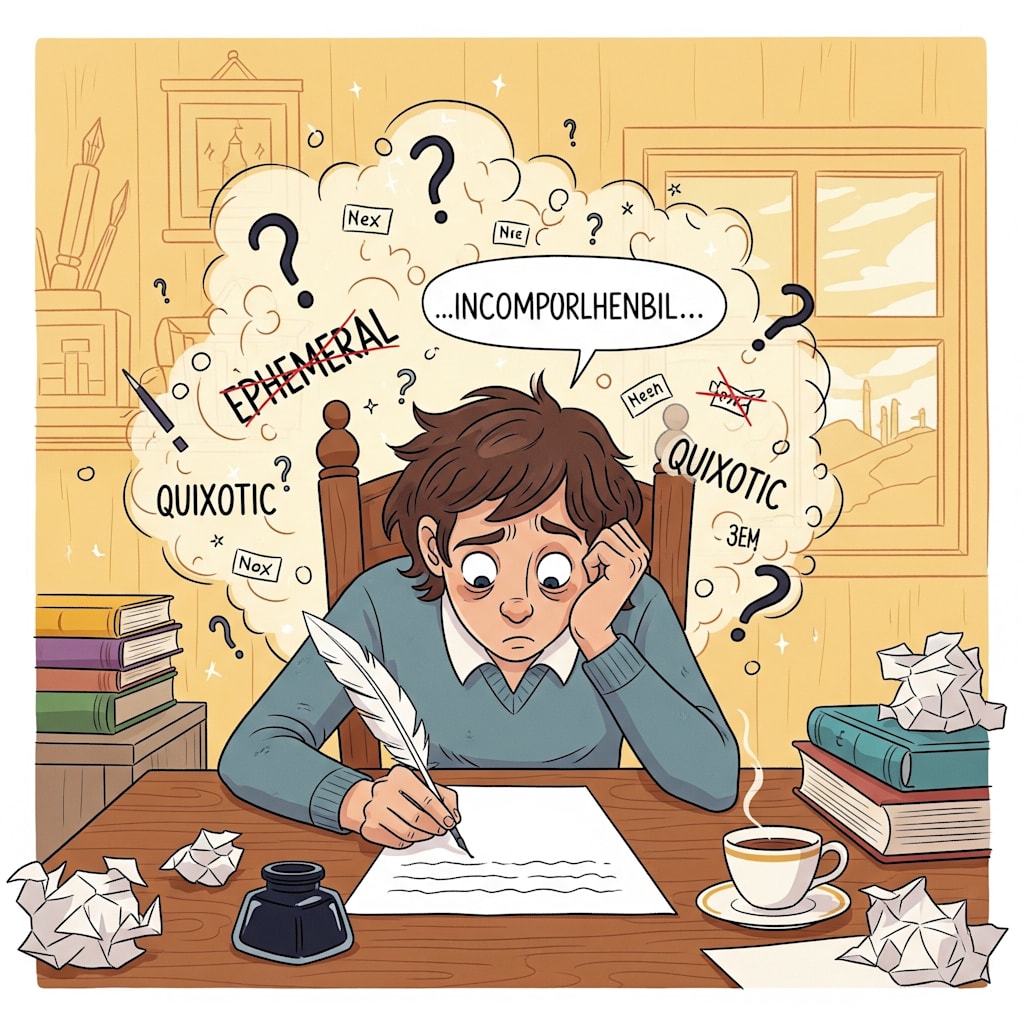
Imagine sitting down to write and being unable to. Not because you have writer’s block from not knowing what you want to write about, but because you forgot a word's definition, therefore, you were unable to recall the proper word you needed. So you spend hours looking in a thesaurus or dictionary, hoping the word you want will pop out to you. While causing you to struggle for hours, even days, on just a few sentences, just a couple of paragraphs. Sometimes, unable to find the words, you’ll break down and ask your teenager to help you, fully ashamed that they elude you. Mortified more when they inform you it’s all a misspelling on your part.
Welcome to my life. This doesn’t just happen once in a while; it happens daily. Sometimes several times in one day. My daughters joke and tell me I’m suffering from dementia.
From the moment I wake up, I struggle with words, and rarely with the same ones twice. When speaking or writing, I never know if I’ll have a problem finding the word I need. It’s very frustrating when the word is on the tip of my tongue.
I’ve suffered from this since my first heart attack. I’ve had four since 2017, plus a pacemaker installed. This, combined with my age and the stress of the last few years, has really taken a toll on my cognitive recall.
There’s a name for this disorder. Anomic aphasia. Word recall issues. Many suffer from this condition to some degree. Different things can cause it.
Of course, there are things you can do to treat anomic aphasia. Although it cannot be cured, you can significantly improve your life. So it’s not hopeless, it just feels that way.
Treatment includes:
- Speech-language therapy (SLT). You retrain your brain for word retrieval with this rehabilitation technique. This is the primary therapy used.
- Semantic feature analysis (SFA). A method in which you describe an item’s categories to prompt word retrieval.
- Phonological component analysis (PCA). This one concentrates on the sounds within a word to prompt word recall.
- Circumlocution therapy. Trains you to talk around the words with descriptions, rather than getting stuck.
- Visual action therapy. In severe cases, when words are unavailable, pictures and gestures are used.
- Non-invasive brain stimulation. Procedures like repetitive transcranial magnetic stimulation may be used.
- Technology Aids: Using technology for speech exercises and communication support. There are apps created to help with this disorder.
It’s not easy keeping up with losing your mind. Some days are better than others, but not a day goes by that I don’t have trouble remembering some word. At first, it was easy for me to hide it, since I had a wide vocabulary to begin with. I just switched to a synonym. It’s become harder to hide, and I’m at the point where my children have noticed and taken action, telling me something must be done.
I work daily with word problems, crosswords, and other memory games. I read different dictionary words with their definitions. I read either a book or on Vocal.
My word recall isn’t perfect. Most days, I spend hours on one verse to get the words I want so it sounds just right. Writing stories now takes me weeks, because I’m constantly reworking them. After all, the words don’t flow as they should. Challenges are a nightmare for me, and I hardly ever finish my entry in time, if I even start it.
Then there are the days when I sit down, and the words just flow from my fingers as I write. My mind goes into the zone, and nothing can distract me. Thirty minutes, maybe an hour or two pass, and I’ve turned out a poem that I think is pretty good. I don’t even want to change a word, and amazingly, I only have to find a few “lost” words on those days.
Whether I have a hard or easy time writing, a finished piece is a victory for me. It’s something I work hard to accomplish. I’m not saying that I work harder than others, but compared to how easy writing was before my first heart attack, things aren’t easy-peasy. Whether it’s a short poem or a short story, completing them lets me know that no matter what, I can.
I can.
I will.
I will never give up on writing. Therefore, I refuse to go down without a fight. I will not lose my words if I can help it. Completing any steps I can to strengthen my memory, and in tandem, my vocabulary, I’ll rebuild it one word at a time, if I have to. Even if it’s three steps forward and two back, I will continue on this path of trying to retain and regrow the words I used to know.
About the Creator
Enjoyed the story? Support the Creator.
Subscribe for free to receive all their stories in your feed. You could also become a paid subscriber, letting them know you appreciate their work.
Comments
There are no comments for this story
Be the first to respond and start the conversation.