
Why Job Loss Exhausts You Even When You’re Doing Nothing
Shrinking savings and unanswered applications are visible. The deeper drain is a feedback loop you can interrupt.
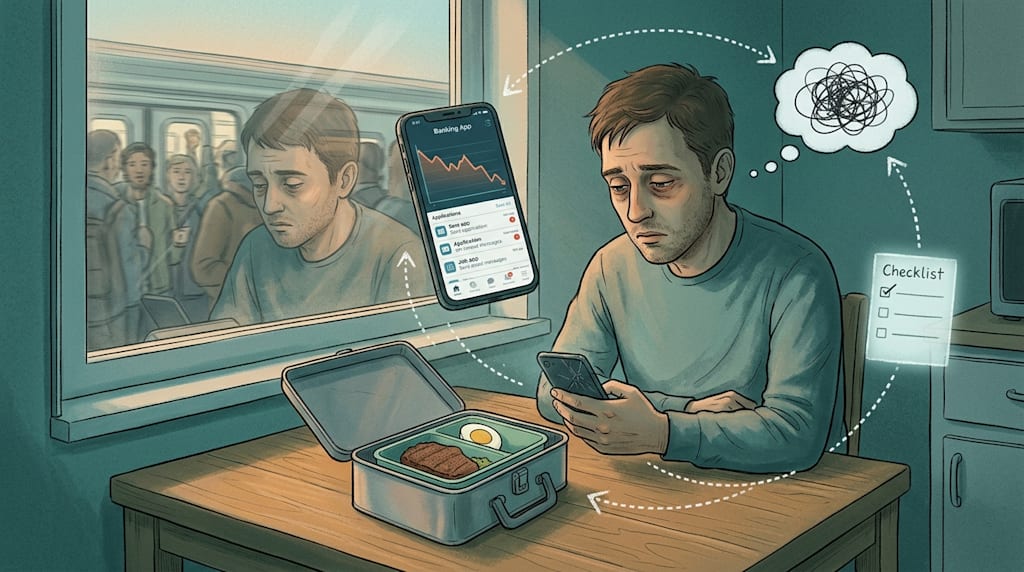
After losing a job, most people feel anxious.
On the surface, the anxiety is about shrinking savings and not having found work yet. Look one layer deeper, and those two things are just the most visible exits.
Underneath sits a certainty mismatch. We keep preparing. We keep setting goals. Once my state of mind is right, I will send resumes. Once my resume is perfect, I will reach out. Once I figure out the next step, I will act. My state of mind never gets right. My resume can always be revised. The next step never becomes fully clear. I do not know whether the goal will be reached, and much of it is not up to me.
At the same time, the savings number is clear. The job listings are clear. The messages marked read with no reply are clear. The interview results are clear. They are so certain they feel cruel.
That certainty is the reality you cannot face yet. So the anxiety grows.
The more you focus on concrete things, the more you want to be prepared, the more urgently you want to solve the problem, the more you find you cannot solve it. Looking at your savings will not stop them from shrinking. Refreshing the recruiting app ten times will not produce a suitable job. Asking yourself what you are supposed to do will not steady your emotions.
A negative feedback loop forms. You look at savings, feel anxious, want a job more urgently, scroll the recruiting app, get no reply, doubt yourself, feel more anxious, act less, then look at savings again.
Your situation may not have gotten worse. Your perception has been captured by negative feedback. You are stuck in endless drain. You look like you are doing nothing, yet you are more exhausted than when you were working.
1. Job loss can be a huge thing, or a small thing
In the past two years, I have seen far too many people around me lose their jobs, including myself. I have been unemployed twice. I have watched the states people are in and the paths they take after losing a job. Slowly I realized one thing. The impact of job loss on a person does not depend entirely on how bad the reality is. It also depends on how the person faces it.
Let me start with the hardest case I have seen.
A former colleague of mine was a cashier earning about 7,000 yuan a month. She has two sons. In Shanghai, she has no car, no home, no local hukou, and no savings. One of her sons has ALS. Her husband was laid off, and because his industry is unusual, he could not find work for a long time. Then the company I worked for also had layoffs, and she became unemployed.
For most people, this situation would be enough to keep them awake at night with anxiety.
She did not fall apart. Finding work was very difficult for her. Eventually she found a job at a small bookkeeping firm. They did not pay social insurance and said they would start after she had been there for a year. Both she and her husband have bachelor’s degrees, and both are hardworking people. Their life has not been easy.
I talked with her once and asked if she was anxious. She said, “It’s okay.”
I did not push further. Later, I noticed something. She brought lunch every day. Her lunch box always had two dishes: one meat, one vegetable. She ate half of the meat and packed the other half back. Her phone lock screen was a photo of her two sons. The upper right corner of the screen was cracked, and she had taped it with clear tape in a cross shape. She had not replaced it.
During the time she was job hunting, she left home at seven every morning, took the subway to that bookkeeping firm, got home at six thirty, and cooked for her son. One day she posted a photo on WeChat Moments: her own face reflected in the subway window. The caption was just two words: “Arrived.”
Anxiety was useless to her. She had no time to sink into specific emotions, to think too much about how much savings was left or what kind of job she should find. Her attention was on “Why am I so miserable?” for maybe a second. Then it moved to “This meal is handled. Where is the next one coming from?”
Her response is attention anchoring forced out of her by reality. There is nothing light or cheerful about it. People do not always act because they have figured everything out. Often, they act by doing one small thing, so their emotions have somewhere to land.
I also want to add one thing. Do not romanticize suffering. She can carry it. That does not mean everyone should be able to carry it. Structural hardship is real. It will not disappear just because someone has a good attitude. A person being able to hold on does not mean they do not need help. A person temporarily being unable to hold on does not mean they are not strong enough.
2. Plans are good, but a plan without positive feedback will turn on you
We are too used to making plans and setting goals. We know too well what we should do. I should hurry up and find a job. I should get my state of mind right. I should pull myself together. I should figure out the next three to five years.
The problem is exactly this: we cannot do it, or we cannot do it well.
You want to get your state of mind right, so you look at whether your savings can support you. When you have no income, your savings are bound to shrink. That shrinkage makes you anxious, because your attention is on negative feedback. So the goal of getting your state of mind right is never reached, because your state is being dragged around by the savings number.
You say, fine, then I will look for a job first. The moment you open the recruiting app and start applying, all you can think about are the bad experiences at work. The physical and mental exhaustion makes you afraid to reach out and apply. Even if you do apply, there may be no reply, which intensifies your fear of job hunting and your self-doubt.
You want to look, but you cannot. You want to adjust, but you cannot.
Plans and goals are good. But when the process of carrying out a plan or goal has no positive feedback to support you moving forward, do not rush to make a one-step plan. Do not set a goal that says you must figure everything out immediately. Follow your inner feelings first. Put your attention back on yourself.
This does not mean you should never make plans again. It means you should not make plans that have only an endpoint and no steps. You can change it into minimum action plus a time box. Today, do just one small controllable thing. Revise one section of your resume. Ask a former colleague a question. Record one day of expenses. Go outside for a twenty-minute walk. Once you do it, count it as positive feedback. Do not settle the account by whether you have found a job.
A person first needs a small feeling of “I can complete one thing” before they have the strength to face bigger uncertainty.
3. Put your attention on things that give you positive feedback
My former colleague’s attention was on “this meal is handled. Where is the next one coming from?” She needed a job first. An ideal job could wait.
If your shrinking savings make you anxious, do not struggle back and forth between looking for a job and not looking for a job. Ask what you can do to increase income and slow the decline of your savings. It could be a side hustle. It could be cutting expenses. Whether you earn a little money or save a little money, it is positive feedback for your savings.
If you want to get your state of mind right, do not keep thinking about what getting it right is supposed to look like. If you want to lie down, lie down for a while. If you want to sit in the sun, sit in the sun for a while. If you want to watch a show, sleep for a while. When you want to exercise, go exercise. When emotions are seen and satisfied, the body will naturally become better and more active.
People’s anxiety comes down to two reasons: expectations are not met, and fear of the unknown has nowhere to rest.
My solution is this. First see your expectations. Then start solving the concrete problems. Treat fear of the unknown as a problem that needs to be solved, not something you are trying to control.
Try making three distinctions.
What you can control: send one resume today, cut one hundred yuan of spending, cook a meal, exercise for twenty minutes, contact one person.
What you cannot control: whether HR replies, whether you pass the interview, when your savings stop shrinking, how others see you.
What needs to be seen: fear, shame, exhaustion, unwillingness. Seeing it does not mean letting it take over.
Anxiety fears grand truths less than it fears concrete, completable small actions. Your colleague’s attention was on where the next meal is coming from. Your attention can also first find one small thing you can close the loop on today. Once positive feedback accumulates, a person has the energy to deal with bigger problems.
Job loss, of course, needs to be solved. Before solving it, a person first needs to stop being endlessly drained by negative feedback. Shrinking savings are a fact. The certainty of the recruiting app is also a fact. You are not limited to staring at them.
You can move your gaze a little. Move it to one small thing you can complete today, one small thing that can give you a little positive feedback. Drag the recruiting app icon from your home screen into a folder on the second screen. Add an egg to your lunch box at noon today.
Your situation may not have gotten worse. Many times, your perception has been taken over by negative feedback. Take your perception back first, and the road will slowly begin to appear.
About the Creator
Jin
Writer of reamstories
https://reamstories.com/jin
Enjoyed the story? Support the Creator.
Subscribe for free to receive all their stories in your feed. You could also become a paid subscriber, letting them know you appreciate their work.
Comments
There are no comments for this story
Be the first to respond and start the conversation.