
The Cancer List Changed. The Death List Didn't.
China's 2024 cancer data shows a country getting better at finding some cancers and failing to stop others. The gap between the two lists is the real story.
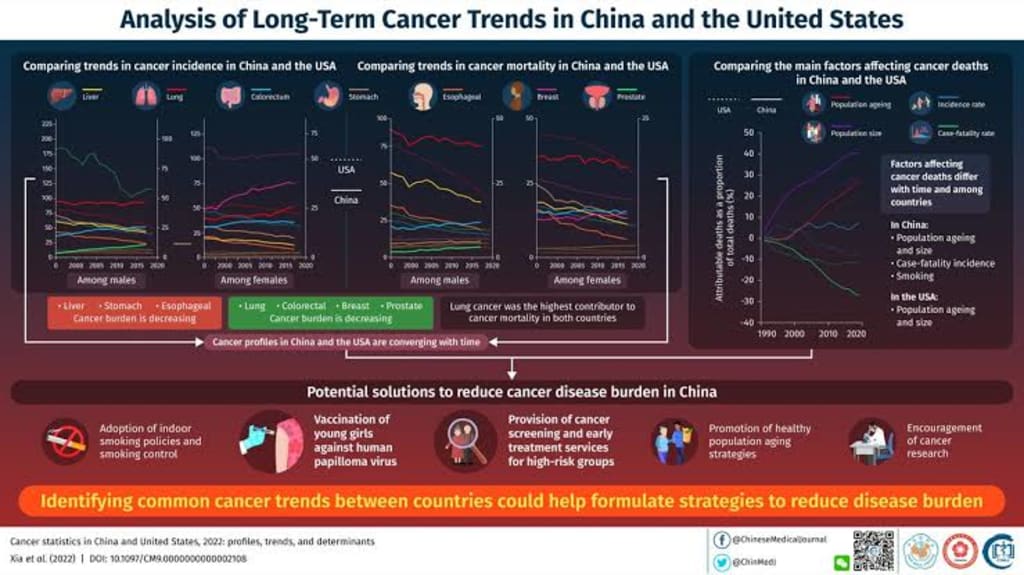
What two decades of China's cancer data actually show
In October 2026, China's National Cancer Center released its analysis of 2024 data: roughly 5.1506 million new malignant tumor cases and 2.5822 million cancer deaths nationwide.
The top five by incidence were lung cancer, female breast cancer, thyroid cancer, colorectal cancer, and liver cancer. The top five by mortality were lung cancer, liver cancer, colorectal cancer, gastric cancer, and esophageal cancer.
Gastric and esophageal cancers dropped out of the incidence top five. They did not drop out of the mortality top five. Same dataset, two lists, two different stories. The incidence list records what a country has learned to see. The mortality list records what is still killing people. The distance between the two is the story.
Upper gastrointestinal cancers: the flow is falling, the stock is not
The decline in gastric cancer's incidence ranking has a verifiable cause. In China, 78.5% of non-cardia gastric cancer and 62.1% of cardia gastric cancer has been attributable to Helicobacter pylori infection. But H. pylori seroprevalence has fallen from 60.5% before 2000 to 40.66% today. A community study with 20-year follow-up found that successful eradication reduced gastric cancer risk by 43%. Refrigeration squeezed the space in which pickled and moldy foods survive. High-salt exposure kept falling as food storage improved. Esophageal cancer follows a similar path, but it maps even more directly onto basic living conditions: nitrosamine exposure, moldy food, poor drinking-water quality were always byproducts of underdevelopment. Since 2000, among the top ten cancers, only esophageal, gastric, and liver cancer have shown sustained declines in age-standardized incidence. The other seven have risen. Upper gastrointestinal cancers are retreating because the conditions that produced them are retreating.
But a retreat is not a disappearance, and it is not an even retreat. Gastric and esophageal cancers still occupy two seats on the mortality list. Esophageal cancer mortality in men is about 2.7 times that in women. The burden is markedly higher in rural and elderly populations, whose exposure histories are longer and whose access to screening is lower. Gastric cancer is also splitting internally: overall incidence is falling, but the share of patients under 35 rose to 6%–11% in the past five years. Late nights, irregular meals, and ultra-processed foods are partly offsetting the gains from traditional public-health measures. The decline in upper gastrointestinal cancers is a curve with structural ruts: it improves in the statistical average, and improves slowest in the populations that carry the heaviest burden.
The risers: found earlier, and genuinely growing
Thyroid cancer and breast cancer have entered the incidence top five. Lung and colorectal cancer remain on it. The rise of these four cannot be lumped together as "more cancer." At least two different kinds of increase are involved.
Thyroid cancer's jump is largely a projection of diagnostic sensitivity. A 2025 study in The Lancet Diabetes & Endocrinology, covering 185 countries, found that between 2003 and 2017, annual thyroid cancer incidence among Chinese aged 15–39 rose by 20.8% in women and 27.6% in men, while mortality stayed extremely low. The researchers used the incidence-to-mortality ratio to quantify overdiagnosis: globally, in young adults, the average ratio was 122 for women and 95 for men, versus below 10 for other common cancers. In some countries, the figures exceeded 3,300 and 600. A cancer with near-negligible mortality rising to third place by incidence measures how high-resolution ultrasound has found a large number of indolent microcarcinomas that would otherwise never have entered clinical view. Thyroid cancer's ranking measures the health system's ability to find disease, not the population's speed of growing it.
Lung cancer's continued first place combines real cumulative risk with screening detection, and the two cannot be cleanly separated. Aging is the deepest driver: lung cancer mortality rises from 6.83 per 100,000 in the 40–44 age group to 545.93 per 100,000 in the 80–84 group. The historical effects of smoking and long-term air pollution are still being released. But the spread of low-dose spiral CT has also reshaped lung cancer's epidemiology. An analysis based on more than 3.2 million residents in Shanghai's Pudong New Area estimated that China's lung cancer overdiagnosis rate may be as high as 50%. Among women, about 88% of female lung adenocarcinoma was judged overdiagnosed. Pathology is shifting too: adenocarcinoma has replaced squamous cell carcinoma as the most common subtype and accounts for 53%–70% of lung cancer in non-smokers. In China, 86% of female lung cancer patients are non-smokers. Annual lung cancer incidence among non-smoking women doubled from 9.2 to 18.6 per 100,000 over 13 years. Kitchen fumes, indoor air pollution, and genetic susceptibility are repeatedly mentioned, but no single factor has yet won sufficiently strong causal argument. Lung cancer's first-place status is real, but the ratio of real risk to screening discovery varies enormously across populations and subtypes.
Breast and colorectal cancer rises depend less on being found and more on shifts in reproductive structure and lifestyle. Chinese women's average age at menarche is 12.3 and at menopause 50, so breast tissue is exposed to endogenous estrogen for roughly a decade longer than in Western populations. Average age at first birth has moved from 25 to 30. Nulliparous women have 2.5 times the risk, and the protective effect of pregnancy-related breast-cell maturation is compressed as childbirth is delayed. Each year of delay raises breast cancer risk by 3%–5%. Colorectal cancer's drivers are more metabolic: rising red and processed meat intake, insufficient dietary fiber, climbing obesity, and sedentary life. The share of patients under 40 rose 15% in a decade. The share under 30 is still rising. These are systemic migrations of exposure at the population level, not artifacts of screening.
The time lag between the two lists
In the incidence top five, lung, breast, and colorectal cancer are also high-incidence cancers in developed countries. Thyroid cancer's "epidemic" appeared in South Korea and other societies with high screening intensity. The fall of gastric and esophageal cancer from the incidence list corresponds to a relative contraction of infection-related and poverty-related cancers. China's cancer profile is converging toward the high-income pattern.
The mortality profile has not turned in step. The names on the mortality top five have not changed in 20 years. But the internal order has shifted: colorectal cancer passed gastric and esophageal cancer to become third by mortality, and second among women. Esophageal cancer dropped out of the female mortality top five. That reordering is not driven by colorectal cancer suddenly becoming more lethal. It is driven by its incidence base expanding while the incidence bases of gastric and esophageal cancer contract. The mortality-side reshuffle is a lagging projection of the incidence-side turnover. Thyroid and breast cancer sit high on the incidence list but pull the mortality list only weakly, because their five-year survival is far higher than that of lung, liver, gastric, and esophageal cancer. Lung cancer alone sits at the top of both lists. It is the only cancer simultaneously being found on a large scale by screening and pushed up by real risk.
The incidence decline in upper gastrointestinal cancers is documented. But digesting the mortality burden takes far longer than turning the incidence curve. A person exposed at 50 to H. pylori and pickled food does not see that gastric cancer risk vanish in the same year that refrigeration spreads or eradication is promoted. After eradication, a proportion still progresses to gastric cancer 10–20 years later. As infection rates fall, the share of H. pylori-negative gastric cancer rises, and the risk structure itself becomes more complex. Esophageal cancer mortality remains markedly higher in men, rural populations, and the elderly. Those are precisely the groups with the weakest screening adherence and access to primary prevention.
The refrigerator is universal. What is inside it has changed.
The mismatch between the incidence top five and the mortality top five is not a contradiction. It is a marker of stage. H. pylori control, hepatitis B vaccination, improved food storage, and tobacco control really are rewriting the cancer profile. That is visible in the curves. But rewriting the increment and digesting the stock follow two different time scales. The former can show up on a curve in 10–20 years. The latter requires screening that reaches downward and equalization of primary prevention before it can loosen.
Thyroid cancer overdiagnosis is a reminder that seeing more does not automatically mean being healthier. The lung cancer screening debate shows that under one "rising incidence" label there can be two realities: a real threat worth finding earlier, and an indolent lesion pulled out of silence by high-sensitivity technology. The young-adult shift in colorectal cancer and the prolonged hormone exposure in breast cancer point in another direction. Some rises are etiologically driven and will not fade automatically when screening strategy is optimized.
The refrigerator is everywhere. But what is inside it has changed from pickles and cured meat to ready-to-eat chicken breast and imported cheese. H. pylori is tested and treated, but the share of high-salt, high-oil takeout has not fallen. Gastric and esophageal cancer are still sitting on the mortality list. The cancer profile has changed. The mortality profile has not yet changed.
About the Creator
Jin
Writer of reamstories
https://reamstories.com/jin
Enjoyed the story? Support the Creator.
Subscribe for free to receive all their stories in your feed. You could also become a paid subscriber, letting them know you appreciate their work.
Comments
There are no comments for this story
Be the first to respond and start the conversation.