
I Had the Same Nosebleed in the UK and China. One System Nearly Broke Me. The Other Fixed Me in 30 Minutes.
I paid £10 for prescription shampoo, waited 25 minutes on the phone while bleeding, and watched Beijing’s ER weld my artery shut for 300 RMB. Here’s what “free” healthcare actually costs.
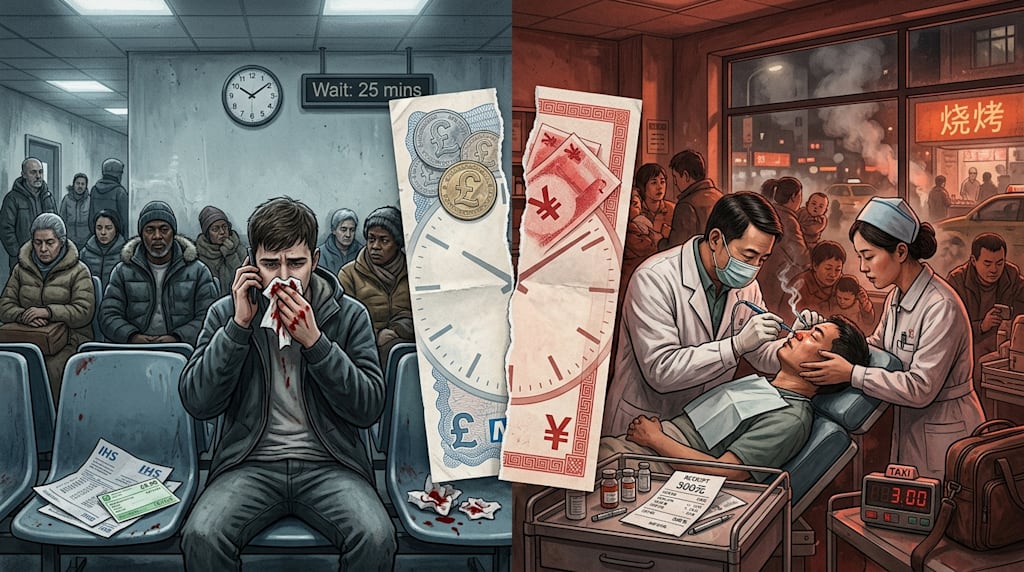
The Bill for Free Healthcare: NHS, IHS, and a Beijing ER
Britain says it has free healthcare. For international students and visa holders, that sentence has a gate in front of it: IHS. You pay the Immigration Health Surcharge before your visa. Students pay around £776 a year. Other visa holders pay around £1,035 a year. After that, if you are in the UK, most treatment does not require a large payment at the door. The system is prepaid. You have not caught a cold yet, and the bill is already sitting in your visa application.
The NHS does not cover everything for free. In England, prescription drugs are charged at a fixed fee per item, around £9.90. Scotland, Wales, and Northern Ireland have free prescriptions. England charges per item. The rule is strange. If the doctor gives you a hundred-pound drug, £10 is a steal. If the doctor gives you a medicated shampoo you could buy at the supermarket for a few pounds, you still pay £10 through the prescription. I once got a medicated lotion. The prescription cost £10. On the way home I passed Boots and saw something similar on the shelf for just over £3. The wind was strong that day. I folded the prescription slip and put it in my coat pocket. There was a bus ticket from yesterday in the same pocket.
The NHS works for chronic illness and serious disease. A friend had high blood sugar. After registration, the system sent regular follow-up notices. The tracking was detailed. No long queue. For severe illness, it makes sure you will not lose your home because of drug costs. If you get seriously ill in the UK, you can focus on treatment. That is the floor. For people who cannot afford major treatment, and for chronic patients, the NHS is friendly. For sudden, urgent, but not immediately fatal problems, the NHS can drive you mad.
I had a nosebleed in the UK that would not stop. I tilted my head back. Ice. Old tricks. Nothing. I had half a paper cup of blood. I called for help. It took nearly 10 minutes to get through. Someone picked up and started checking name, sex, medical history, symptoms. My English was not fluent then. In that panic, the call dragged for nearly 25 minutes. By the time it ended, the nosebleed had stopped on its own. I sat on the edge of the bed, holding a red tissue, listening to the kitchen tap drip onto stainless steel. NHS logic: if you are not dying right now, you wait through the process. It does not sort by how much pain you are in. It sorts by how likely you are to die soon.
Two years ago in Beijing, the same fragile artery broke again. Blood poured. I opened Gaode Maps, searched the nearest hospital, just over a kilometer, took a taxi to the ER. Registration was a few dozen yuan. I waited about ten minutes. The doctor’s CV said he was a medical PhD who had trained in the US. He glanced once, just once, and called it: arterial rupture. He moved fast, put me in a treatment chair, and prepared electrocoagulation. Like a tiny soldering iron, welding the wound shut. It hurt. I moved. The wound tore wider. He called a colleague, who held my head down, and he burned it three or four times. The bleeding stopped. From walking in to done, under half an hour. Before treatment, the doctor said, “You don’t have insurance, so self-pay is a bit expensive, around 1,000 yuan.” I thought: 1,000 RMB, less than £100, expensive? The final bill was just over 300 RMB, about £30. On the way home I bought a bottle of ice water. The cap took three twists to open.
In the UK, a private clinic for a foot fungus: £55 per session, up to six sessions, at least two or three. Beijing ER electrocoagulation: just over 300 RMB. Put those numbers side by side. Many arguments can stop there.
Free healthcare moves cost. Taxes, social insurance, IHS, waiting lists, prescription fees, dental self-pay, and private supplements are where it lands. When the price is zero, demand rises. A minor illness you used to endure, you now get checked. A medicine you used to buy yourself, you now get on prescription. A problem you used to handle at home, you now call an ambulance for. When supply cannot keep up, rationing shifts from money to queues, triage, waiting lists, referral thresholds. You no longer queue with money. You queue with time.
A state payer has some incentive to care more about public health. Half of that argument holds. A single payer has an incentive to push smoking cessation, alcohol control, sugar taxes, screening, vaccines, and chronic disease management. The NHS pushes these because major illness costs more. But occupational disease does not disappear. It can only be reduced. Free healthcare cannot manage dust, noise, chemicals, radiation, ergonomics, or psychosocial hazards alone. You need labor inspection, engineering controls, protective equipment, occupational health monitoring, union bargaining. Free healthcare is the safety net after the fact. Prevention happens before.
Diet will face more intervention. Sugar taxes, salt taxes, labels, advertising restrictions, school meal standards: these can improve health. The food industry will push back. Consumers will complain. Politics will swing. The UK has a sugar tax. Obesity is still serious. Strict working-hour rules can improve health. Long hours increase cardiovascular risk, mental illness, and accidents. Rules that are too strict can raise costs, push informal employment, and drive firms abroad. This is not solved by saying “the state cares.”
There is no reliable basis for cutting medical costs by 50%. Prevention can save avoidable hospitalization and early death. Aging, new drugs, new technology, chronic disease, and public expectations all push total spending up. The NHS budget has risen for years. Prevention works as health investment. It does not cut the total bill in half.
The ideal system mixes universal coverage with primary care, prevention, regulation, private speed, transparent rationing, and staff investment. Universal basic coverage, so major illness does not bankrupt you. Strong primary care and tiered referral, so minor illness stays in the community, major illness goes to specialists, and the ER is stratified. Prevention: vaccines, screening, tobacco control, sugar control, alcohol limits, occupational health, mental health. Labor and food regulation: working hours, safety, dust, noise, chemical exposure, food labels, advertising restrictions. A public-private mix: public coverage as the floor, private care for speed. Transparent rationing: waiting lists, priorities, cost-effectiveness reviews, all public. Investment in staff: pay, staffing, equipment, dignity. Skip one, and the others strain.
The UK NHS shows that free care can save lives. It cannot save efficiency. The Beijing ER shows that speed can save an emergency. The speed comes from doctors and nurses working under pressure. That night in Beijing, I walked out of the hospital. A barbecue stall was just setting up. Charcoal smoke mixed with car exhaust. I held a receipt for just over 300 RMB. In the UK, a private foot appointment is £55, up to six times. IHS is around £1,000 a year. The bill shows who waited and who paid.
About the Creator
Jin
Writer of reamstories
https://reamstories.com/jin
Enjoyed the story? Support the Creator.
Subscribe for free to receive all their stories in your feed. You could also become a paid subscriber, letting them know you appreciate their work.
Comments
There are no comments for this story
Be the first to respond and start the conversation.