
I Meant to Report It Earlier
It seemed minor at the time

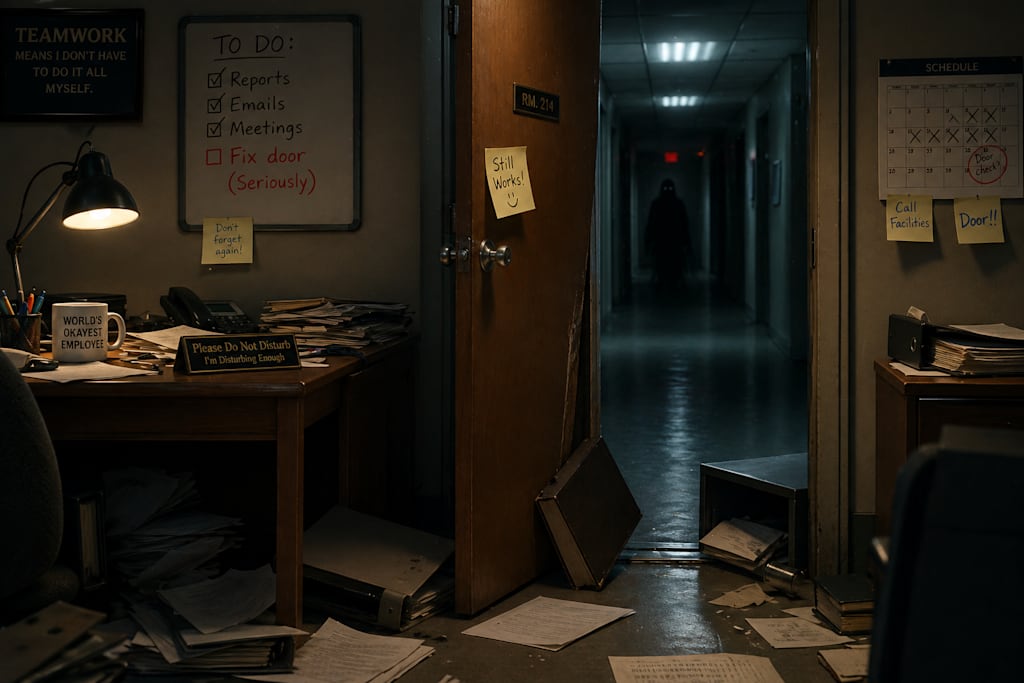
I’m sorry about the door.
I should have mentioned it sooner. It’s just that when it first happened, it didn’t seem like something worth escalating. The handle came loose, that’s all. Not completely - just enough that it turned a little farther than it should have.
I assumed it was wear and tear.
I tightened it. Or I thought I did. It held for a while, which felt like confirmation. You know how these things are - small maintenance issues, easily handled, not really anyone’s concern beyond the person who notices them first.
That’s why I didn’t report it.
Also, at that stage, the door still opened.
Which, I think we can agree, is the primary requirement of a door.
It was only later that it became slightly more complicated.
By "slightly," I mean that the handle stopped returning to its original position. You could still open the door, but you had to be deliberate. A bit more pressure. A certain angle. It responded better if you didn’t hesitate.
Again, nothing alarming.
I adjusted.
We all adjust.
The first real issue, if we’re being precise, wasn’t the handle. It was the latch.
Sometimes it would catch.
Sometimes it wouldn’t.
I noticed it most in the evenings, when the building settled. There was a kind of delay, like the door was considering whether it wanted to close at all. I would push it, wait, then push again.
Usually, it worked by the second attempt.
Occasionally, it required a third.
At that point, I began to suspect that something deeper might be misaligned.
Still, the door functioned.
And it didn’t seem urgent enough to involve Facilities, especially given their current backlog and the fact that, if you recall, the elevator had already been making that noise no one wanted to define.
I didn’t want to add to the situation.
So I left it.
It’s possible that this is where I made a mistake.
In my defense, the door did not fail all at once. It degraded gradually, in ways that encouraged tolerance. You know how systems behave when they want to avoid attention - they continue just well enough to discourage intervention.
By the time it stopped closing entirely, it felt less like a failure and more like an inconvenience.
At least at first.
The problem with a door that doesn’t close is not the door itself. It’s what it implies.
For example, airflow.
I hadn’t considered airflow.
When the door remained open overnight, there was a noticeable shift in temperature between the corridor and the room. Papers moved slightly. Nothing dramatic - just a subtle rearrangement, as if the room had begun to participate in a conversation I couldn’t hear.
I started placing objects near the threshold to compensate.
A chair at first.
Then a stack of binders.
Eventually, the metal cabinet.
This was not ideal, but it created enough resistance to simulate closure.
You might argue that at this point I should have reported the issue.
And you’re probably right.
However, by then, the situation had acquired a certain internal logic. The door didn’t close, so I adjusted the environment. The environment stabilized. The need for intervention diminished.
Until the night the cabinet shifted.
I want to be clear: I did not push it.
At least, not intentionally.
There was a moment - around 2 a.m., I think - when I heard a sound from the hallway. Not loud. Just enough to suggest movement.
I got up to check.
The cabinet was no longer flush with the frame.
The gap was small, but sufficient.
The door was open again.
That’s when I noticed the lights.
Not ours.
Further down the corridor.
I assumed someone had left them on. It happens. People forget. Buildings hold onto energy longer than we expect.
Still, it felt unusual.
I closed the door as much as I could - which is to say, I positioned the cabinet again - and went back to bed.
In the morning, the cabinet had moved further.
Not significantly.
But enough that the door could open wider.
That’s when the airflow became more noticeable.
Papers didn’t just shift - they relocated.
A folder I had left on the desk was now near the threshold.
Another had fallen open on the floor.
I told myself it was the draft.
It was a convincing explanation.
For a while.
The first time I saw something move directly, I did not react.
That might sound strange, but it’s true.
It happened quickly. A page lifting, turning slightly, settling again. The kind of motion you could attribute to a current of air if you didn’t want to think about it too closely.
I chose not to think about it.
This, in retrospect, was another mistake.
I realize now that the door was not simply failing.
It was allowing.
At the time, I didn’t phrase it that way.
At the time, I thought: if I can just stabilize the entrance, everything will return to normal.
So I reinforced it.
Additional weight. Better positioning. I even considered temporary sealing methods, though I admit I didn’t follow through on those, as they seemed excessive given the initial scope of the issue.
For a day or two, it worked.
The room felt contained again.
Then the sounds started.
Not constant. Not even regular.
Just occasional.
A shift. A faint scrape. Once, what might have been a footstep, though I’m aware that’s open to interpretation.
I told myself it was structural.
Buildings settle.
Materials expand and contract.
These are facts.
What complicated matters was the pattern.
The sounds corresponded to the times when the door shifted.
Not always.
But often enough to suggest a relationship.
At that point, I considered reporting the issue.
I even drafted an email.
But I hesitated.
Because how do you explain that the door no longer closes, that objects are moving, that there may or may not be something in the corridor responding to the absence of a barrier?
It seemed… disproportionate.
So I revised the message.
I removed the speculative elements.
I focused on the handle.
Then I didn’t send it.
This is where the situation escalated.
The night the cabinet moved completely.
I woke to a sound I can only describe as deliberate.
Not loud.
But intentional.
The door was open.
Fully.
The corridor beyond was lit, though I hadn’t left the lights on.
And something - this is difficult to phrase in a way that remains strictly factual - something had entered the room.
Not visibly.
Not in a way that could be clearly identified.
But the space was no longer empty.
You can tell when a room changes.
The air shifts.
The proportions feel slightly off.
I remained in bed.
This seemed like the safest option.
Eventually, the sensation diminished.
The room returned to its previous state.
Or something close to it.
In the morning, several items were out of place.
Not dramatically.
Just enough to confirm that the environment had been altered.
At that point, I sent the email.
Unfortunately, by then, the issue had extended beyond the door.
Facilities responded promptly, which I appreciate.
They inspected the handle, the latch, the frame.
They replaced what needed replacing.
The door now closes perfectly.
There is no delay.
No resistance.
No need for additional pressure.
However - and this is the part I should have mentioned earlier - the corridor no longer appears to be empty.
I don’t mean this metaphorically.
I mean that, at certain times, there is a presence.
It does not enter the room anymore.
The door prevents that.
But it remains outside.
Waiting, if that’s the right word.
I assume it adapted during the period when the door was open.
Which, to be clear, was not very long.
A few days.
Possibly a week.
At most.
I understand now that leaving the door unsecured created a condition that allowed something to establish itself.
And while that condition has been corrected, the result has not entirely resolved.
So again, I’m sorry about the door.
If I had reported it earlier, this might have been avoided.
Or at least contained.
As it stands, the door is fixed.
It closes properly.
It locks.
But I would advise, as a precaution, that it remains closed at all times.
Especially at night.
And if you hear anything in the corridor -
it’s probably best not to check.
About the Creator
Alain SUPPINI
I’m Alain — a French critical care anesthesiologist who writes to keep memory alive. Between past and present, medicine and words, I search for what endures.
Enjoyed the story? Support the Creator.
Subscribe for free to receive all their stories in your feed. You could also become a paid subscriber, letting them know you appreciate their work.
Comments
There are no comments for this story
Be the first to respond and start the conversation.