

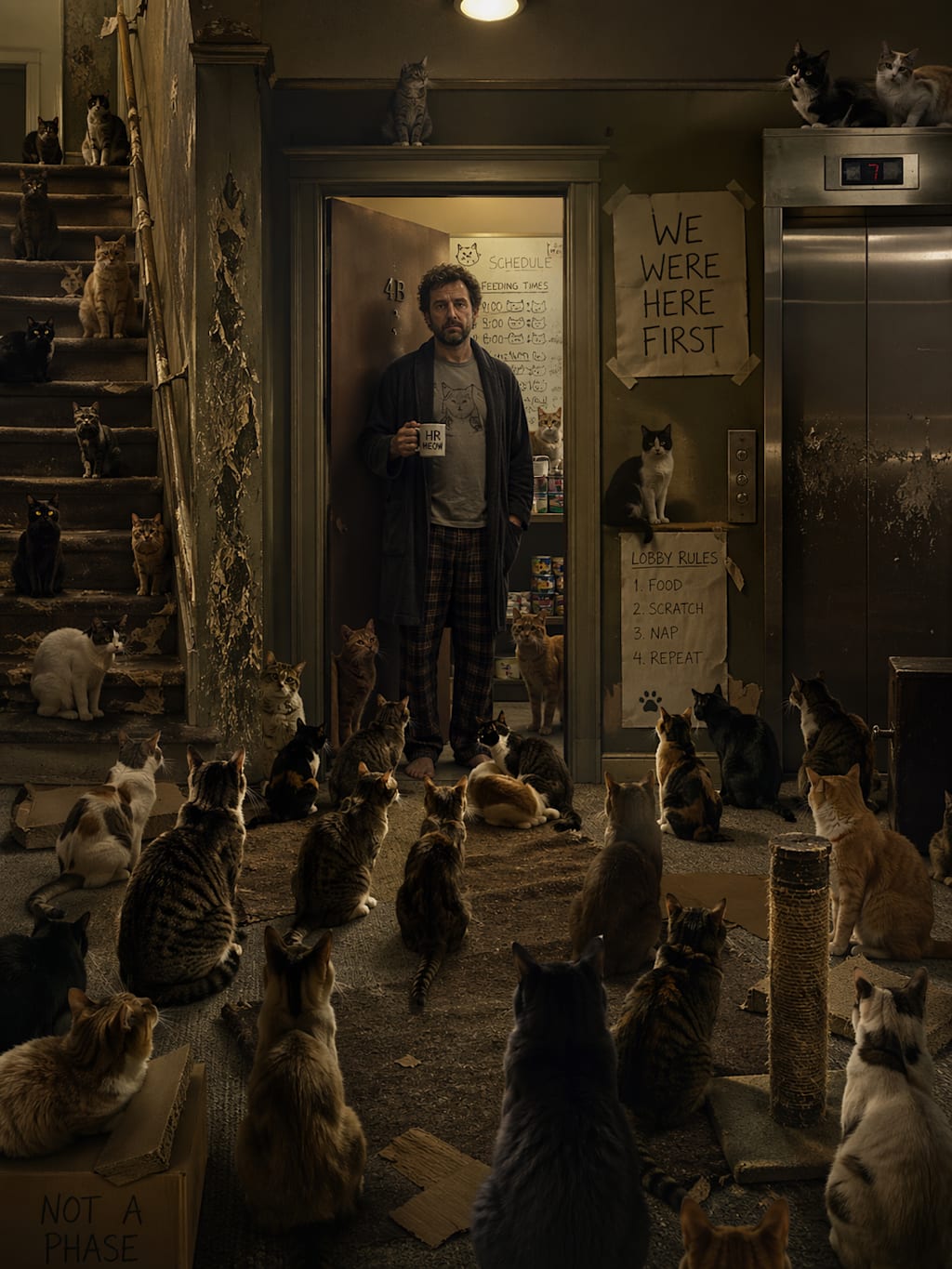
I want to begin by saying I’m sorry.
I’m aware that starting this way may sound rehearsed, but it’s important to me that you know I recognize the inconvenience, and more than that, the distress, that has resulted from my actions. I should have spoken sooner. I should have explained things before they developed to their current scale. And for that, I sincerely apologize.
At the time, it seemed like a very small decision.
In fact, it barely felt like a decision at all. More like a harmless adjustment. A minor correction. Something anyone might do, given the circumstances, which, admittedly, I did not fully consider at the time, but in my defense, the circumstances themselves were not fully formed either.
I am referring, of course, to the cat.
Not your cat, originally.
I want to be very clear about that.
The cat did not belong to you when I first encountered it. It was, as far as I could tell, unclaimed, self-possessed, and aggressively confident in a way that suggested it had either never known ownership or had long since rejected it. It entered the building through the side door—this part has been verified—and established itself in the hallway outside my apartment with what I can only describe as administrative authority.
At first, I assumed it was temporary.
Cats come and go. That is one of their defining characteristics. So I fed it once. Perhaps twice. This is where I see now that things began to deviate from what one might call “reasonable boundaries,” but I would ask that you remember: it was raining, and it looked at me.
There is a way cats look at you that feels less like a request and more like an indictment.
I responded accordingly.
I did not intend to adopt it. I did not name it. I did not invite it inside. I simply acknowledged its presence with food, which, in hindsight, was interpreted by the cat as a binding agreement.
Within three days, it had brought another cat.
I did not invite the second cat.
I did not feed the second cat initially. I want that noted. However, the second cat was smaller, and the first cat appeared to expect a degree of continuity in service. There is a hierarchy to these things. It would have been disruptive—perhaps even irresponsible—to feed one and not the other.
So I adjusted.
Again, a small decision.
By the end of the week, there were five cats.
At this point, I understand that the situation may begin to seem less like an isolated kindness and more like the early stages of a pattern. I will not dispute that. Patterns did begin to emerge. But I want to emphasize that I did not recruit these cats. There was no outreach. No signage. No digital campaign. They appeared organically, as if summoned by a logic I did not fully grasp but felt increasingly obligated to maintain.
I did consider notifying someone.
This is where I acknowledge a lapse in judgment. I thought, briefly, about contacting building management, but I was concerned that doing so might result in consequences for the cats, who, by that point, had come to rely on a certain consistency. And consistency, once established, is difficult to retract without causing distress—not only for the cats, but for oneself.
You become, in a sense, part of a system.
A system that, by the second week, included twelve cats and a schedule.
The schedule was necessary.
Without structure, things would have escalated far more quickly than they ultimately did. Feeding times were staggered. Portions were measured. I kept notes. I would argue that what I was doing, at that stage, bordered on management. Not perfect management, perhaps, but attentive.
It was around this time that the scratching began.
I am aware that this has been a primary concern for you.
The doorframes, the baseboards, the carpeting in the shared hallway—I recognize now that these were not appropriate surfaces for what became, effectively, a communal scratching initiative. However, I did attempt mitigation. I introduced cardboard. I researched alternatives. I even, at one point, ordered a scratching post, though I will admit that it arrived in a form that required assembly, and the cats expressed little interest in the process.
They preferred the walls.
This is not something I encouraged.
I want to be absolutely clear: I did not direct the cats to scratch the walls. They arrived at that conclusion independently, possibly through observation, possibly through consensus. Cats are, in many ways, more organized than we give them credit for.
By the third week, there were twenty-seven cats.
This number has been disputed, but I stand by it.
I had begun to recognize individual personalities. There was one with a limp. One that only appeared at night. One that refused to eat unless observed from a distance, as though privacy were a condition of its participation. I found myself adjusting not just quantities, but strategies.
At no point did I feel in control.
I think that’s important.
From the outside, it may appear that I was orchestrating this, that I was somehow expanding operations, but the reality was far more reactive. I was responding to needs as they presented themselves. And they presented themselves frequently.
It was not until the delivery incident that I realized the full scope of what had developed.
The driver refused to approach the door.
This, I now understand, was reasonable.
From his perspective, there was a visible congregation of animals—alert, expectant, unified in a way that might be described as… coordinated. He remained at a distance. I attempted to reassure him, but communication broke down, as he seemed unwilling to accept my explanation that the cats were, for the most part, independent contractors.
That was poorly phrased.
I accept that.
The food was left on the sidewalk.
This created a logistical challenge.
Transporting multiple bags through a group of increasingly invested cats requires a degree of negotiation that I was not, at that time, fully equipped to handle. There was movement. There was sound. At one point, I believe there was chanting, though I cannot confirm that definitively.
It escalated.
And this is where I must address the lobby.
I understand that the situation in the lobby was unexpected.
It was unexpected for me as well.
The door had been left open—this is not an accusation, simply a statement—and the cats, having grown accustomed to a certain proximity, interpreted the open door as an invitation or perhaps a progression. They entered.
I did attempt to redirect them.
I used verbal cues. I used gestures. I even, briefly, attempted to establish a perimeter. But momentum had already built. Once a group reaches a certain size, individual influence diminishes.
They spread out.
There was exploration.
There was, I will admit, a moment in which one of the cats positioned itself behind the front desk in a manner that suggested oversight. That was concerning, even to me.
I should have intervened sooner.
I see that now.
But by the time I fully grasped the symbolic implications of a cat occupying a position of authority, the others had already begun to mirror the behavior. It became less about individual placement and more about a broader shift in dynamics.
The building, briefly, belonged to them.
I did not intend for that to happen.
I want you to believe that.
I never set out to alter the structure of daily operations or to create an environment in which residents would feel, as you described, “outnumbered by something with whiskers.” That phrase has stayed with me. It is vivid. It is, unfortunately, accurate.
I take responsibility for my role in allowing things to reach that point.
I also want to acknowledge the cleanup.
I did participate in the cleanup.
Perhaps not as quickly as you would have liked, and certainly not as effectively as the situation required, but I was present. I brought supplies. I made an effort. I learned things about odor that I did not previously know.
Growth occurred.
Since then, I have taken steps.
The feeding has stopped.
This was not easy.
There were expectations. There were routines. There were, I believe, emotional bonds that had formed, though I hesitate to assign human frameworks to feline behavior. Still, the adjustment has been significant—for all parties involved.
The number has decreased.
Gradually.
They still visit.
Not all at once, and not with the same intensity, but there are reminders. A glance. A shadow. A presence that suggests that while the system has been disrupted, it has not been entirely dismantled.
I am working on that.
Responsibly.
With boundaries.
In closing, I want to reiterate my apology.
I understand that what began as a simple act has resulted in consequences that extend far beyond what anyone could reasonably anticipate. I regret the impact this has had on you, on the building, and, in some cases, on the furniture.
If there is anything further I can do to repair the situation, I am open to discussion, provided it does not involve reintroducing food-based incentives.
That, I have learned, is where things begin.
And, as we have all now seen, where they very quickly do not end.
I'm sorry.
About the Creator
Violet Hamilton
Harlem born. Author of Shark Weak. Wrote multiple Award-Winning Cast and Crew screenplay "What If" and "Trickster." Educated. World traveler. I now reside in Long Island, New York. I adore writing. It's the only time I get to play God.
Enjoyed the story? Support the Creator.
Subscribe for free to receive all their stories in your feed.
Comments
There are no comments for this story
Be the first to respond and start the conversation.