
You Don’t Owe Forgiveness to the Person Who Hurt You
How to leave the low point without letting the injury keep setting your schedule.
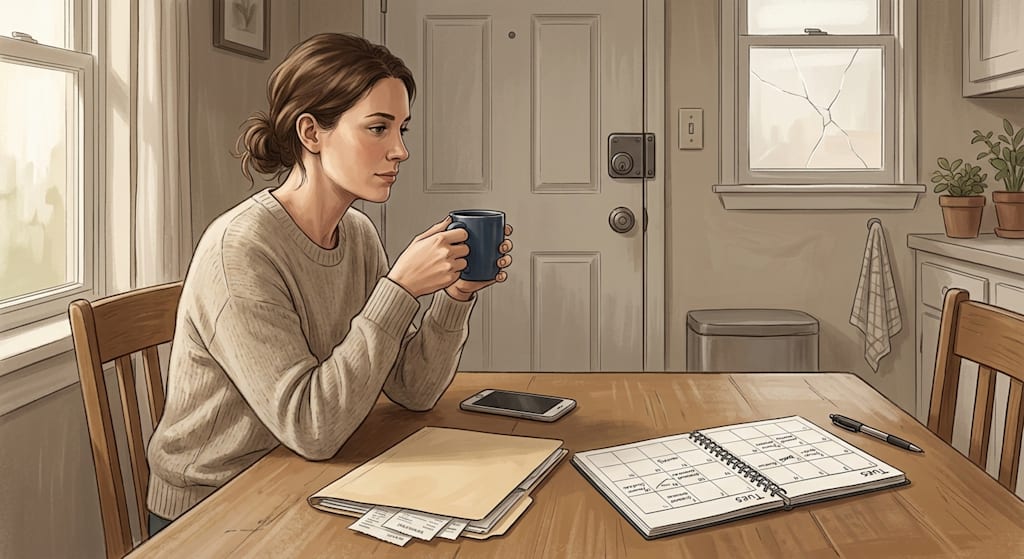
A friend asked me this last week, then corrected herself. “No,” she said. “Don’t answer yet. Tell me what you do with the anger on a Tuesday.”
That second question is sharper. The first one sounds like a verdict: low point survived, forgiveness granted, case closed. Real life is messier. You can be out of the worst of it and still flinch when a certain name lights up your phone. You can sleep through the night and still not want that person at your table. You can stop crying in the car and still keep the screenshots.
So no, getting out of the low point does not come with a forgiveness requirement. The exit sign does not read “Forgive.” It reads “You can leave now.”
Forgiveness Is Not the Exit Sign
People treat forgiveness as the diploma you need before you can say you have recovered. No diploma, no graduation. But a diploma on the wall does not stop someone from walking through your front door. A lock does.
The useful test has nothing to do with whether you can say “I forgive you” without your jaw tightening. The useful test is whether the person still gets to set your schedule. Do you check their social media at midnight? Do you rehearse old arguments in the shower? Do you take the long route home because their car might be parked on the short one? If the answer is yes, the work is not about producing a generous sentence. The work is about taking back the calendar.
You can skip forgiveness and still be out of the low point. Hatred is optional too; the boundary is not. You can say, “I understand why you did it,” and also say, “You do not get access to me.” Those sentences can live in the same body.
Forgiveness, reconciliation, trust, and accountability are four different things. Forgiveness can be a private decision. Reconciliation needs the other person to admit damage and change behavior. Trust needs time and evidence. Accountability needs records, boundaries, sometimes a lawyer. Mixing all four into one word is how people end up exhausted. They think they have failed at forgiveness when they have only failed at trusting someone who has not earned it.
The Test Is Who Controls Your Tuesday
A low point stretches past the week everything fell apart. It includes the months after, when the crisis is over and ordinary days arrive. The empty Sunday. The work meeting you sit through with a calm face. The grocery store where you run into someone who knows both of you and asks a question you have learned to answer in one sentence.
The person who hurt you does not get a permanent seat in your head just because you have not forgiven them. They also do not lose that seat the moment you decide to be noble. The seat is lost through small, repeated actions: you delete the number, you stop rereading the message, you go to the appointment, you tell one friend the true version, you put the documents in a folder and stop opening the folder at 2 a.m.
If you still flinch when their name appears, that is information, not failure. A scar is not a moral defect. It is a record of where the skin closed. You do not have to sand it down to prove you have moved forward.
“I Was Hurt Because I Was Not Strong Enough” Is Half a Sentence
There is a popular sentence: “I was hurt because I was not strong enough. What hurts me makes me stronger.”
The first half is dangerous if you keep it whole. Being hurt does not prove you were weak. It proves someone chose to cross a line, or that you were in a room where the power was not equal. A child is not weak because an adult shouts. An employee is not weak because a manager lies. A person in love is not weak because they trusted someone who turned out to be careless with that trust.
Strength shows up as noticing the boundary, stopping the loss, asking for help, keeping records, and letting yourself cry without turning the cry into a verdict about your worth. Strength is also knowing when to leave a room, a contract, a family pattern, a group chat.
The second half of the sentence has value, but it needs a correction. Pain can become experience. It does not automatically become wisdom. A fall can teach you where the uneven pavement is. It does not mean the pavement was good for you. You can take the lesson and still send the repair bill to the person who broke the window.
Anger Is a Signal, Not a Residence
Do not force yourself to stop being angry before you have listened to the anger. Anger often arrives with useful information: that was unfair; that was unsafe; that person does not respect a no; this arrangement costs more than it gives.
The first wave of anger is fine. The damage comes when you turn it into a residence. You move in, put up curtains, and start explaining the furniture to everyone who visits. You rehearse the argument for a year. You write the perfect reply and never send it. You make the injury the center of your personality, and then you wonder why the low point keeps following you.
A better use of anger is to convert it into a boundary and a task. Write the timeline. Save the receipt. Cancel the card. Ask a friend to sit with you while you send the message. Book the appointment. Put the phone in another room at night. The goal is to stop letting the feeling do all the driving, not to feel nothing.
Gratitude Has a Boundary
You can learn from an injury without thanking the person who caused it. Many people get stuck here. They hear “everything happens for a reason” or “she was your teacher” and feel guilty for not feeling grateful. Gratitude is not a debt you owe to someone who hurt you.
Thank the friend who answered the phone. Thank the doctor who explained the scan. Thank the colleague who told you where to find the form. Thank yourself for getting out of bed on the day you wanted to stay under the blanket. Thank the version of you who kept the evidence even when you were tired.
The person who broke the window does not get credit for the glazier. The lesson has value. The harm still has a cost. You can hold both.
Different Losses Need Different Receipts
“Forgive and move on” sounds clean because it treats all injuries as the same size. They are not. A rude comment and a stolen year are not the same. A broken promise and a broken contract are not the same. A bad week and a lost career are not the same.
If the loss is money, keep the receipts, the messages, the bank records. Ask what can be recovered and what must be written off. Do not use forgiveness as a substitute for accounting.
If the loss is reputation, save the screenshots. Correct the record where it matters. Tell the truth to the people who need it. Stop auditioning for people who have already decided what they want to believe.
If the loss is health, go to the appointment. Take the medication. Ask for the second opinion. Rest. Tell someone what is happening. A moral lesson does not replace a medical plan.
If the loss is opportunity, document the closed door. Ask for feedback in writing. Look for another entrance. Grieve the time you lost. Then put the dates on a calendar and decide what the next application will say.
If the loss is love, name the boundary and stop auditioning for someone who already showed you the script. You can miss the person and still not open the door. You can remember the good parts and still not call.
None of this requires hatred. None of this requires a public statement. It requires a folder, a calendar, a friend, a professional, a locked door. The practical steps are not the opposite of recovery. They are how recovery stops being a mood and becomes a structure.
The Dots, the String, and the Hand
Steve Jobs said it well in his 2005 Stanford commencement speech:
You can’t connect the dots looking forward; you can only connect them looking backwards. So you have to trust that the dots will somehow connect in your future. You have to trust in something — your gut, destiny, life, karma, whatever. This approach has never let me down, and it has made all the difference in my life.
The line is useful because it gives permission to not understand the meaning of a hard year while you are inside it. Time does not turn every injury into a pearl. Time gives you a room. What you put on the table in that room changes the shape of the story: the medical record, the budget, the message you finally send, the friend who sits with you, the afternoon you spend filling out a form instead of rereading an old thread.
The dots do not connect by themselves. The hand that strings them is yours. A few will stay ugly. Others will become useful. One may become a warning sign you put on the road for the next person, or for yourself.
After the Low Point
So do you have to forgive the person who hurt you?
No. Forgiveness can stay off the table. Hatred can stay off the table too, and the boundary can remain. A private forgiveness does not require reconciliation. Forgiveness does not require trust. Trust returns only after the other person has done the slow, boring work of change.
Ask instead whether you are done letting the injury set your schedule. You answer that one on a Tuesday, not in a speech.
The message can stay unanswered. The receipts stay in the folder. The door stays locked. You go to work. You eat lunch. You call the friend back. You do not need a diploma for that.
About the Creator
Jin
Writer of reamstories
https://reamstories.com/jin
Enjoyed the story? Support the Creator.
Subscribe for free to receive all their stories in your feed. You could also become a paid subscriber, letting them know you appreciate their work.
Comments
There are no comments for this story
Be the first to respond and start the conversation.