
The Last Train: What I Saw in an OB/GYN Clinic When Women Over 35 Were Told Their Pregnancy Couldn’t Be Saved
I was a resident in Melbourne’s west. Every day, I watched women run for a train they were terrified to miss.
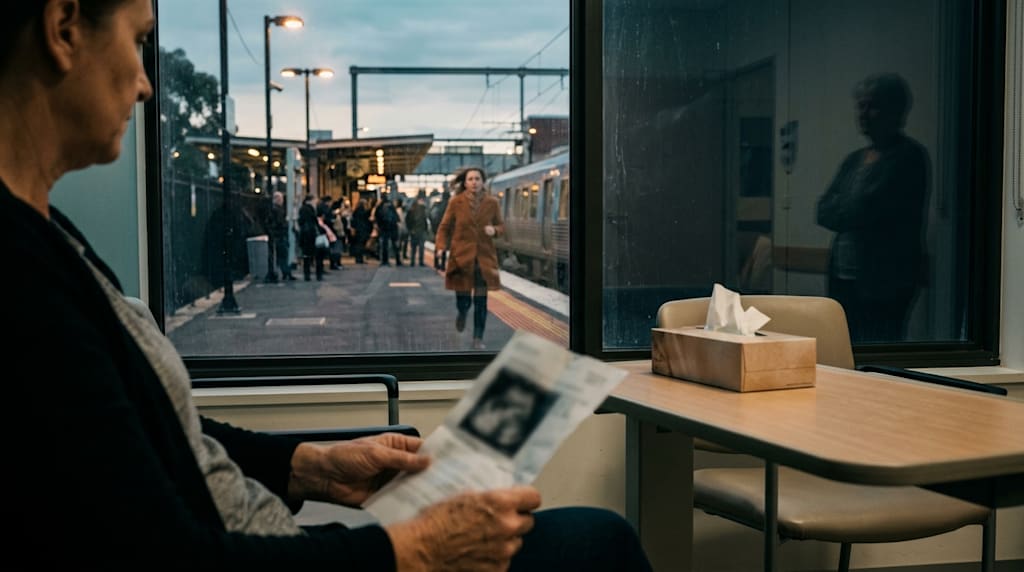
The clinic door closes. Outside is the three o’clock sun of Melbourne’s west. Inside is air conditioning and a table with a box of tissues.
The tissues are for them. I learned to put the box on the patient’s right side, closer to her, farther from me. She could reach it without looking at me. Without checking whether I pitied her, whether I was tired of her.
My supervisor said: Let her in. Tell her the pregnancy cannot be saved. Let her cry for ten minutes. Then talk.
At first I thought ten minutes was cruel. Some women needed longer. Some cried from the moment they sat down until the only sound left was the air conditioner. Some asked every medical question first. Then, standing to put on their coats, they crouched and held their bellies and made a sound I still cannot describe.
I heard it many times. I never knew what to do. I pushed the tissues closer.
My patients were roughly three kinds.
First, women who had miscarried their first pregnancy. Young, usually in their twenties. They came in hoping. If the doctor called me, something can be done. When I finished, they froze, then cried. Loud, direct, like a child who has fallen. That crying was easier. They still had something underneath. They had a next time. The next time would be fine.
Second, women who had miscarried several times. They already knew. They knew the process. History, examination, options, appointment. They did not cry. They nodded. Said okay. Said I know. Said it was like this last time. The visit ended in ten or twenty minutes. Not because they felt less. They had felt too much. They had learned to fold it up and put it in a drawer. Only they heard the drawer close.
Third, older women. Women who had done IVF. Women whose pregnancies had failed again and again. Their eyes were red when they came in. They had cried in emergency, in the car, before sleep the night before. They sat with their hands on their knees, fingers gripping their trousers, knuckles white. They asked: Doctor, is there still hope?
I said no.
Then they collapsed.
That collapse was different. The younger women cried for this time. These women cried for all the times. Three years of injections. Egg retrieval. The fourteen days after transfer when they lay still, afraid to move. Every pregnancy test that never showed the line. The money. What the mother-in-law said last night. The silent back of the husband in the living room. Themselves. This forty-three-year-old body that had stopped obeying, that had betrayed them.
They asked the same questions: What did I do wrong? What should I watch next time? How many chances are left?
I did not know how to answer. Textbooks list success rates, age curves, chromosomal abnormality probabilities. They do not say how to face your body failing again and again. They do not say how to keep living on an afternoon when you have lost a child.
The west was an immigrant neighborhood, largely Indian. Many women had little education. Their families held traditional values. Often the mother-in-law came too. She sat beside her daughter-in-law, arms crossed, looking at me. Then at the patient.
“You would not listen. A few years ago you refused. Now look.”
“You ate so much ice. I told you.”
“Our family has only one son.”
I saw one mother-in-law, while the patient was still bleeding, say: If you cannot give birth, my son cannot have no heir. The patient sat there, hands trembling. She had just lost a six-week pregnancy. She had just heard me say: no fetal heartbeat. She had not cried yet. Then her mother-in-law began. Then she began calculating what the patient had cost the family.
After that I made a rule. Except for the husband, no family in the room. The nurse asked why. I said no reason. I could not explain that I was watching a woman who had just miscarried being publicly executed by her own mother-in-law, and the only thing I could do was say: Auntie, please leave.
Medicine deals with the body. Suffering lives in the family. In that mother-in-law’s mouth.
Why do so many women over thirty-five suddenly fight to have a child? They know the risks. Injections, medication, just to get pregnant. Is this child something they must have?
I thought about it for a long time.
They do not suddenly want it. A wish that always existed, postponed, is triggered by something. A birthday. A number on a health report. Peers posting pregnancy announcements. A relationship finally stable. Or waking one morning with a ding in the head: now. Otherwise, never.
The desire has been there a long time. It breaks through when the ground is about to freeze.
One patient said: Doctor, I used to think having a child was an option. Now I think it is the judgment on my life. If I cannot give birth, my whole life is a failure. She was clutching an ultrasound report. On it was an empty gestational sac.
I wanted to argue. I wanted to say her life was not decided by this. I could not. In her world, in the home she returned to, in her mother-in-law’s eyes, in her husband’s silence, her life was decided by this. At least, that was what she had been told.
Women having children late are like people running for the subway.
When you are young, missing a train means waiting five minutes. You miss one after another. Career. Fun. Uncertainty. Then you realize this train, or the next, may be the last. You run. You run on the platform, on the stairs, through the crowd. You have to catch it.
If you do not, you take a taxi home. Or you sleep on the street.
The taxi is IVF. High cost. Thirty percent failure.
The street is never becoming a biological mother. Tense family relationships. A broken relationship with your mother-in-law. Discrimination from relatives. Your husband’s silence. Every night, your own judgment of yourself.
A small Israeli study found that among mothers who had experienced failed IVF, 9.4 percent had suicidal thoughts. An older Guardian article reported that 50 percent of infertility treatments are unsuccessful, and 20 percent of couples who cannot have a child have had suicidal thoughts.
These numbers are the women in the clinic who cried until they could not speak. Their question: Why me? The silent dinner table at home. The accusing eyes. The judgment of a world.
They know the risks. They know better than anyone. After thirty-five, chromosomal abnormalities rise. Gestational hypertension, diabetes, premature birth. They know what injections, medication, egg retrieval, transfer, pregnancy maintenance mean. Their bodies have been pierced, thrown into chaos by hormones, torn between hope and disappointment. They know too clearly.
But risk calculation collapses in the face of running out of time.
When a person still has countless next times, she can weigh things. When she feels this is the last train, reason steps back. Fear and longing move forward. She is not calculating whether it is worth it. She is asking: If I do not try, will I hate myself later?
After multiple miscarriages or IVF failures, having a child stops being just “wanting a child.” It becomes proof that she is whole, that she controls her fate, that her life continues. Their lives fill with fear and self-blame. They ask what they did wrong. The failure has become a doubt about their worth. My body betrayed me. My function as a woman is incomplete.
So continuing treatment becomes an act against that doubt. Stopping feels like admitting the incompleteness is final. Like accepting society’s verdict. What is “must have” may not be the child. It may be a complete identity, recognized by herself, her family, her society.
If you saw only the half hour in the clinic, you would think they were crazy. If you saw where they returned to, you would understand. They run from a life judged as failure, toward a child they hope will save them.
Social pain often kills before medical risk does. In places where infertility is stigmatized, it brings social exclusion, emotional distress, suicidal thoughts. The Israeli study found 9.4 percent. The Guardian article found 20 percent of childless couples with suicidal thoughts. Behind those numbers is the trauma of losing a child, public blame from those closest, and the fear of losing your place in the family.
Later I refused to let family members other than the husband into the room. I was not disrespecting family. I was protecting a woman who had just lost a child. For one hour, she would not face both the medical verdict and the family’s judgment.
Medicine treats the body. Suffering lives in society, in time, in the self.
When someone asks, do they not know the risks, is this child a must, I think of that clinic room. They know. They know better than anyone. They stand at the door of the last train. Behind them the platform closes. Beneath them the tracks. Ahead, darkness. You cannot convince someone who may never get another train with “you can take a taxi.”
There was one patient, forty-one, who had done IVF three times. All failed. The last time she came, she no longer cried. She asked calmly: Doctor, if I stop treatment, what else can I do?
I said, you can rest.
She smiled a little. Rest. And then?
Then she stood, picked up her bag, said thank you, and left. I do not know what happened later. I remember the smile. That smile is what is left when a person has cried all her tears.
Do not urge kindness on someone whose suffering you have not endured.
I am not asking anyone to abandon reason or deny personal choice. Freedom of choice requires a bearable cost. For women running under last-train anxiety, family pressure, and the social gaze, what they face may never have been a free multiple-choice question. It is a survival question with almost no choice.
I am still grateful for that experience. It made me less quick to judge. It taught me that under labels like older mother, IVF failure, three miscarriages, there are specific people. So specific that they cry for ten minutes in a clinic room. Then dry their tears and ask: Doctor, what should I pay attention to next time?
What they run toward is an answer, in the world they live in, to the question of what they are.
And there is one thing we can do.
Do not stand on the platform pointing at those who run with all their might.
Slide the tissue box a little closer to her.
About the Creator
Jin
Writer of reamstories
https://reamstories.com/jin
Enjoyed the story? Support the Creator.
Subscribe for free to receive all their stories in your feed. You could also become a paid subscriber, letting them know you appreciate their work.
Comments
There are no comments for this story
Be the first to respond and start the conversation.