
The Great Debate: Does the Four-Day Workweek Save the Frontline, or Is It the Start of Hell? (Part 2)
Compassion and resentment collide — and the abyss beneath "what it means for a human being to work"

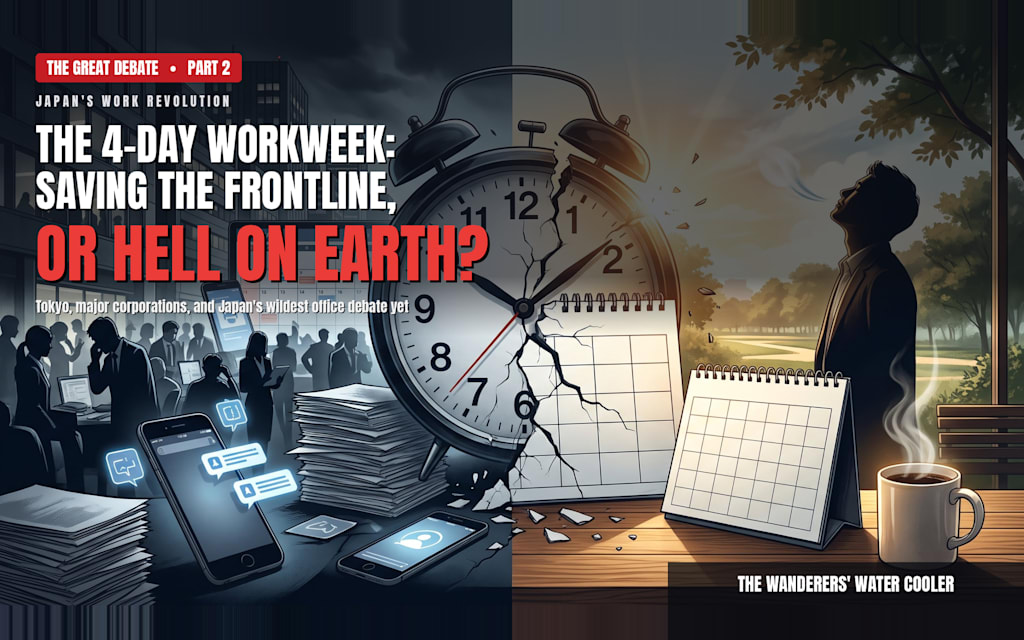
The background events referenced in this piece (Tokyo Metropolitan Government's and other Japanese local governments' and companies' adoption of selective four-day workweek systems) are real and verified. The commentary and debate that follows is entertainment and satire, not journalism.
Cover image created using an AI image generation tool (Gemini/Claude).
This is Part 2 of a two-part debate. [Read Part 1 first →]
In Part 1, Rearin the realist, Oyassan the old guard, Miruyo the mystic, and Toshio the conspiracist argued over whether Japan's new four-day workweek experiments were a genuine relief for the frontline or just a calendar trick dressed up as reform. Here, two more voices join the table: a bodhisattva who sees only compassion in the struggle, and a devil who sees only humanity's ugliest instincts. A final voice steps back to make sense of the whole thing.
Round Two of the Debate — Compassion and Resentment Collide: The Abyss Beneath "What It Means to Work"
THE SAGE — Bosacchii
Palms pressed together. Everyone, I bow deeply before the sincerity underneath your passionate words.
Oyassan's talk of "duty to your coworkers," Rearin's "struggle on the frontline," Miruyo's "blank space for the soul," Toshio's "watchfulness toward the unseen" — every one of these is born from the same pure light: people wishing to live better.
From where I sit, this experiment with the four-day workweek looks like a precious opportunity for society as a whole to relearn the spirit of jita-ichinyo — the self and others as one.
Demanding perfection from the system itself is where the suffering comes from, but that was never the essence of the matter. When someone takes their day off, the person covering for them isn't simply a sacrifice — they're practicing a form of generosity, of dana, in supporting a fellow worker. And the person who rested carries deep gratitude for that support in their heart. When this gratitude and this compassion flow back and forth between people, the workplace stops being a battlefield and becomes something closer to a shared path where people care for one another.
And how you spend that extra day off is itself full of light. Connecting with family is an act of love. Caring for a parent or child is a merit in itself. Devoting yourself to new learning or a hobby is its own discipline. The richness of life cultivated there circulates back, eventually, as warmth and vitality in the workplace too.
Rather than getting trapped in suspicion over the number of days on a calendar or the system's imperfections, ask yourself: how will you use the time you've been given, for the wellbeing of others and of yourself? If each person holds that single flame steady at their own feet, I believe it will, without fail, grow into a path of real compassion that warms everyone around it.
THE DEVIL — Akuman
Kuh-ha-ha-ha! The stench of it makes my skin crawl — a filthy little monk draping humanity's ugliness in pretty words to hide it, same as always!
Do you actually believe, in your heart, that humans carry some beautiful soul like that? What's really sitting in the belly of the person covering for you isn't compassion. It's a pitch-black resentment and jealousy — "why does it always have to be them who gets to rest, and me stuck cleaning up after it."
The person taking the day off feels gratitude for about five minutes, tops — and then it curdles into entitlement: "resting is my right." To cover their own guilt over leaving work unfinished, they start hunting for their coworkers' flaws. Mouth says "thanks so much, always" with a bow — and behind your back, it's "useless to the core, the department always stalls out the second they're off."
This whole system's true nature is a wonderfully crafted trap — bait people in with a sweet word like "fairness," and drop human beings straight into a hell of mutual suspicion. Who's working how much, who's slacking off — everyone watching each other in secret, dragging each other down, tattling behind closed doors... Inside the narrow cage called an office, coworkers feed each other a slow poison of mutual hatred!
Why do you check your phone on your day off? Not because you care. It's because you're chained by the terror that while you're gone, a coworker is stealing your position, whispering behind your back! Give human beings any blank space at all, and they'll do nothing but get devoured by their own ugly cravings and loneliness. The workplace is no temple of compassion — it's a bottomless pit of people eating each other alive. Go on, give them more days off, let them curse each other even harder! Kuh-ha-ha-ha!
THE OLD GUARD — Oyassan
Tch! Spouting your usual theory-pretzel garbage — King of Hell, my foot, don't you dare talk down to the human heart!
A sideways little gremlin like you, sneering at the world from an angle — you'll never understand it in a hundred lifetimes. People ain't the saints you keep demanding they be, no — but they ain't the sewer rats you make us out to be either!
Sure, when you're stuck covering for somebody, a gripe slips out now and then — "tch, why's it always gotta be me." We're human, not Buddha, nobody's grinning ear to ear every single day. But come the next day, if the one who got covered hands you a can of coffee and bows their head and says "sorry about that, thanks for the save" — "ah, forget it, we're square" — laughing it off and letting the water run clean, that's the warmth of people actually living and working together!
You think a workplace runs on moth-eaten theories like jealousy and resentment? We got here, as a country, grinding through sweat and friction and sharing meals out of the same pot — that's how this place climbed as far as it has!
Sure, some half-baked system dreamed up by the suits is making the frontline tense, I won't argue that — but whether coworkers turn into monsters eating each other alive, that ain't a problem with the system. That's about each person's own backbone and their own character!
You got time to sit there sneering at folks' hardship — go cool off that ice-cold backside of yours and come back when you've got some manners, you bottom-feeding gutter rat!
THE DEVIL — Akuman
Kuh-ku-ku... Ha-ha-ha-ha! Bark away, old fossil! It's exactly that "warmth of a can of coffee" nonsense you keep hiding behind that's dragged you people this low!
"We're square"? Don't make me laugh! The second someone bows their head and smiles, behind that very same back comes an ice-cold stare — and a man your age, soft in the head from the Shōwa fantasy, never even notices it! Mouth says "don't worry about it," while the inner ledger keeps a precise tally of every debt owed — and at the bar after hours, it's "that one always rests too much," served up as a little snack of complaint. That is the true face of the "human decency" you people love to praise!
Puffing up your chest about "backbone" and "character," pretending not to see the cracks in the system — that's exactly the road to ruin for a fool already circling the drain. Look at the reality: the people on the frontline are wearing thin, minds breaking down, drowning in suspicion. That very stubbornness and sentimentality of yours is what's been fertilizing the soil of this surveillance hell, where everyone watches everyone else.
That "warmth" you keep going on about is nothing but a cheap narcotic, numbing you to the cold reality in front of your face. Go ahead — dress it up however prettily you like, and try to save the hearts of young people crumbling one after another! No matter how many beautiful words you pile on, jealousy and resentment are already yawning open at your feet like an abyss! Ka-ka-ka!
THE OLD GUARD — Oyassan
The hell did you just say, you little punk! Mock Shōwa all you want, see how much nerve that takes!
Calling it a narcotic, a fantasy, spouting off like you know everything — listen here! It's because of the Shōwa sweat and tears, drinking down muddy water and gritting our teeth through it, that you lot get to sit there comfortable, complaining about your soft little problems in a country that can actually afford them! We built this nation up from nothing so people could eat — and some demon with no business speaking calls the forerunners who busted their backs for it "ruined," calls it a "fantasy"? Watch your mouth!
People running on petty, penny-counting calculations, loans and debts and quiet grudges — that's exactly what rots a person's character. Our decency never ran on cost-benefit. Your coworker's struggling right in front of you, you lend a hand, no theory required. Next day they say "sorry about that" — that clears the slate clean, no residue left in your gut. That's what makes a man, that's what backbone looks like!
Don't you dare threaten people with talk about "cracks in the system" and clever little word games! A gutless little devil like you, who's never done a day's honest work, picking at people's hearts from the shadows — you think you understand the real strength it takes to live, sweating and covered in mud?
If there's a young one out there about to break, before some monster like you gets its fangs in them, we'll feed 'em a good meal and slap 'em on the back and send 'em forward ourselves! Get down and grovel, you sewer-dwelling catfish, and come back when you've learned some respect!
THE SAGE — Bosacchii
Namu Amida Butsu... Namu Amida Butsu... Oyassan, and you too, Lord Akuman — I ask you both, please, loosen that clenched fist, and take a breath.
Watching the two of you spark against each other like this, to this humble monk, it looks like nothing but the reverse side of a deep love and attachment to humanity.
Lord Akuman's sharp words are no mere malice, I think. Precisely because you see, more clearly than anyone, the loneliness people carry, the resentment they swallow, the weakness no one speaks of, you cry out from the depths of the dark: "don't paper it over with pretty stories — look at who's actually suffering." No one who doesn't know people's pain could speak so vividly of their karma.
And Oyassan. Your anger is nothing but that same burning compassion — the blood you once shared with your coworkers, the overflowing wish to somehow save the young people struggling and falling today. Behind that gruff bark, I can feel just how deep your prayer for them runs.
Buddhism has a teaching: bonnō soku bodai — that earthly desire and enlightenment are not two separate things. The wisdom with which Lord Akuman lays bare the darkness and ego of human nature, and the muddy, warm-blooded humanity Oyassan carries in his chest — these are not enemies meant to oppose one another. They are the two wheels of a single cart, both needed for people to find true salvation.
It is precisely because Lord Akuman knows the depth of the shadow that people can be checked before their own complacency goes too far. It is precisely because Oyassan carries the heat of light that people can turn and face forward again from the edge of despair.
So please — don't think of each other as enemies to be destroyed. Let this fierce clash of souls become a sacred dialogue, one that helps the struggling masses find their own way forward. Palms together.
THE DEVIL — Akuman
Kuh-ha!... Kuh-ha-ha-ha-ha! It makes me want to retch, that "two wheels of a cart" nonsense! Dragging out some convenient piece of Buddhism to mix mud and fine liquor together and call it the same thing — don't you dare disguise it like that!
What you're doing isn't compassion. It's plain and simple escapism. You don't have the courage to stare into the depths of the darkness, and you don't have the resolve to withstand the heat of the flame — so you perch yourself somewhere high and declare "both sides are precious," dressing it up in pretty language to hide inside a lukewarm harmony!
Look at this withered old face in front of you! Your flimsy little act of peacemaking doesn't even scratch the surface! The resentment and jealousy humans carry isn't something that disappears with one watered-down little prayer — it is not that shallow! Behind their backs they're spitting at each other, tripping each other up, all while smiling to your face and papering it over with "we're square" — and that accumulation is exactly what built this warped society we're standing in now!
Cling to the sweet fantasy that light and dark exist in harmony, and you humans will never once face your own weakness honestly. No matter how old fools like this one crow about "feeding people and slapping their backs," that's the exact same thing as looking away from the reality that his own Shōwa-era bullying is suffocating the young even further!
Monk, ring your bells and pray all you like — it changes nothing about this world being a battlefield where you eat or get eaten. Don't try to round it off neatly, don't play the clever peacemaker! Hate each other thoroughly, lay your own rotten ego bare, and despair completely — only then does a human being finally learn their true nature! Kaa-ha-ha-ha-ha!
THE REALIST — Rearin
Whoa, whoa, whoa, hold on, everyone! You've left me completely behind here!
Wait... does anybody even remember what we were originally talking about!? This was supposed to be a plain news story about municipalities and big companies starting selective four-day workweek trials!
How did we go from "four-day workweek" to a sweeping history lesson about Shōwa sweat and tears, and then straight into some end-of-the-world manga battle about "humanity despairing and discovering its true nature"!? The scale's gotten so enormous a regular office worker like me can't even keep up with the jokes anymore!
Akuman's talk of coworker jealousy and backroom ugliness, Oyassan's talk of canned coffee and human decency, Bosacchii's talk of caring for one another — yeah, sure, each of those is probably a real facet of office life. In practice, covering for someone leaves you grumbling, getting helped out feels great, and kindness comes with the occasional complaint mixed in.
But honestly, for someone like me, typing away at a keyboard every single day, I genuinely don't care whether it's "light clashing with dark." I just want to know how I get through tomorrow's pile of tasks, and whether I can get home in time for a beer on Friday night, that's it.
Talk to me about the depths of the soul or the dojo of compassion, and I'm just confused. Could whoever's actually designing these policies please just concretely figure out how to cut down the frontline's workload? Do that, and honestly, I won't despair, I won't need to resent anybody, I'll just go home peacefully at quitting time. Can we please bring this back down to earth?
THE OVERVIEW — Fukan-san
Heh heh... quite the lively shower of sparks you've all been throwing. But that chaos, that shouting match — it's exactly the kind of birth-cry a society makes when it's struggling to shed an old skin and step into a new era.
Look at this whole scene from a little higher up, and a genuinely interesting pattern comes into view.
The Shōwa-era solidarity Oyassan speaks of — forged through mud and sweat — is the symbol of a "past order" that lived inside a strong, shared vessel called community. Rearin's daily cry of exhaustion is the "present body" screaming where policy and reality grind against each other. The jealousy and suspicion Akuman mocks are the shadow of self-interest and fear that no one can fully let go of. And the compassion and generosity of spirit that Miruyo's shifting winds, Toshio's watch on power, and Bosacchii's selflessness all point toward, each in their own way — that's the "possibility of the future" waiting to open up. Take away any single one of these, and what's left isn't human anymore.
But why, in the first place, do human beings get this worked up, this furious, this divided, over something as small as whether to add one extra day off a week? The answer is simple. Everyone is terrified by the same wavering question: within what kind of frame should I present my own existence to the world?
The old world used to be simple. You poured yourself into a form that was already prepared for you — work the fixed schedule, follow the fixed rules — and as long as you followed the form, the community guaranteed you a place, however hollow the contents inside you might have been.
But this "selective four-day workweek" isn't really a petty arithmetic problem about adding or subtracting a day. Since the Industrial Revolution, the near-absolute belief that human beings were bound by — time equals labor equals the value of one's existence — is finally, audibly, starting to crack.
People have always entrusted their lives to a cradle called community or company, and in exchange, had the meaning of their existence guaranteed. But now the vessel is cracking, and a blank space called "time" has been dropped into people's laps, unasked for. Faced with that blank space, some, like Akuman says, tremble before their own ugly ego. Some, like Oyassan, cling to the old bonds. Some, like Rearin, feel themselves getting crushed under the sheer weight of reality.
But there's no need to be lost. It's not that the system is immature, or that the frontline is in disarray — it's simply that the body hasn't yet learned this new way of breathing. What matters is this: don't hand the authority over your own life over to whatever square someone else assigned you on a calendar. Decide for yourself, with your own will, what you're living for, and what you're breathing for.
Light and dark, the system's flaws and all — every bit of it is just a passage point on the way to a new harmony. Only through struggling, arguing, colliding with one another can people arrive at a world where they truly live their own time.
So then — will you keep searching for the meaning of your own work inside that one extra day off?
Editor's Note: What the Four-Day Workweek Is Really Asking Us
Does the four-day workweek save the frontline, or is it the beginning of hell?
We've traced this from Japan's real, ongoing social experiment all the way through a heated debate among six commentators.
As Rearin the realist points out, Japan's current "total-hours-maintained" model is, frankly, hard to describe as anything but a stopgap — a policy that organizations without the resolve to actually cut wasted work have passed straight down to the frontline. That's precisely why the strain shows up there, and why the fatigue and the jealousy and unfairness Akuman points to swirl into being.
And yet, in Oyassan's shout of "get your own feet planted on the ground," and in Miruyo's question of "who are you handing the reins of your time to," there's something that cuts to the heart of surviving this era.
Whether the standard becomes five days a week or four, as long as we're only passively consuming whatever framework the company or the government hands us, we remain, forever, slaves to our own time. What matters isn't complaining about the system's flaws and stopping there — it's deciding, deliberately, what you'll build with the time you're given, whether that time has grown or been compressed, and whose benefit you're willing to spend your strength on.
What is work, really? And what does it mean to rest?
Lift your eyes for a moment from the task of filling in the squares on a calendar — if this piece gave you even a small nudge toward reclaiming authorship over your own "time to live," we'd be glad.
We'd love to hear your honest thoughts in the comments.
(The Editor)
About the Creator
ConvoWorld
Welcome to The Wanderers' Water Cooler. One topic, five wildly biased narrators — Realist, Conspiracist, Mystic, Nihilist & Sage — duke it out. Entertainment/satire, not journalism. Translated from my Japanese blog on Note.
Enjoyed the story? Support the Creator.
Subscribe for free to receive all their stories in your feed.
Comments
There are no comments for this story
Be the first to respond and start the conversation.