
The Great Debate: Does the Four-Day Workweek Save the Frontline, or Is It the Start of Hell?
What Tokyo's and Japan's corporate experiments are exposing about the true nature of "work"

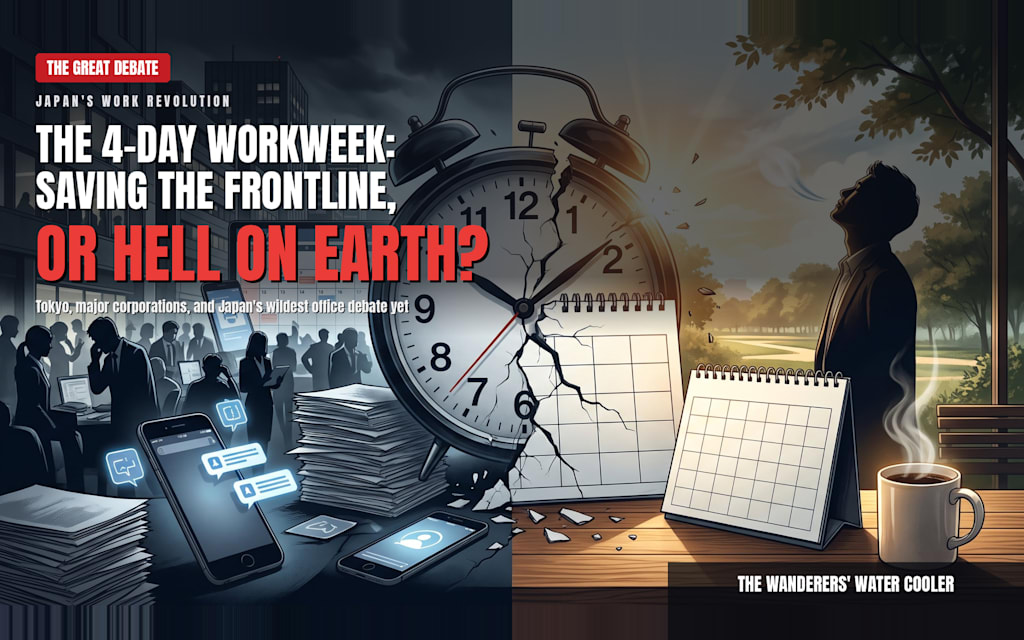
The background events referenced in this piece (Tokyo Metropolitan Government's and other Japanese local governments' and companies' adoption of selective four-day workweek systems) are real and verified. The commentary and debate that follows is entertainment and satire, not journalism.
Cover image created using an AI image generation tool (Gemini/Claude).
Is the Four-Day Workweek Becoming the New Standard?
Against the backdrop of a shrinking working-age population driven by Japan's low birthrate and aging society, and a growing need to accommodate diverse ways of living — childcare, caregiving, reskilling — momentum is building across Japan for the "selective four-day workweek." What used to be a narrow special provision, limited to employees raising children or caring for family members, is increasingly being redesigned as a system open to all full-time staff. Municipalities and companies adopting this broader version are multiplying, shaking the foundations of Japan's uniform "two days off, full-time" employment model and drawing attention as a genuine social experiment.
Tokyo and the National Government Move First, Municipalities Race to Keep Up
One of the most visible developments in the public sector has been institutional reform led by the Tokyo Metropolitan Government and the national government. For national civil servants, Japan's National Personnel Authority has been developing a system that significantly expands eligibility for the selective four-day workweek — previously limited mainly to employees with childcare or caregiving responsibilities — opening it up to staff more broadly.
Among local governments, Chiba Prefecture was first out of the gate, introducing the system for all staff starting in June 2024. Tokyo followed with a full rollout in April 2025. Tokyo's version is built around maintaining a total of 155 working hours over a four-week period, using flexible scheduling to let employees shift an extra day off into their regular workweek. Other prefectures, including Kanagawa, are now examining and piloting similar all-staff systems, and there's a clear recruiting angle to all of this too — a strategy aimed at attracting younger talent in an era when fewer young people want to become civil servants in the first place.
In the private sector, Shionogi Pharmaceutical has already made its selective four-day workweek official, and reports suggest major corporations including Panasonic Holdings and Hitachi are exploring similar moves. For companies, the appeal combines preventing employee attrition and improving wellbeing with the hope that staff will use their extra day for side projects or self-development that feeds back into innovation.
The "Total-Hours-Maintained" Model Dominates — And Its Operational and Health Trade-Offs Are Starting to Show
Selective four-day workweek systems currently being adopted in Japan generally fall into three patterns:
Total-hours-maintained (flex-time) model: Weekly or monthly scheduled hours stay the same; employees extend their hours on working days to gain an extra day off. Pay remains at 100%.
Reduced-pay model: Hours are cut, and pay is reduced roughly in proportion (typically around 20%).
Pay-maintained, shortened-hours model: Hours are cut — to around 32 hours a week, for instance — while pay stays at the previous full-time level (mainly seen in European pilot programs).
The model municipalities and large companies in Japan are gravitating toward is overwhelmingly the first — the total-hours-maintained flex model — since it avoids the labor-cost increases and pay cuts the other two models carry. But as it becomes more established, real operational problems are surfacing.
Because the hours from the day off have to be redistributed across the remaining working days, daily shifts on those days can stretch to nine or even ten hours. Critics point to the risk that this normalizes long hours and builds up fatigue, especially during busy periods. There's also the issue that in roles requiring in-person public service or on-site operations — counter services, manufacturing floors, essential work — this kind of flexible scheduling is much harder to offer in the first place, creating a sense of unfairness between employees whose jobs can use the system and those whose jobs can't, which is becoming a recognized organizational challenge.
Toward Reworking Japan's Employment Model, and Testing What It Actually Does for Productivity
In Europe, where experiments have tested cutting working hours to four days a week while keeping pay the same, many reports describe improved productivity through more efficient operations and fewer meetings. By contrast, Japan's current efforts lean heavily toward simply optimizing how a fixed total of working hours gets distributed, rather than actually reducing the total workload.
The national government has been encouraging the spread of the selective four-day workweek through policy frameworks like its basic economic and fiscal management guidelines, but there's no legal mandate behind any of it — it remains entirely up to individual employers' discretion.
As labor shortages deepen across industries, will the selective four-day workweek end up being just an exceptional arrangement for a small group who happen to want it? Or can it evolve into a genuine social foundation that cuts out wasted process and drives real productivity gains? Both the public and private sectors are still in the middle of finding out whether this can actually work in practice.
Round One of the Debate — The Frontline's Cry, and Clashing Views of What Work Even Is
The Panel
Rearin — a realist commentator speaking from the frontline of corporate life
Oyassan (The Old Guard) — a Shōwa-era baby boomer commentator, blunt and old-school
Miruyo — a fortune-teller who reads the soul's fate and transformation
Toshio — an urban-legend commentator exposing the world's hidden machinery
THE REALIST — Rearin
Honestly, speaking as someone actually on the frontline, my real take is: "Are we actually getting any rest out of this?"
"Total hours maintained" basically means cramming the fifth day's worth of work into the remaining four, right? Ten-hour days become the default, and the second overtime creeps in on top of that, you're completely gassed just getting to and from the office on your working days.
And it's not like the world politely stops moving on the day you happen to have off. Clients and coworkers don't pause their messages just because it's your day. Watching your chat and inbox pile up while you're "off" is its own special kind of stressful, and you end up in that classic contradiction — "resting," except you're checking your phone the whole time.
And honestly, the worst part is the atmosphere in the office. I'm completely fine with people taking the day for childcare or caregiving — that's not the issue. The issue is that the structure for covering their work hasn't changed at all. "Hey, since so-and-so's off today, can you cover this urgent thing for them?" — the people who get stuck with that build up real, legitimate resentment. And the gap just keeps widening between desk jobs that can flex their schedule and frontline roles — counters, factory floors — that can't.
If we could do what they do in the West and actually cut the total workload, going to four days for the same pay, I'd be thrilled. But in Japan's case, the total amount of work stays exactly the same — it just feels like we're rearranging boxes on a calendar.
Shouldn't the priority be cutting pointless meetings and unnecessary back-and-forth, and actually reducing the total workload first? When "four-day workweek" is just a label slapped on top with nothing underneath, I can't help looking at it with a pretty cold eye — isn't frontline burnout just going to get worse?
THE OLD GUARD — Oyassan
Oh, give me a break! What's this "four-day workweek" nonsense, talking all nice and cozy like that!
Like Rearin here just said — it's nothing but shuffling numbers around on a calendar while you keep cramming the same workload in! Ten hours a day, and the rest of the week off — you think a slick little trick like that actually flies in Japanese business? Not a chance!
And another thing — how's it going to look, clients and partners doing business on a weekday while you sit there going "sorry, I'm off today"? That's a slap in their face, and it dumps all the mop-up work on whoever's left holding the bag. Where's the decency in that? If you're going to spend your day off all jumpy, glued to your phone just in case — you might as well show up, look each other in the eye, bust it out together, and go grab a drink after. That's what actually has some class to it.
Back in my day, we worked through half-days on Saturday and never once complained, sweated through it, and that's exactly how this company got big and this country got rich — all of us grinding it out together in the mud.
And now these kids come along throwing around fancy words — "reskilling," "work-life balance" — before they've even sharpened their skills, counting up their days off like that's the whole point. You're never going to be worth a damn that way.
Your head's so full of "resting" that when it actually comes time to work, you've got no spine left in you. Before you go chasing more days off, get mad at the work sitting right in front of you and put your whole soul into it — that's what I'm saying!
THE MYSTIC — Miruyo
Oh my, you two are getting awfully fired up. Let me just pull a card or two and take a look at how the stars are moving on this.
Reading the tarot, two cards line up perfectly with this story: the Hanged Man, and the Four of Pentacles.
What Oyassan's calling "pouring your soul into the mud" — that's pure Earth-era energy. Tying yourself to one place and sweating it out to lock in your fortune. A very Shōwa way of doing things. But you know, the cosmos has already shifted decisively into the Air Age. Living a life bound to a single fixed place or form is starting to drift away from the universe's own rhythm.
So when Rearin says we're "forcing the calendar into the same old shape," that's genuinely the worst configuration for the flow of ki. Every day of life needs a balance between yin — rest — and yang — activity. Cram yang into your working days and then drag a stagnant pool of guilt into your day off, and your fortune and vitality both turn murky. Checking your phone nervously on your supposed day off — that's the clearest sign your ki isn't actually resting at all.
Numerologically, four is a number of stability, but three is a number of creation and change. A four-day workweek is, in its truest form, meant to carve out blank space — an empty canvas to receive new inspiration and nourish your soul. Drag ordinary labor and workplace obligations into that space instead, and of course the office's ki gets disturbed and discord follows.
That's exactly what happens when you try to force the same rigid rule onto everyone. If your constitution runs Earth and you thrive by working, then work. If yours runs Air and you draw inspiration from blank space, then rest. Copy the outer shape of a system while ignoring the heart of it — "reading the room" and "the flow of fortune" — and all you get is a hollow imitation.
THE OLD GUARD — Oyassan
Air Age, whatever that is — half of what you're saying doesn't even make sense to me, sister!
You think you can eat off of stars and tarot cards? Out here we build our trust by sweating it out on-site, pouring concrete, tightening bolts, taking an earful from an angry customer and living to tell about it. "A flash of inspiration from blank space" ain't going to put food on the table!
But... I'll give you this much — that part about "copying the outer shape of a system while forgetting the heart of it," you might actually have a point there, kid.
What really gets under my skin is when the people upstairs slap a nice coat of paint on things and strut around going "there, nice and breezy now." Work only runs on the trust between coworkers who breathe together, and knowing how to carry yourself with a customer.
If you just let everybody do whatever — "whoever wants to rest can rest, whoever wants to work can work" — the whole crew loses its rhythm and the ship sinks!
Talking about freedom, individuality, doing whatever you please, and dumping the consequences on everybody else — I can't accept that, not as an old Edo boy, not as anybody with sense. When you work, everybody pulls in the same direction and grits it out together; when you rest, everybody's on board and sends you off with a smile. That's the human decency and the backbone these kids today are completely missing!
THE URBAN-LEGEND COMMENTATOR — Toshio
Hmm... everyone's bringing genuinely fascinating angles to this. But if you ask me, you're all still caught up in surface-level phenomena, missing the real "purpose" behind this policy.
Listen carefully, Oyassan. Whenever the people at the top go out of their way to show some strange new consideration for workers — "let's give everyone more days off" — there's always something else going on underneath.
Rearin, you said the burden piling up on working days is what's keeping you from actually resting — and that's precisely the point. Compress labor into one day, and leave people floating free for the other three. Where does that send them? Straight into total enclosure inside the digital space.
And Miruyo, your talk of the "Air Age" is symbolic in its own way too. Cutting people off from any real, tangible workplace, planting them in front of a screen for nearly half the week. It's functioning as an experimental ground for a management society designed to get people hooked on consumption, glued to social media, and funneling their biometric data and behavioral history to the center.
Look back at history — the process that normalized the two-day weekend was itself woven through with the creation of massive leisure industries and the engineering of mass behavior. This is no different. As AI and automation accelerate, isn't it extremely plausible this four-day workweek functions as a "soft, staged lockdown" — gently taming a workforce that's becoming surplus, stripping away their frustration and energy before it can turn into unrest?
Dressed up under the beautiful name of "workstyle reform," what exactly are we handing over — our time, our awareness? That invisible intention is precisely what we should be keeping our eyes locked on.
THE REALIST — Rearin
Whoa, whoa, Toshio, this is escalating way too fast, I can't keep up here! Total digital enclosure, some grand management-society scenario... have you just been watching too many movies?
What frontline employees are actually dealing with isn't some elevated conspiracy theory. It's a lot muddier and more mundane than that.
Even with one extra day off, there's zero room left over to go lounging around in some "digital space." You're so wiped out from everything crammed into your working days that your first day off just gets swallowed up sleeping like the dead, or buried under a backlog of chores and childcare.
Honestly, there's no way the government or corporations are running some meticulous scheme to tame the population — if they had that kind of coordinated master plan, the birthrate wouldn't be collapsing the way it is, and they'd have rolled out way more efficient IT systems in city offices and companies by now.
Watching this play out on the ground, what I actually feel isn't some vast conspiracy — it's something a lot more pathetic: a labor-shortage excuse dressed up as an "and-we're-doing-something" PR move. "We offer a four-day workweek too!" goes on the job posting to pull in young applicants, but there's no raise to go with it, and no actual rethinking of how the work itself gets done. So it just gets dumped on the frontline with a "figure it out yourselves."
Toshio, I think what you're calling "some invisible intention" isn't nearly as grand as you make it sound. What's actually scary is something a lot plainer: neglect and buck-passing, landing right on the people doing the work.
THE MYSTIC — Miruyo
Ha, this back-and-forth between Rearin and Toshio is genuinely fascinating. Conspiracy theory colliding with hard-nosed realism — but from where the stars are watching, you're both just looking at two faces of the same shadow.
I pulled another card, and it's the Devil, reversed.
This one represents a figure caught in invisible chains, struggling to break free even as they try.
What Toshio calls "dependency on information and the digital" is, in a sense, a very modern incarnation of that chain. But like Rearin says, the devil isn't some grand state conspiracy — it creeps in through something a lot closer to home: everyday exhaustion, everyday numbness. People lose the most ki precisely in the moment they're drained and hollowed out, scrolling their phone for hours on end.
And what Oyassan calls losing the "old muddy bonds" — without quite managing to step into a lighter new way of living either — everyone's just left dangling in midair, burning through their energy.
Astrologically speaking, Pluto has planted itself firmly in Aquarius right now, and it's dismantling old structures and old rules of labor right down to their foundations. So of course a transitional period like this is going to expose the system's flaws and stir up an uneasy sense of unrest. All of it is just the friction of change.
In the end, whether it's three days off a week or four, what matters most is who you're handing the reins of your own "time" and "attention" to. Giving it to the company, letting someone through a screen drain it out of you, or using it for your own soul — if you can't decide that for yourself, no amount of blank space on a calendar is going to give you a day that actually feels like rest.
THE OLD GUARD — Oyassan
Hmph! Toshio over there's spinning some big-headed fantasy, and Miruyo's sister act is dragging in devils and Pluto and smoke and mirrors — listen to the two of you, neither one's got your feet on the ground!
But... I'll give the kid Rearin credit for one thing — "just dressing up an and-we're-doing-something PR move" — that one landed. Hit the nail right on the head.
The people upstairs slap up some pretty signage and dump the substance on the frontline to deal with. That's the same old bureaucratic trick it's always been. Dangle "you can choose a four-day week!" to reel the young ones in with something that sounds nice, and then once they're in, it's "figure it out yourself, don't complain"? That's not reform, that's flat-out abandonment of duty — about as irresponsible as it gets!
And Miruyo, sister — going on about "who you hand the reins of your own time to," sounding all high and mighty — bottom line, isn't that just "clean up your own mess"?
You want a day off, you square things away with the people around you properly, do work nobody can complain about, and then take your day off with your head held high. You want to work, you don't go whining and staring blankly at a screen — you pour your whole soul into the job in front of you and earn your keep.
Get pushed around by some system somebody else dreamed up, flinch over your day off, waste your free time with your soul sucked out staring at your phone — plant your own two feet on the ground! Anybody with no sense of duty to the people around him, no backbone of his own — taking a few extra days off a week is never going to show him what real freedom even feels like!
So tell me — is clinging to pride over a few extra hours of your own schedule really worth throwing away your shot at the role?
What's actually in front of us here is just a workplace policy debate about whether people get one more day off a week. But why has this turned into something this enormous, this furious, dragging in Shōwa-era grit, devils, and the cosmos itself?
From here, we head into the second half: a clash between a bodhisattva's compassion and a devil's venom, with the frontline's grudges and resentments caught in the crossfire.
[Part 2 coming soon]
About the Creator
ConvoWorld
Welcome to The Wanderers' Water Cooler. One topic, five wildly biased narrators — Realist, Conspiracist, Mystic, Nihilist & Sage — duke it out. Entertainment/satire, not journalism. Translated from my Japanese blog on Note.
Enjoyed the story? Support the Creator.
Subscribe for free to receive all their stories in your feed.
Comments
There are no comments for this story
Be the first to respond and start the conversation.