
The Execution Button No One Thinks They Pressed
Inside placebo, obedience, and the quiet math of divided responsibility.
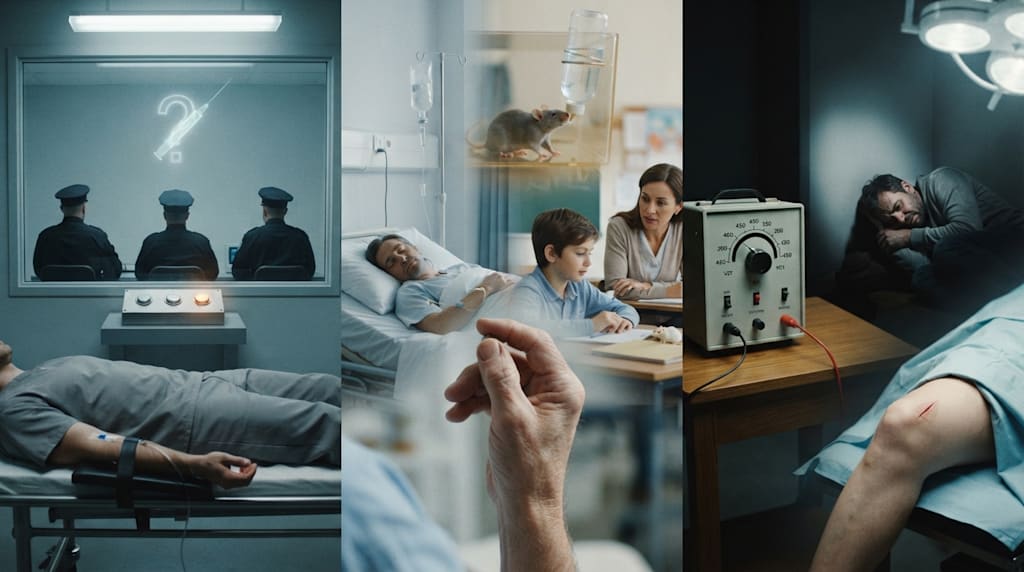
The execution room light is white. A nurse inserts an IV catheter into the prisoner’s arm, tapes it down, connects the tubing to the machine, and leaves. She does not have to watch what comes next. Three officers stand at the console. Each has a button. The machine will push the drugs in sequence. First anesthesia. Then a muscle relaxant. Then potassium chloride. Only one of the three buttons is live. The live button rotates electronically. No one knows whether his button is the one.
The button goes down. The pump hums. The sound is soft, like a refrigerator compressor.
The officers watch the machine. One later washes his hands for a long time. Beside the sink is a bottle of stomach medicine with a green cap. Next to it is a pothos in a pot, leaves yellow at the edges. None of this has anything to do with death. After death, a person still has to touch something else.
The nurse signs a form in the hallway. She inserted one IV catheter. That is all.
In a cancer ward in the same city, a patient takes a syringe. The nurse says, “This is a strong painkiller.” Saline goes into the vein. Ten minutes later, he presses the call button less. He turns over and sleeps. The doctor writes in the chart: pain score decreased.
If naloxone is given now, part of the pain relief recedes. The saline is the same. The brain’s explanation of the saline changed. The prefrontal cortex, the anterior cingulate, the periaqueductal gray light up. The endogenous opioid system begins to work. The body issues its own medicine.
In a lab, mice drink saccharin water again and again while receiving an immunosuppressant. Later, they receive only the saccharin water. Their immune response drops. The saccharin has no immune function. It is a signal. Once the signal is established, the body follows it.
A Parkinson’s patient believes the brain stimulator has been turned on. His fingers move. Dopamine release in the striatum increases. The machine is off. His fingers move because he expects them to.
The opposite effect is documented. The drug label says: may cause headache, nausea, palpitations. The patient reads it. The headache arrives. The nausea arrives. The palpitations arrive. The pill has not been swallowed.
In a school hallway, a teacher receives a list. The names on the list were chosen at random. Someone tells the teacher: these children are about to bloom. At the end of the term, these children have better scores. The teacher did not give them extra lessons. The teacher looked at them more often, nodded more often, wrote longer comments on their work. The students caught the signal and changed their posture.
Anthropologists have recorded another signal. A cursed person is told he will not live past a few days. He lies down. His breathing shallows. His heart rhythm breaks. Walter Cannon discussed this kind of death in 1942. Extreme fear drives the sympathetic nervous system. The heart can stop. The cases are few, the evidence uneven. But the direction is clear: an explanation can kill, though it usually takes extreme conditions.
In Milgram’s experiment, ordinary people sit at a switch. An authority says continue. The voltage rises. A voice cries out from the other room. Most people keep pressing. Responsibility moves to the white coat, the experimenter, the rule, the procedure. The hand presses. The person thinks: the rule did this, not me.
The three buttons in the execution room and Milgram’s switch are separated by a table.
A knee arthritis patient receives a lavage. One group gets the full procedure. One group gets a sham procedure. The sham group is cut open, flushed, and sewn up. Pain scores improve similarly. Ritual, expectation, nursing, and the white coat all play a part. But a sham operation cannot fix a fracture, cannot kill bacteria, cannot replace insulin. Suggestion has a boundary.
Suggestion works inside that boundary. It does not work outside it.
The execution room. The pump stops. The officers leave the console. One buys water from a vending machine. The coin drops into the slot. Clang. One checks his phone. On the screen is his child’s class group. The teacher has posted a notice: bring colored pens tomorrow. One twists open the stomach medicine, pours out two pills, and swallows them dry.
The nurse returns to the end of the hallway. She inserted the IV catheter. She remembers only that the tape was curling at the edge.
Potassium chloride enters the vein. The heart stops. The machine records the time. The lights on all three buttons go out. Which one was live, no one knows.
The plastic shell of the button still holds fingerprints.
About the Creator
Jin
Writer of reamstories
https://reamstories.com/jin
Enjoyed the story? Support the Creator.
Subscribe for free to receive all their stories in your feed. You could also become a paid subscriber, letting them know you appreciate their work.
Comments
There are no comments for this story
Be the first to respond and start the conversation.