
Singapore Is Using a Nobel Prize-Winning Algorithm to Find Love for Its Civil Servants
The country's birth rate just hit a historic low. Now the government is playing matchmaker, and not everyone is comfortable with it.
I
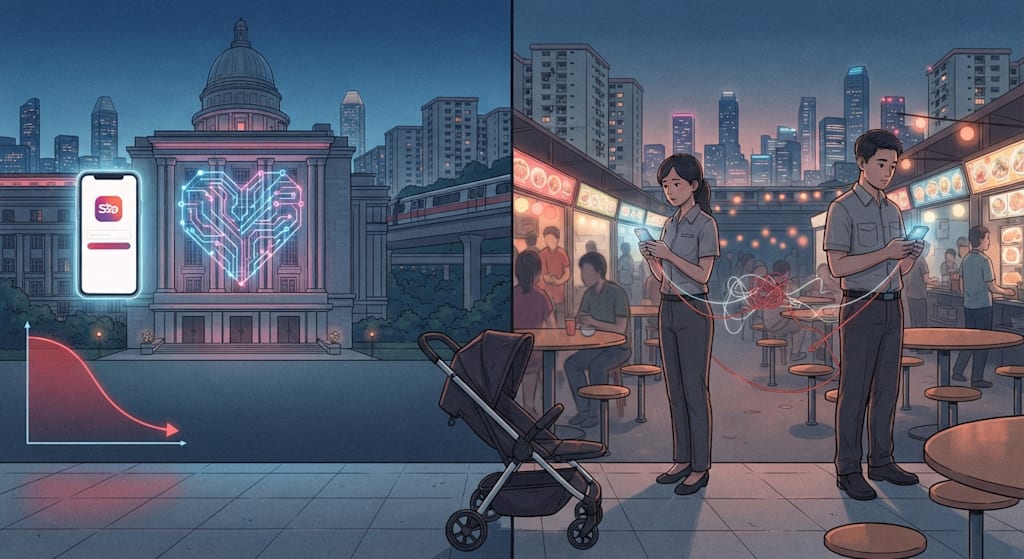
On September 29, 2026, Singapore's Government Technology Agency launched a dating platform. Registration stayed open for seven days and closed on October 5. Participants logged in with Singpass, filled out a questionnaire, and waited. The wait time was uncertain. The outcome was binary: matched or not matched.
Matched users received a notification and had 72 hours to accept. Only after both people accepted did the platform exchange contact information. GovTech confirmed one detail: participants would not be matched with colleagues from the same government agency. That detail implied a premise. The system knew your department, knew whom you dealt with daily, and knew who should be kept away from you.
The platform was called FirstDate. It was open to civil servants aged 21 to 35.
II
FirstDate was not Singapore's first attempt at this.
In 1984, the government established the Social Development Unit to organize social activities for university-educated singles. It was a policy tool of the Lee Kuan Yew era. The 1980 census had found that many highly educated women remained unmarried past forty. The SDU carried the elitism of that era. It was restricted to university graduates. The government argued that non-graduates did not seem to have much difficulty finding partners. That argument exposed the policy logic. Marriage was treated as a matter of managing the talent pool. The unmarried status of highly educated women was treated as a resource misallocation that needed correction.
The SDU was eventually phased out. Its legacy was an acronym and a social label. People called participants "Single, Desperate and Ugly." Many refused to join for fear of being seen as unwanted. In 1985, the government set up another agency, this one for non-graduates.
Forty years later, FirstDate's screening criteria shifted from education to occupation and age. Civil servants, under 35. The criteria were narrower than the SDU's. The logic was related. The government first defined a group it believed should marry and have children, then gave them a tool.
III
In 2025, Singapore's birth population was 29,864. It was the first time since independence in 1965 that the figure fell below 30,000. The total fertility rate was 0.87, tied with South Korea for the lowest in the world. Deaths numbered 26,499, a slight year-on-year increase. Deputy Prime Minister Gan Kim Yong warned that without additional measures, the country's population could begin to decline in the early 2040s.
The trend made the numbers severe. In 2021, the birth population was 38,672. In four years, it fell by nearly nine thousand. This was not a one-year fluctuation. It was a continuously downward line.
In August 2026, Prime Minister Lawrence Wong announced the SG Child Support Package. It provides about S$70,000 in support for each Singaporean child from birth to age 17. That includes a newborn cash gift of S$10,000, a MediSave grant of S$5,000, a Child Development Account start-up grant of S$5,000, and S$2,000 in annual child credits until age 16. The income ceiling for Build-To-Order flats was raised. First-time homebuyer families with children received more ballot chances.
This system covered every node from birth to adulthood. But it addressed the problem of "cannot afford to raise." FirstDate tried to reach an earlier link: before birth, before child-rearing, before two people even meet.
IV
On the FirstDate homepage was a line: "Swipe fatigue ends here."
That line pointed to a specific exhaustion. A 2024 survey found that about 70% of Japanese people interested in marriage were not actively participating in matchmaking activities. The endless swiping model of commercial dating apps created a paradox. More choices made decisions harder. Easier matches made people less serious. Fake identities, online scams, and ghosting became common in young people's descriptions of online dating.
FirstDate's selling point was that it matched only one person at a time. It claimed to use the Gale-Shapley stable marriage algorithm. David Gale and Lloyd Shapley proposed the algorithm in 1962. Shapley received the 2012 Nobel Memorial Prize in Economic Sciences for it. The logic: two groups of equal size rank each other by preference. Through deferred acceptance, the process produces a stable matching. Stable means no man and woman both think the other is better than their current match.
This result can be proven mathematically. What it guarantees is stability, not happiness.
Vijay Vazirani, a computer scientist at the University of California, Irvine, noted that Gale-Shapley produces extreme matches at both ends. A more fundamental limitation is that the algorithm assumes every person has a complete preference ranking over all potential partners. That is almost impossible in reality. Chemistry, timing, and contingency in love cannot be captured by a questionnaire. Someone who matches you perfectly on a values survey may evoke nothing when you meet in person. The reverse is also true.
Research suggests that for users of online dating platforms, the Gale-Shapley algorithm may produce worse outcomes than users' own choices. The algorithm optimizes for mathematical stability, not emotional suitability.
V
After FirstDate launched, Singaporean society split in its reactions.
Support came from recognition of its safety and efficiency. Elizabeth, a 29-year-old Ministry of Defence employee, told the BBC: "Knowing that the possibility of being scammed is much lower feels good. After all, we're all civil servants looking for a partner, aren't we?" This mindset reflected young people's crisis of trust in commercial dating platforms. When fake identities and online scams become pervasive, a platform that logs in with the national identity system at least rules out the worst-case scenarios.
Criticism was sharper. Some social media users argued that opening the service only to civil servants constituted discrimination. More concentrated skepticism targeted the age limit. One Reddit user wrote: "Because the risk of childbirth is higher after 35, the government simply excludes older singles." Another netizen's comment went straight to the motive: "They're only doing this to raise the total fertility rate. They don't actually care whether we find partners."
GovTech responded that the 21-to-35 age group is most likely to be actively dating and interested in trying the service. Limiting the age range also helps test the service with a more focused user base. This explanation did not dispel a deeper unease. The government holds your identity credentials, occupational information, interest preferences, and values data. It uses them to choose dating partners for you. Where is the boundary between the private sphere and public governance?
Research from the National University of Singapore has pointed out that Singaporeans harbor a certain "aversion to the commodification of love" toward commercial matchmaking services. They also resist measuring potential spouses by social status. This cultural psychology does not disappear simply because the service provider changes from a commercial company to the government. A CNA commentary acknowledged that even in a society like Singapore, where residents have high trust in the government, the idea of state intervention in love may make some people uneasy.
VI
Tokyo offers a reference point.
In September 2024, the Tokyo Metropolitan Government launched an AI dating app called TOKYO Enmusubi. As of June 2026, among 16,000 registered members, 760 couples had entered serious relationships and 265 couples had married. The Tokyo government cited the story of a female user pseudonymed Turtle. She saw the app as a last chance as she approached 40. After several dates, she met her current husband.
There are differences between Tokyo's and Singapore's models. Tokyo's app is open to all single residents, not just civil servants. It uses AI matching rather than the Gale-Shapley algorithm. Registrants must provide proof of legal singleness and pass an online interview. Over two years, 16,000 users produced 265 marriages. That is a conversion rate of about 1.7%. The number can be read as initial success or as limited efficiency.
Governments across East Asia are intervening in the marriage and dating sphere in different ways. South Korean local governments organize matchmaking events and offer marriage incentives. Chinese state-owned enterprises combine matchmaking events with local festivals. Vietnam officially abolished the two-child limit per couple in 2025. The common backdrop is the marriage and childbearing crisis facing East Asian societies broadly: later marriage, rising non-marriage rates, and persistently low fertility.
In a paper on low-fertility Asian societies, scholar Jolene Tan and others pointed out that these pronatalist policies suffer from a problem of goal misalignment. When policies focus on encouraging married couples to have more children, they overlook the more fundamental cause of fertility decline: marriage itself is happening later and less often.
VII
FirstDate's registration closed on October 5. The matching process is underway. GovTech said no decision has been made on whether to extend the service beyond the civil service.
The experiment exposes a tension. The government can use algorithms to optimize the stability of matches. It can use financial subsidies to lower the cost of child-rearing. It can use policy tools to reshape ideas about marriage and childbirth. It cannot manufacture the unpredictable attraction between two people.
The Gale-Shapley algorithm is elegant mathematically. It guarantees the existence of a stable matching. It proves that the process must terminate after a finite number of iterations. In the world of love, stability may be the least important quality. What people seek is not a mathematically impeccable match. They seek someone willing to pick up the phone at 3 a.m., someone who makes them feel this is the one. A questionnaire cannot ask these things. An algorithm cannot calculate them. A government cannot match them.
Singapore's birth rate will not stage a dramatic reversal because of FirstDate. The experiment still matters. The questions it raises matter more than the answers it provides. When the public consequences of private life become large enough, where should the boundary of state intervention be drawn? Between efficiency and freedom, between collective interest and individual choice, there is no algorithmic answer.
At the bottom of FirstDate's website, in an inconspicuous place, there is a line of small text. It reads: This service is provided by GovTech. Final interpretation rights belong to the government.
That line is the most honest sentence in the entire terms of service.
About the Creator
Jin
Writer of reamstories
https://reamstories.com/jin
Enjoyed the story? Support the Creator.
Subscribe for free to receive all their stories in your feed. You could also become a paid subscriber, letting them know you appreciate their work.
Comments
There are no comments for this story
Be the first to respond and start the conversation.