
No Streetlights by the River
A story of almost‑love, the weight of unspoken words, and the goodbye that never quite happened.
I was pushing my luggage cart out of the arrivals hall when her call came. The air in Chengdu at the end of March carried a damp, clingy moisture that fought in my nostrils with the dry European air still lingering in the cabin. My phone buzzed. The screen showed a two‑character note: her name. I watched those two characters flash for five or six seconds before I swiped to answer.
“You’re back?” Her voice was lighter than before she left, like someone just getting over a cold, or like she’d swallowed before speaking.
“Just landed. Still at the airport.”
“Can I… see you?” She paused. “Today.”
I said yes, I’d drop off my suitcase and come over. After hanging up, I stood in the parking lot for a while, keys clenched in my palm, the metal edges pressing into my lifelines. Jet lag turned my brain into a sponge soaking in lukewarm water; you know it’s absorbing, but you don’t know what.
She lived in an old neighbourhood on the west side. The navigation led me down an alley where the plane trees on both sides hadn’t yet grown their full leaves. I pulled over. In the side mirror I could see her building: six stories, white square tiles on the facade, several missing to reveal gray concrete beneath. She’d messaged: Door’s unlocked, come straight up.
Half the motion‑sensor lights in the stairwell were broken. One finally flicked on when I reached the third floor, casting a long yellow shadow that folded across the steps like another staircase. At the half‑landing on the fourth floor, a locksmith ad had been peeled back at the corners, the edge worn smooth by someone’s shoe.
Her door was ajar, a thin line of light bleeding through. When I pushed it open, she was sitting on the edge of the bed, wearing a loose gray hoodie, hair loose over her shoulders – longer than before. She looked up. Her eyes were rimmed red, but she hadn’t been crying.
Then she stood, walked over, and hugged me.
Her arms locked tight around my back; her face pressed into my chest. I could feel her eyelashes fluttering – quick, light, like some small animal sniffing for a scent. She didn’t speak, just held on, maybe half a minute. My suitcase still leaned against the doorframe, its wheels wedged against the panel, keeping the door half‑open.
“You’ve lost weight,” I said.
She didn’t answer. She let go, stepped back, and sat down on the bed again, hands tucked between her knees. I noticed her fingernails were cut very short, almost to the quick.
“Sit down,” she said, shifting aside to make room. “I’ll get you water.” As she stood to fetch a cup, I saw a discoloured patch on the back of her hoodie, like bleach had splashed on it after many washes. I recognised that hoodie. She’d worn it her second week at the company, back when the weather was still cold, curling up at her desk, saying it was an old thing she’d dug out of her closet back home.
She came back with the water but didn’t hand it to me; she set it on the nightstand first, the base making a soft thunk against the wood.
“I found a job,” she said. “Confirmed last week.”
I blinked. She’d been searching for a month without a single reply. This was good news.
“Doing what?”
“E‑commerce customer service. Morning shift eight to four, evening shift four to midnight. Rotating.” She smiled – the corners of her mouth pulling sideways, not fully natural, but at least a shape that resembled a smile. “I’ll probably move out next month. The office is down south. I’ll find a cheap single room there.”
I didn’t respond. The room was so quiet I could hear someone downstairs trying to start a car: engine turning over, dying, turning again, dying – like a dead battery.
“So today is goodbye?” I asked.
She shook her head, then nodded. “I don’t know,” she said. “I just wanted to see you. Last time I said I’d let you see me off, but after thinking about it, I figured it’s better not.”
“I saw what you wrote.”
She lowered her eyes, lashes hiding her pupils. “I wrote it very seriously. Right after I sent it, I regretted it. But I couldn’t take it back.”
I picked up the water and took a sip. It was cold – probably boiled that morning. The rim felt slightly damp; I couldn’t tell if it was hers or mine.
“Are you hungry?” she asked suddenly. “The barbecue place downstairs is still open.”
“It’s only six.”
“That place stays open till six in the morning.” She stood and reached back to pull the hood out from under her collar. That gesture reminded me of her first day at work: she’d adjusted her jacket collar the same way, then looked up at me with a smile and said, Brother, I’ll be counting on you from now on.
That barbecue dinner had been four months ago.
By then she’d been with us almost a month and had picked up the work I delegated fairly smoothly. When the restructuring list came down at the end of March, HR called her in. She came out with a blank expression, went to her desk, gathered a pen, a notebook, a charging cable, stuffed them into a non‑woven tote, and tied the mouth shut. She walked over to my cubicle and said quietly, Brother, HR says I have to go today.
I said, let’s have dinner tonight.
She said okay.
We went to a small place in the alley next to the office. We ordered boiled fish in chilli oil, sliced pork with garlic sauce, and a plate of greens. She ate two bowls of rice. I had little appetite. Toward the end she put down her chopsticks and asked, “Brother, is it because I’m not good enough?”
“No.”
“Then why me?”
I didn’t answer directly. The restructuring had nothing to do with her ability, but she might not understand that – or even if she did, she might not truly believe it. I poured her tea and said, take some time off, the severance should cover a month or two, no rush.
She nodded and said okay. Then she lowered her head and went back to shovelling rice. Back then her ponytail was tied high, the ends nearly brushing the rim of her bowl when she bent forward. I thought that dinner was our farewell.
The walk by the river came a few days later.
In the days just after I returned from abroad, jet lag had me waking at three in the morning, lying with my eyes open until dawn. She sent me several messages, asking if I was around; sometimes I replied, sometimes not. One afternoon she called and asked if we could have dinner. I said sure.
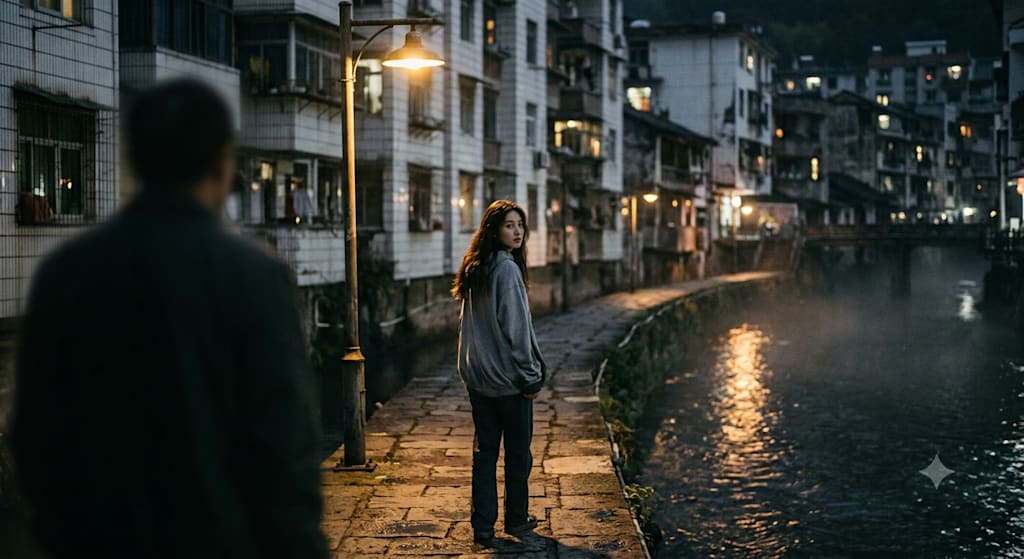
That evening by the river, the wind was gentle. A layer of green scum floated on the water – maybe algae, maybe rotting leaves. She walked beside me, light‑footed in canvas shoes that made almost no sound on the flagstones. Suddenly she said, “You know, I’ve been anxious all this time,” then jogged a few steps ahead, turned to face me, and walked backward. “But now that you’re back, I’m not anxious anymore.”
As she walked backward, the river breeze lifted the loose hairs across her forehead. The streetlight hit her from the side, carving a sharp line of light and shadow across her face.
I said, that’s good.
Then she stopped, stood still, looked at me. Her lips parted, but no words came.
I’ve wondered since then: what if I hadn’t walked her upstairs that night, or turned around at the building entrance? But there’s no point dwelling on it. Just like right now, as she sits across from me, a plate of grilled eggplant and half a dozen beef skewers between us, the charcoal glow flickering across her face. Her hand is steady holding the skewer, but I know what she’s thinking.
“Why don’t you ask me?” She picked up a piece of eggplant and blew on it.
“Ask you what?”
“Ask me why I insisted on seeing you today.”
I smiled, said nothing.
She put down her chopsticks and took a sip of the soy milk in front of her. “I’ve thought about it a lot. After that night, I thought a lot. At first I was furious with you – furious you didn’t reject me cleanly, and furious you didn’t reject me completely either. Later I realised I was furious at myself.”
“You don’t have to be.”
“I know.” She looked down at the label on the soy milk bottle, picking at its edge with a fingernail. “But you know that feeling: when you know someone isn’t going to stay, but you still want them to hold you one last time before they go? Pretty stupid, isn’t it.”
I shook my head.
She looked up, the bare bulb of the barbecue stall reflected in her eyes, glistening like water pooled. “So why don’t you ask me – ask me if I still want you to hold me right now.”
I reached for a beef skewer, the bamboo slightly charred, the meat coated in chilli flakes. “Eat first.”
She laughed – a real laugh, not that forced half‑smile. “You’re still like this,” she said, pushing the soy milk bottle toward me. “Always half a step back.”
That was our last meal together.
After we finished, she said she didn’t want me to see her off and called a ride herself. I stood at the entrance of the stall and watched her get into the car. She didn’t look back. The door shut, she said something to the driver, and the car pulled away.
The next morning she sent me a short message: Everything I said last night was true. But don’t reply – I know what you’d say. Then a string of ellipses, maybe typed and half‑deleted.
I didn’t reply.
Back home, I took a shower and lay on the sofa. A thin crack ran across the ceiling, from the corner all the way to the lamp fixture. I closed my eyes, and I saw her sitting on the edge of the bed again: gray hoodie, short nails, and those bright, glistening eyes.
She never actually said the word “goodbye” last night. But I knew she’d change her number, move to the south side, sit at a new desk tapping “Dear, let me check that for you” into a screen, and zone out on the metro with earphones in on her way home. She was right – not seeing each other was better.
I turned over, buried my face in the sofa cushion, and caught a faint whiff of laundry detergent – the same brand as her hoodie.
Downstairs, that car with the dead battery was still trying to turn over, its engine coughing and sputtering like someone struggling to say something but unable to finish the sentence. Eventually it went quiet. It must have given up.
About the Creator
Jin
Writer of reamstories
https://reamstories.com/jin
Enjoyed the story? Support the Creator.
Subscribe for free to receive all their stories in your feed. You could also become a paid subscriber, letting them know you appreciate their work.
Comments
There are no comments for this story
Be the first to respond and start the conversation.