

I was home for the holidays, standing in my childhood kitchen, when my mom said something that stopped me cold.
She was folding laundry—my old towels, the ones with the faded blue stripes—and she looked up with this soft, proud smile. “You were always so good at math,” she said. “Remember how you’d help your little brother with his fractions? I always knew you’d end up in something analytical.”
I didn't correct her.
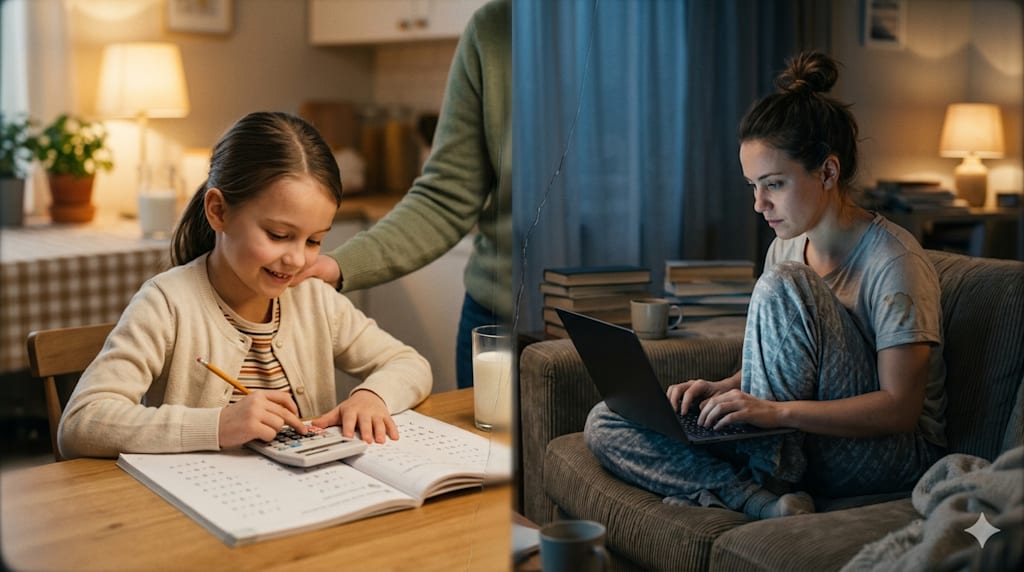
I haven't taken a math class in twelve years. I failed statistics twice in college. My job involves words, not numbers. But in her head, I'm still the version of me who sat quietly at the kitchen table with a calculator and a pencil behind my ear.
It’s not that she’s wrong. It’s that she’s remembering wrong. And I let her. Because the real version of me feels like a disappointment I don't know how to explain.
Here’s the thing about parents: they build a house for you in their mind before you’re even born.
Maybe it’s the son who becomes a doctor. The daughter who marries well. The one who stays close, calls every Sunday, buys the house with the big backyard. They don’t mean to trap you there. They just love you inside a story that makes sense to them.
The problem is, you grow up and realize you don’t fit in that house anymore. The ceilings are too low. The rooms are painted the wrong color. And every time you visit, you shrink a little without meaning to.
I do this thing—maybe you do too—where I filter my life before I share it with them.
I don’t mention the job I quit after eight months. I say “I’m freelance now” instead of “I had a breakdown in the parking lot and couldn’t go back.” I laugh off my tattoos as “just a phase” even though I’m 34. I text photos of my cat, not the guy I’ve been dating for two years, because I still don't know how to say this is serious without them asking is he the one? in that hopeful, heavy way.
My parents’ version of me is kind, stable, a little shy, and very good at math.
The real one is anxious, loud in private, bad with money, and deeply unsure if she wants kids.
They’re not the same person. And some nights—like tonight—that feels like a kind of grief.
The shift happened three years ago, at a diner off the highway.
My dad and I had driven separate cars to meet halfway between his town and mine. It was one of those gray November afternoons where the light feels like a held breath. We ordered coffee. He asked how work was. I gave the usual answer: fine, busy, good.
Then he said something he’d never said before.
“You know, you don’t have to perform for me.”
I froze. My hand on the white ceramic mug. The waitress’s shoes squeaking somewhere behind us.
He wasn’t angry. He just looked tired. Like he’d been carrying something for a long time and finally decided to set it down.
“I know I had ideas about who you’d be,” he said. “But I’d rather know who you are than keep pretending.”
I cried into my French fries. Not pretty crying. The kind where your nose runs and you can’t talk for a full minute. He didn't hug me. He just sat there, which was somehow better.
That was the first time I realized: maybe their version of me wasn't a cage. Maybe it was just a first draft. And maybe they were waiting for me to hand them the revision.
But here's the part I still wrestle with.
How much of their version is their fault, and how much is mine?
Because I've been lying by omission for years. Not to hurt them. To protect myself from the look on their face when I say I'm not the person you raised me to be. I’ve chosen the easy silence over the hard truth so many times that I can't blame them for not knowing me.
They're not mind readers. They're just people who loved a child and then watched that child become a stranger without ever sending a memo.
So whose version is real? The one they see? The one I hide? Or the messy, unfinished one somewhere in between?
I don't have an answer. I just know that every time I visit, I feel the gap. And every time I leave, I think next time I'll be braver.
Sometimes I am. Sometimes I tell them a real thing—like the therapist, or the panic attack, or the name of the guy. And they don't collapse. They don't disown me. My mom just nods and says I wondered and my dad asks if I need money.
And that's when I realize: maybe they've been ready for the real me all along. Maybe I'm the one who wasn't ready to show her.
Tonight I'm scrolling through old photos on my phone. There's one of me at seven, missing two front teeth, holding a plastic trophy from a spelling bee. My parents are kneeling on either side, beaming like I just won an Olympic medal.
That girl was good at math. She did want to make them proud.
She’s still in there somewhere. But she’s not the whole story.
The real me is sitting on a worn-out couch at midnight, typing this, wearing pajama pants with a stain she can't remember. The real me is scared and soft and trying so hard to be honest. The real me loves her parents deeply—and also needs them to see her as she is, not as she was.
I don’t know if I’ll ever fully close the gap. Maybe that’s not the point.
Maybe the point is to stop building two separate selves and let them meet somewhere messy, in the middle, over cold coffee and a confession.
What would you tell your parents, if you knew they wouldn't be hurt?
And more terrifying: what would you tell them if you knew they'd understand?
About the Creator
John Smith
AI is rewriting the world. I'm here to ask the questions that matter. Tech writer. Deep thinker. Always curious.
Enjoyed the story? Support the Creator.
Subscribe for free to receive all their stories in your feed.
Comments
There are no comments for this story
Be the first to respond and start the conversation.