
Learning to See Black Men Clearly Again.
A personal reckoning with Black male friendship.

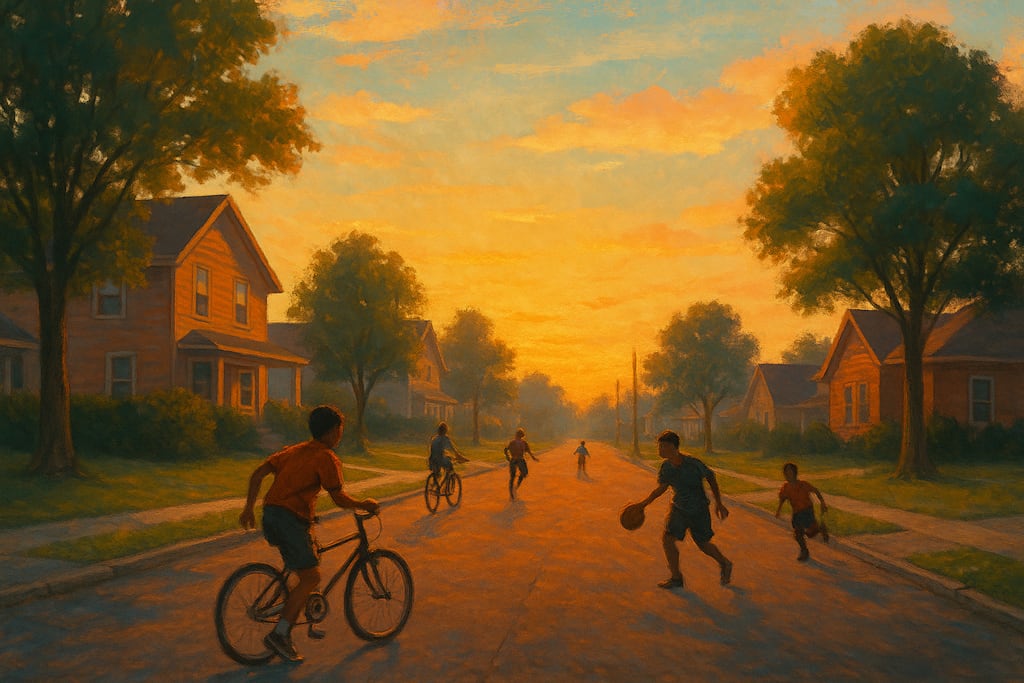
I grew up on a block where childhood felt like one long, shared backyard. We weren’t just neighbors—we were a roaming crew of kids who inherited each other because our houses shared the same sidewalk and our parents trusted the street to raise us as much as they did. The boys were Jarrett, who lived down the street; Michael, right next door; and later Brian, who moved in across from them. The girls were Valerie and her cousin Simone, and my siblings and the younger kids drifted in and out of our group depending on the day. Some friendships faded quickly, some lasted a few summers, but the only friendship from that time that truly lasted was with a girl—my best friend. That says something too.
We all went to the same school, so the block felt like an extension of the cafeteria and the playground. You’d see someone in homeroom and again in a game of tag after school. Even when we didn’t always get along, even when friendships shifted, we still moved through childhood like pieces of the same small ecosystem.
Within all of that, some bonds ran deeper than others.
Jarrett and I were close—a steady, uncomplicated closeness. Michael was someone I naturally clicked with, but when he moved away, the dynamic shifted.
Then Brian arrived.
He slid into our group effortlessly. We all played together, boys and girls, older kids and younger ones. But the instant connection between him and Jarrett felt… different. It formed right in front of me, in slow motion.
At first, it didn’t hurt.
But as time passed and their friendship deepened, the hurt settled in gradually. You don’t always remember the details of someone drifting away, but you always remember how it made you feel.
I remember standing in Jarrett’s backyard while he and Brian laughed at something I wasn’t part of. I was physically there but emotionally sidelined. And a kid feels that long before they can articulate it.
And it wasn’t just the boys on my block.
Even the Black boys I did click with—the rare ones I felt fully myself around—never seemed to stay.
There was Prentice, a school friend who drifted away when he switched schools. And Brandon, my locker partner, someone I talked to on the phone after school. He moved away too.
After a while, losing Black male friends didn’t just hurt—it shaped me. It taught me to expect loss. To expect distance. To believe that even when the connection felt right, it wouldn’t last long enough to matter.
And somewhere in that mix—block friendships breaking, school friendships dissolving, teasing growing louder—another truth settled in:
Being friends with boys, especially Black boys, was always harder for me than being friends with girls.
Girls accepted me naturally.
Boys questioned me in ways that cut deeper.
By my teens, the teasing was sharper. My voice. My mannerisms. The parts of me that didn’t fit someone else’s definition of Black masculinity. I wasn’t rough enough, loud enough, “enough.”
So I learned to guard myself.
I thought adulthood would erase all of this.
I truly did.
But the tension followed me.
Even now, at social gatherings or family events, I sometimes feel myself pull back around groups of Black men. Not because they’re doing anything wrong—because old wounds don’t retire themselves.
And it’s not just old wounds.
Sometimes, being around certain Black men still gives me pause. Some still make me uncomfortable. And yes — sometimes my instincts end up being right. Sometimes I do come across the very type of man whose behavior taught me to brace myself in the first place. There are Black men who echo the ignorance, the harshness, or the shallow masculinity I’ve seen online and experienced growing up.
But I have to remind myself—again and again—that these men are not the blueprint for all of them. They’re just the ones who happened to shape my early memories. They’re the loudest examples, not the truest ones. And if I’m not careful, I’ll end up letting a handful of painful encounters rewrite an entire community that is far more varied, loving, and complex than the worst of what I’ve seen.
And social media hasn’t made it easier. Watching some Black men fall into red-pill ideology, misogynoir, and rigid masculinity—it disappointed me. It made me guarded.
My empathy aligns me more with women, so seeing Black men tear them down makes me recoil. It complicates how I see the men in my own community—even when I don’t want it to.
But beneath all those layers is the truth:
I don’t want distance.
I don’t want mistrust.
I don’t want old hurt shaping how I see Black men anymore.
What I want is simple and huge.
I want ease.
I want trust.
I want softness.
I want real, lasting friendships with Black men—relationships where I don’t have to perform masculinity or shrink myself.
I want to see Black men clearly again—
not through childhood pain,
not through social media distortion,
not through stereotypes,
not through fear.
Just clearly.
Because Black men are not a monolith.
And neither am I.
Maybe writing this is my way of stepping back into the circle—not the childhood one in Jarrett’s backyard, but a new one. One built in adulthood, with room for honesty, vulnerability, and connection.
I’m ready for that now.
And I’m ready to see us—myself included—with an open heart.
Author’s Note:
These thoughts sat with me for a long time before I finally put them into words. Sharing them is a step toward the kind of healing and connection I want for myself. If you see any part of your own journey in mine, I hope it reminds you that growth isn’t linear, but it’s possible. And if any part of this touched a nerve, please know that no offense is intended — this is simply my truth as I’ve lived it.
About the Creator
Travis Johnson
Aspiring actor and writer, Pop Culture lover and alien. With a penchant for beef jerky, gotta have that jerky.
Follow me if you’d like https://www.instagram.com/sivetoblake/ and Substack https://travisj.substack.com/subscribe
Enjoyed the story? Support the Creator.
Subscribe for free to receive all their stories in your feed.
Comments
There are no comments for this story
Be the first to respond and start the conversation.