
I Gave Her Everything. Then I Became Optional.
What happens when one person keeps giving and the other stops noticing.
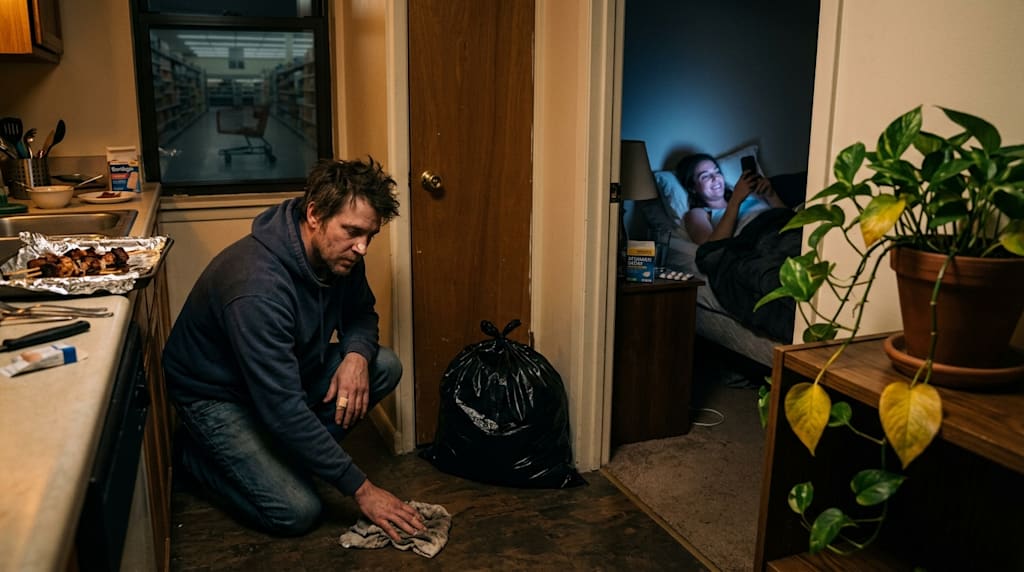
At one in the morning, he squatted in the kitchen, wiping the floor.
Half an hour earlier, she had texted: "Are you asleep?" He replied: "No." She said nothing else. This was the third time this month he had gone to her place in the middle of the night. The first time, she had a fever. The second, she forgot her keys. The third, she said she was afraid of thunder. He wiped the floor, tied up the trash bag, and carried it downstairs. When he came back, she was leaning against the headboard, scrolling short videos, laughing out loud. He stood in the doorway, still holding the trash bag handle. She didn't look up.
Many men later cannot understand why giving more makes her take them less seriously.
It wasn't like this at first. He walked her home, and she said thank you. He remembered she didn't eat cilantro, and she put the beef from her bowl into his. He canceled his pickup game to go shopping with her, and she said, "You're so good to me." Later, the more he did, the more she took it for granted. The more he retreated, the more she pushed. The more afraid he was that she would leave, the less afraid she was that he would.
There's an old line: too close, and they grow insolent; too far, and they grow resentful. Too close, and boundaries are lost; too far, and resentment grows. The most hidden pit in an intimate relationship is right here.
One: give too much, and the hand loosens
He canceled his pickup game to go to the mall with her.
She tried on seven outfits and asked which one looked best. He said they all looked good. She rolled her eyes. "Can you have an opinion?" He said the third one. She said, "You don't understand me at all." He swiped his card. On the way home, she scrolled on her phone while he carried the bags. The bag handles cut into his hand. He switched hands once. She didn't notice.
At two in the morning, she said she wanted barbecue from the west side of town. He drove forty minutes to buy it. When he got back, she ate two skewers, said it was cold, and went to sleep. He sat in the living room and finished the rest. A skewer splinter pricked his hand. He rinsed it at the sink. The water was cold.
She got angry, and he coaxed her. She gave him the silent treatment, and he bowed his head. She made demands, and he agreed. She crossed a line, and he stepped back. He thought this was love. What she received was a different message: my limits can move, and you don't have to pay for anything.
So she began to test. She tested his patience, his limits, how far he could endure. The fewer boundaries he had, the less sense of proportion she had. The more afraid he was of losing her, the less she worried about losing him.
She had the power. He brought the love. When one person holds too much power, it is hard not to abuse it. She wasn't born bad. Unrestrained human nature expands.
Two: she drove him away, then didn't look at herself
He left.
She cursed him first. She sent voice messages to her best friend: "There's not a single good man out there." Three days later, she texted: "I'm sick." He didn't reply. She called. The line was busy. She checked his social media and saw him at the gym, eating with colleagues, laughing easily. She panicked. She texted: "Let's talk." He replied: "I've been busy." She stared at the screen, typed a long message, deleted it, and finally sent: "You've changed."
She didn't know that he had been sick before too. That time, he went to the hospital alone, got an IV, and came back to cook for her. She said, "Why are you so late? I'm starving." He set the food on the table and said, "Traffic." He didn't mention the IV. She didn't ask.
Admitting "I drove him away with my drama" hurts too much. Cursing him is easy. Curse him, and tonight you can sleep. Admit you were wrong, and tonight you cannot. She chose the easy path. She missed the services: midnight barbecue, carried bags, coaxing after a scolding. She thought that was love. It was him before he got tired.
Three: men later learn to read feedback
He met someone new.
She brought him coffee, and he treated her to lunch. She remembered he didn't eat cilantro, and next time he remembered she was afraid of cold and put his jacket on her chair. She texted, and he replied, but not instantly. She asked, "Do you not like me that much?" He said, "I'm here." No explanation.
He had learned to read feedback. As much as she gave, he gave. If she was sincere, he was sincere. If she was perfunctory, he withdrew. Not scorekeeping. He just stopped burning on one side.
Outsiders looked at him and said he had become calculating, cold, a player. He knew himself: he was afraid. He had once gone all in, and the other person began to take him for granted, to push further, to grow insolent from closeness. He didn't want to act out that play again.
But after defending for so long, it becomes hard to say, "I need you." Once, he worked overtime until his stomach hurt. She asked what was wrong. He said nothing. He wanted to say: buy me a box of stomach medicine. He didn't say it. She didn't ask again. The two of them sat at opposite ends of the sofa, the TV on, neither watching. Someone onscreen was laughing. The laughter was very loud.
Double loss. Men don't dare be sincere; women don't get sincerity. Men fear being let down; women fear being schemed against. The relationship turns from intimacy into a game, from trust into transaction. No one wins.
Four: on the woman's side, there is also an account she cannot read
She asked him, "Why won't you say it?"
He said, "Say what?" She said, "You're obviously unhappy." He said, "I'm not." Then he went to the balcony to smoke. She followed. He stubbed out the cigarette. She said, "You're always like this." He said, "Like what?" She cried. He handed her a tissue and said nothing.
She didn't know that when he cried as a child, his father told him to "hold it back." So he couldn't say it. He had needs. He had been taught since childhood: men must endure, must not be melodramatic, must not act like a woman. So he hid his vulnerability, translated his needs into anger, and turned asking for help into disappearing.
One uses pushing to confirm love; the other uses retreating to protect himself. One pushes harder and harder; the other retreats farther and farther. Both think the other is impossible to reason with.
Five: boundaries are not the absence of love; they give love shape
At two in the morning, she said she wanted barbecue.
He said, "Tomorrow morning I'll have soy milk and fried dough sticks with you." She paused. "Then come over now." He said, "No. See you tomorrow." She hung up. The next day, he went. She didn't mention the night before. After that, she never brought up midnight barbecue again.
She bought him stomach medicine. He fixed her computer. Each answered the other. Affection without response will sooner or later turn into resentment.
He asked himself: Have I taken her giving for granted? She asked herself: Have I treated his goodness as something that will never leave?
For men: give with boundaries, bet according to feedback. For women: being loved means responsibility. For everyone: don't turn the person willing to go all in into a calculating strategic defender.
Six
Later, they ran into each other at the supermarket.
She was pushing a cart. In it was a box of stomach medicine. He was holding a bunch of cilantro, then put it back. She saw him and opened her mouth. He said, "How have you been?" She said, "Not bad." He said, "That's good." He left.
She stood there. Her phone buzzed. A promotional text. She put the stomach medicine back on the shelf and pushed the cart away. Next to the checkout, the pothos had two yellow leaves. She didn't see it.
About the Creator
Jin
Writer of reamstories
https://reamstories.com/jin
Enjoyed the story? Support the Creator.
Subscribe for free to receive all their stories in your feed. You could also become a paid subscriber, letting them know you appreciate their work.
Comments
There are no comments for this story
Be the first to respond and start the conversation.