
I Broke My Writing Streak for Four Days. Here’s What Finally Got Me Back.
A low-pressure system for people who are tired of starting over.
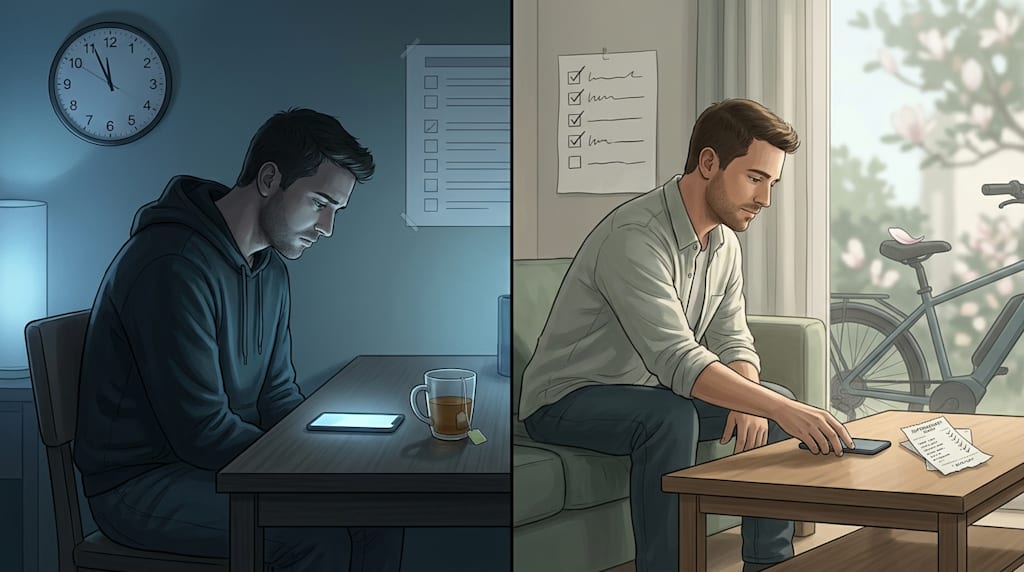
At 11:40 p.m., Chen Mo turned off his phone, then turned it on again. The plan was taped to the wall above his desk, printed in bold: up at 6:30, read for forty minutes, write five hundred words, work out for half an hour. In the corner, small type read: Day 1 of the streak.
That was three days ago. Today’s box was empty.
He turned over. The refrigerator compressor hummed in the living room. A half cup of cold tea sat on the nightstand, the tea bag tag hanging over the rim. He reached for his phone. His thumb opened short videos, swiped through seven, and stopped on the eighth: “How to read a hundred books a year.” He watched fifteen seconds and swiped away.
The next morning he woke at 7:20. The 6:30 box was gone. He sat up and began counting what he owed: no writing yesterday, three hundred words but no workout the day before, five pages of reading the day before that. The count finished, he pulled the blanket over his head and lay there another twenty minutes.
He had three proposals to revise that morning, a meeting in the afternoon, and likely overtime at night. He was not avoiding work because he was lazy. Every time he pictured the string “up at 6:30, read, write five hundred words, work out,” his shoulders tightened. The string looked like an IOU.
Step one: change the judgment about yourself
Chen Mo had long believed he was “the kind of person who slacks off.” The evidence was strong: college papers finished the night before the deadline, a gym membership used seven times in three years, an online course still on lesson two. He treated that evidence like an ID card.
The shift came on a Wednesday. He was supposed to write a quarterly summary. At three in the afternoon, the document was still closed. He stood up for water, passed his desk, and saw the plan on the wall. He did not tear it down. He wrote at the top: I am someone who comes back after an interruption.
The sentence sounded weak. It also moved him from “I slack off” to “I come back.” The first was a verdict. The second gave him a next move. He sat down and wrote fifty words of a product description. Then he washed his cup, threw the tea bag into the wet-waste bin, and watched the wet tag stick to the side.
He wrote another fifty words when he came back. The summary stayed unfinished, but the document was open and saved.
Step two: lower the threshold until skipping feels strange
He changed the plan. The 6:30 line became: after getting up, put the phone on the living-room coffee table. Reading for forty minutes became: open the book and read one page. Writing five hundred words became: open the document, write fifty words, close it. Working out for half an hour became: put on sneakers and walk downstairs for ten minutes.
His first one-page reading happened on Thursday night. The book was Sapiens, kept on the toilet tank lid. He read a page and a half, closed it, and went to wash dishes. By the third dish, he remembered the page was about wheat domesticating humans. He found that mildly interesting and kept washing. The next day he read one page and then a second.
The fifty-word rule produced a client email opening: “Mr. Wang, regarding Thursday’s schedule, we suggest putting Version A in the morning.” He closed the email without sending it. The next morning he finished it because the opening was already there.
A low threshold does one job: it keeps the brain’s alarm quiet. With the alarm quiet, he sometimes did a little extra. That extra bit is where momentum starts.
Step three: put the phone out of reach
He had tried willpower. He turned the phone to grayscale and deleted three short-video apps, then reinstalled two within a week. Later he stopped fighting himself. When he wrote, the phone went into the gap of the living-room sofa, screen down. On the computer, WeChat notifications went off; email stayed on. A kitchen timer sat on the desk, set for twenty-five minutes.
The first session was restless. For ten minutes his fingers tapped the space bar and reached for the mouse. On the third reach, he remembered the phone was in the other room. He walked to the living room and back. After two round trips, he sat down, turned the timer to fifteen minutes, and kept writing.
Focus became easier once the room changed. He stopped competing with algorithms over attention. He put the phone farther away and kept the timer close.
Step four: stop when the basic action is done
He used to finish one task and immediately count the next. After one page, he thought, “Only one page?” After fifty words, “Still four hundred and fifty short.” The day ended with work done and a head full of debt.
He set a new rule: when the basic action is done, the day passes. One page, passed. Fifty words, passed. Ten minutes of walking, passed. After passing, he watched one episode of a show or sat on the balcony watching kids play soccer downstairs.
He changed his review. The old note said: “Didn’t read forty minutes. Didn’t write five hundred words.” The new note said: “Phone in living room. Wrote fifty words. Walked ten minutes.” He stuck each note on the monitor frame. Four notes were already there; the oldest had a curled corner and said, “Washed the dishes.”
On a headache night, he did only one basic action: phone in the living room. Then he slept. The next morning he skipped the make-up work and wrote his fifty words. Make-up homework made the document harder to open.
Step five: after a break, return to the basic action
He broke the streak for four days during a business trip. On Sunday he sat at his desk and saw four empty boxes. He began the old accounting: two hundred words owed, four pages owed, forty minutes of walking owed. He closed the laptop and took a shower.
When he came out, he turned the debt page over and wrote: Today I will open the document and write fifty words. He wrote fifty-seven words about a road sign from the trip. Then he closed the document and went downstairs for soy sauce. The bottle sat on the kitchen counter, label facing out.
The next day he wrote eighty words. The day after, he put the phone in the living room and wrote two hundred. He never made up the two hundred he owed. He never counted again.
A streak can break. The return matters more. One day off, return the next. Four days off, return on the fifth. If the return starts with self-punishment, the system stalls.
Ending
A month later, the plan on his wall was new. It had no streak count. It had five lines: phone in the living room; read one page; write fifty words; walk ten minutes; if broken, come back.
Under the plan was a supermarket receipt. On the back he had written: “Today I went downstairs for a package and saw the magnolia by the gate had bloomed. Petals had fallen on an electric bike seat, and no one had wiped them off.”
The receipt corner curled in the wind. He taped it down. The tape went on crooked. He left it.
About the Creator
Jin
Writer of reamstories
https://reamstories.com/jin
Enjoyed the story? Support the Creator.
Subscribe for free to receive all their stories in your feed. You could also become a paid subscriber, letting them know you appreciate their work.
Comments
There are no comments for this story
Be the first to respond and start the conversation.