
China’s Marriage Crisis Is Turning Into a Gender War
High bride prices, a surplus of men, and online communities like Hupu are turning private economic frustration into a broader fight over women, feminism, and masculinity.
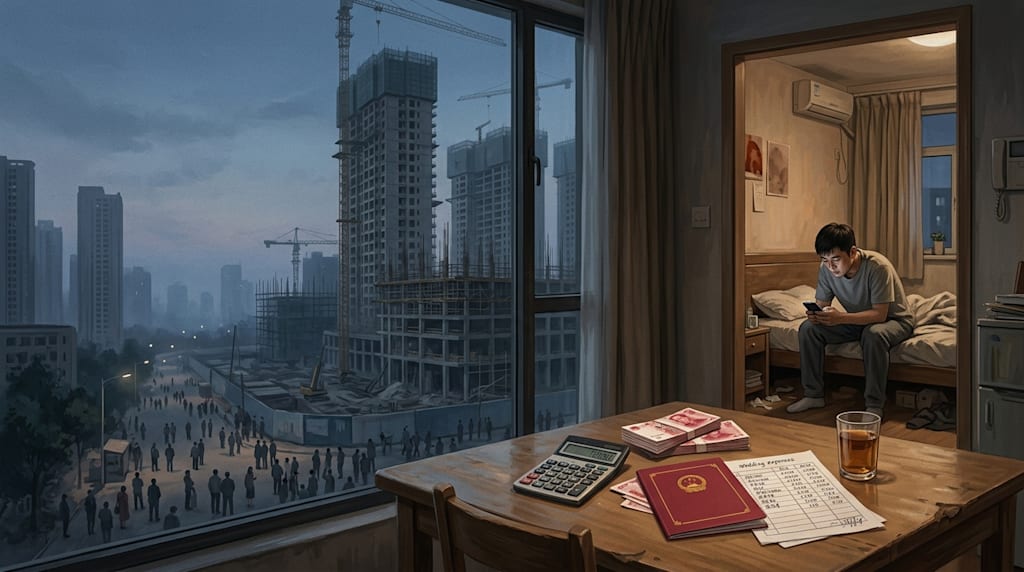
Bride Prices, Gender Imbalance, and Hupu: The Three Layers of China’s Online Male Sphere
The argument usually starts with a simple question: why are some Chinese men so angry at women?
The harder answer begins with money.
In 2024, disposable income per capita for rural residents in China was RMB 23,119. In May 2026, Xinhua, citing a research team from Wuhan University’s School of Sociology, reported that the average bride price in rural China had risen from roughly RMB 10,000 to RMB 20,000 around 2000 to about RMB 140,000 by 2021. Once housing, cars, wedding banquets, gold jewelry and other marriage expenses are included, the total cost for a rural family marrying off a son can reach RMB 600,000 to RMB 1 million.
A crude comparison with rural household income puts that at roughly 26 to 43 years of income.
That does not mean a family literally has to work for 43 years to get its son married. Household income is not the income of a single person, and no family puts all of its earnings into one wedding. But the calculation shows the scale of the problem. Marriage can require years of saving and the transfer of a large share of family wealth.
The problem becomes harder to explain once the marriage bill is placed next to China’s demographic structure.
China’s sex ratio at birth stayed unusually high for decades and reached 121.2 boys for every 100 girls in 2004. The seventh national census found that there were about 17.52 million more men than women aged 20 to 40, implying a sex ratio of 108.9 in that age group. In rural areas, the gap is larger. One study using census data found that the sex ratio among unmarried young people in rural China was 158.03 in 2020, far above the urban figure.
Several forces sit behind those numbers. China’s long period of skewed birth ratios is one. Rural women moving to cities is another. Education, employment, housing and family background all affect who marries whom.
But in some rural marriage markets, the basic arithmetic is hard to ignore. There are more men competing for fewer women, while the groom’s family may be expected to provide a house, a car, a bride price and a large wedding expense. For families with limited assets, the question becomes more than whether a son can find a partner. It becomes whether the family can afford to enter the market at all.
That creates a particular kind of frustration.
A young man who cannot afford marriage can blame his income. He can blame house prices. He can blame the rural-urban divide. He can blame decades of demographic policy and the sex ratio.
Or he can blame women.
That shift matters because the internet gives private frustration a vocabulary.
A 2026 study published in Humanities and Social Sciences Communications examined anti-feminist discussion on Zhihu between 2016 and 2020. The researchers found that male users often drew on digital nationalism, framing feminism as an outside threat and casting women in terms of the nation, marriage and sexual resources. Some female users, meanwhile, reproduced misogynistic ideas through what the study described as a Confucian family framework, including forms of self-objectification and self-commercialization in discussions of marriage and heterosexual relationships.
The researchers did not treat online misogyny as one coherent male ideology. They described a more complicated mix of nationalism, family values and gender politics.
That distinction matters.
A man starts with a private problem: “I cannot afford to get married.”
Online, that can become: “Women only care about money.”
Then: “Women today have been ruined by feminism.”
Eventually, the story can become broader: men are losing because the entire gender order is tilted against them.
The economic problem has not disappeared. It has been renamed.
Once the problem has a name, a group can form around it.
Hupu: From Marriage Frustration to the Brotherhood
Hupu is best known as a sports platform, but it has also developed a large male-centered discussion culture, especially around relationships, status and masculinity.
A 2024 study published in Feminist Media Studies examined Hupu as a Chinese online male space. The researchers argued that hegemonic masculinity is reproduced through everyday practices on the platform, including the objectification of women, derogatory gendered language and a strong sense of male solidarity built around the idea of “brothers.”
Those practices reinforce each other.
A man talks about a failed date and he is still describing one personal experience.
Once the story is retold through terms such as “simp,” “ATM” or “cuck,” it becomes part of a larger ranking system. The vocabulary tells men what counts as weakness, what counts as being used by a woman, and what kind of behavior earns approval from other men.
The same research found examples of users collectively rating women’s appearance. A woman who exists in real life as a specific person becomes an object that can be scored, compared and discussed by a group.
The significance of this is easy to miss.
The internet makes a complicated failure easier to explain.
“I could not find the right person” is messy. It leaves room for bad timing, incompatible personalities, money, family expectations and chance.
“Women only care about money” is much easier.
It is short. It is repeatable. Other people can confirm it.
That is how an individual disappointment becomes a group language.
Baidu Tieba: A Community Needs Enemies, but It Also Needs Traitors
In more extreme corners of the internet, the process goes further.
A 2026 study of China’s online male sphere examined Baidu Tieba communities including Sun Xiaochuan Ba, a forum that began as a youth subculture space built around so-called “abstract culture.” The research traces its later movement toward a much more aggressive male identity, with misogynistic language, male grievance and connections to broader incel and manosphere ideas.
The important part is not only the hostility toward women.
A stable group also needs a boundary inside the group.
Terms such as “simp,” “ATM” and “cuck” do that work. They mark the men who are considered too submissive, too eager to please women, or too willing to abandon the expectations of the group.
That creates an internal test.
Who counts as one of us?
Who has violated the rules?
Who has failed to behave like a “real man”?
Once those boundaries become familiar, relationships stop being purely private matters. They become tied to male identity.
That is one of the clearest differences between ordinary complaining and a male online subculture.
A complaint disappears.
A community keeps the vocabulary.
Why Bride Prices Turn Into a Gender Fight
Bride prices are not the original cause of online misogyny.
They are one of the experiences that make the grievance tangible.
A rural family may spend years saving for a son’s marriage. At the same time, demographic imbalance can make marriage harder for some men to enter in the first place.
China’s population data show how quickly the wider context is changing. In 2025, mainland China recorded 7.92 million births, while the year-end population fell by 3.39 million. The country registered 6.763 million marriages that year, up 10.8% from 2024 but still about half the 13.469 million recorded in the 2013 peak year.
The 2025 rebound in registrations matters, but it did not erase the longer decline.
A young man facing this environment can end up dealing with several pressures at once.
His family may lack money.
His local marriage market may have too few women.
Fewer people in the wider society are entering marriage.
None of those problems can be solved by blaming women.
But online language does not have to solve a problem. It only has to explain it.
So complex pressures get compressed into familiar claims:
Women are too materialistic.
They demand too much.
Feminism changed women.
Men are the real victims.
Those statements may grow out of genuine experiences. A man who was rejected because he did not own a house has not imagined the rejection. A family facing a huge bride price is not inventing the financial burden.
The issue is what happens next.
One experience becomes evidence for a general rule.
A collection of individual stories becomes group folklore.
Eventually the explanation starts to feel self-evident because the same story has been repeated so many times.
That is the mechanism the research is picking up.
Why Women Become the Easier Target
Structural problems do not have faces.
House prices do not have faces.
The rural-urban divide does not have a face.
The sex ratio does not have a face.
Population policy does not have a face.
Women do.
This does not mean men are incapable of understanding structural problems. It means that online arguments work better when the object of anger is concrete.
“I cannot afford the cost of marriage” can become “women demand too much.”
“My chances of finding a partner are getting worse” can become “women only choose rich men.”
“I cannot trust relationships anymore” can become “women have all been brainwashed by feminism.”
In social science terms, that is an attribution shift. A diffuse structural problem is turned into a conflict between recognizable groups.
In everyday life, the process may be much less dramatic.
Someone opens his phone.
He sees another man telling the same story.
Someone replies, “Same here.”
The problem has found a second life.
The first life was in the marriage market.
The second is in the comment section.
Regulation Has Arrived, but the Underlying Problems Remain
During the 2026 Lunar New Year period, the Cyberspace Administration of China launched a “Clean Internet 2026” campaign. Its targets included content that promoted not marrying or not having children, encouraged hostility between men and women, or intensified fear around marriage and childbirth.
At the same time, a second body of research has documented the constraints placed on feminist expression online in China. Studies of #MeToo and other feminist campaigns have found that posts, accounts and forms of collective action can face deletion or restrictions, forcing activists to adapt their language and methods of organizing.
That does not, by itself, prove that misogynistic speech is officially tolerated.
The narrower point is easier to support: different forms of gender politics do not face identical conditions online.
A 2026 study of Zhihu found that the label “anti-feminism” was less likely than some other forms of gendered expression to be removed, which gave that language more room to circulate publicly. Research on feminist organizing, meanwhile, has documented stronger constraints on collective and activist forms of expression.
The distinction matters.
When one form of speech becomes harder to sustain and another remains relatively visible, the online world will not present a neutral picture of the underlying society.
But that is a condition of communication, not proof of a simple one-way political cause.
“The Male Sphere Is Growing” Is the Wrong Question
There is no reliable national measure showing how many Chinese men belong to an online “male sphere,” how large it is, or how fast it is growing.
That claim is stronger than the evidence allows.
What can be observed is something more specific: China has a durable network of male-centered online spaces, each with its own language, status rules and ideas about gender.
Zhihu supplies explanations.
Hupu supplies a strong sense of male community.
Baidu Tieba can push those boundaries further, with rougher language and sharper tests of group membership.
The platforms differ, but the mechanism has similarities.
A personal failure is turned into a group identity.
The group identity then gives that personal failure an explanation.
That is the part of the cycle that matters.
Bride Prices Are Not the End of the Story
Talk only about bride prices and the argument becomes a debate about whether bride prices are justified.
Talk only about the sex ratio and the argument becomes a story about too many men.
Talk only about Hupu, Tieba and misogyny and the issue becomes a story about ugly things people say online.
Each version captures something. None explains the whole chain.
The sequence is longer:
Marriage becomes more expensive. Competition becomes harder. Some people fail to enter the marriage market. Failure needs an explanation. Online communities offer a gendered explanation. The explanation becomes part of group identity. That identity then shapes how the next relationship is understood.
At that point, the question is no longer simply why some men are angry.
The harder question is what kind of explanation a society gives people when the forces shaping their lives are too large to control individually.
A young man cannot change the national sex ratio.
He cannot move a rural economy into a different income bracket by himself.
He cannot reverse years of house-price inflation on a dating app.
He cannot rewrite family expectations about marriage.
He can, however, open a forum and find ten thousand people telling him that the problem is women.
That explanation is simple. It also gives the frustration a target.
China is now dealing with several pressures at once: fewer births, a long decline in marriage registrations, persistent concern over the cost of marriage in rural areas, and tighter regulation of how marriage, gender and fertility are discussed online.
Those developments can coexist.
A deleted post does not make marriage cheaper.
Banning a slur does not change the balance between rural incomes and housing costs.
Removing a hostile thread does not give a young man more money, more housing or a better chance of finding a partner.
The difficult part is that the enemy created by an online argument is concrete.
The problems underneath it are not.
That is why the male online sphere deserves attention.
Not because it is necessarily turning into a centralized political movement. There is not enough evidence to make that claim.
The more immediate issue is whether its explanations begin to feel normal.
When a man loses his job, how does he explain it?
When a date fails, what does he blame?
When his parents borrow money for a house, where does he put the responsibility?
When a marriage breaks down, which story does he reach for first?
Those answers matter because people do not enter relationships empty-handed. They bring a set of assumptions with them.
Once those assumptions become shared, repeated and socially rewarded, they stop looking like internet talk.
They become part of everyday life.
About the Creator
Jin
Writer of reamstories
https://reamstories.com/jin
Enjoyed the story? Support the Creator.
Subscribe for free to receive all their stories in your feed. You could also become a paid subscriber, letting them know you appreciate their work.
Comments
There are no comments for this story
Be the first to respond and start the conversation.