
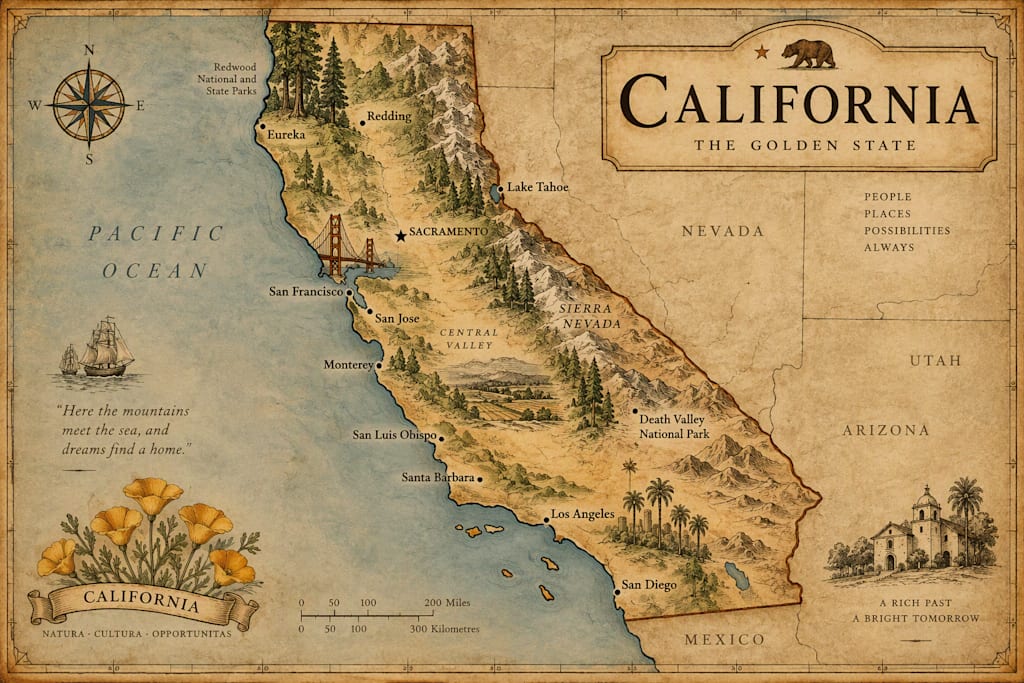
One morning, as I dropped off my daughter, son-in-law, and grandson at the airport, I found myself thinking about their journey. They were traveling to the West Coast of the United States to see and explore California.
Then I started thinking about the name itself.
California.
It sounds so beautiful and musical. But where did this name come from? Who came up with it? And what does it actually mean?
I started looking into the story behind the name, and what I found amazed me.
We often take names for granted. They become part of our everyday lives, and we rarely stop to wonder where they came from or what stories they carry. But behind the name California lies a fascinating story, one that reaches across oceans, literature, history, and cultures.
So, I wanted to share that story.
Like me, I believe many Americans may never have stopped to wonder about the interesting story behind the name California.
History has a peculiar way of hiding its greatest surprises in plain sight.
Sometimes, what we think we know has traveled a much longer road than we could ever imagine.
In 1510, barely eighteen years after the fall of Granada, a Spanish writer, Garci Rodríguez de Montalvo, published a wildly popular chivalric romance known simply as Esplandián. Like many great works of imagination, it transported its readers into a world where history and fantasy blended seamlessly.
Among its many wonders was a magnificent island inhabited by fierce warrior women clad in gold and ruled by a legendary queen named Calafia. The novel captured the imagination of Spain and became one of the great bestsellers of its age. Decades later, Miguel de Cervantes would even mention it in Don Quixote, a testament to its enduring popularity.
Then fiction took an unexpected turn.
In the 1530s, Spanish explorers sailing along the western coast of the New World believed they had discovered a vast island. Like countless readers before them, they were captivated by Montalvo's tale. Believing they had found an island worthy of his mythical kingdom, they borrowed the name from his novel and placed it upon their maps.
But where did Montalvo find the name Calafia?
That question puzzled historians for centuries.
The answer appears to lie in the Spain he knew so well.
Most historians and linguists agree that Montalvo drew inspiration from the Arabic word Khalīfa (خليفة)—"Caliph," meaning successor, ruler, or leader. Living in a Spain that had only recently emerged from nearly eight centuries of Muslim civilization, words such as califa, and the grandeur of the great Caliphates, remained part of the cultural memory of his generation.
Rather than merely borrowing the title, Montalvo transformed it into the feminine name Calafia, the powerful queen of his imagined kingdom. The literary creation was entirely his own, but its inspiration appears deeply rooted in the world that had shaped Spain for centuries.
For nearly eight centuries (711–1492), much of the Iberian Peninsula was under Muslim rule. Those centuries transformed Spain in countless ways—its architecture, science, agriculture, philosophy, music, and above all, its language. Linguists estimate that nearly eight percent of modern Spanish vocabulary, around 4,000 words, is derived from Arabic.
Empires rise and fall.
Languages remember.
From Khalīfa came Calafia.
From Calafia came the name of her mythical kingdom.
And from that mythical kingdom came a name spoken by millions of people every single day without ever wondering where it began.
That name was...
California.
Centuries later, the literary origin of the name faded into obscurity until historians such as Edward Everett Hale and Ruth Putnam painstakingly traced it back through early Spanish manuscripts, confirming the remarkable journey of a word that had crossed languages, civilizations, literature, and continents.
History often reminds us that civilizations are far more connected than we imagine. The imagination that created California was itself shaped by centuries of interaction with Islamic civilization.
This is not a story about one civilization claiming another. It is a reminder that no civilization develops in isolation. Languages borrow. Stories travel. Ideas cross borders. Writers absorb the worlds around them, often without realizing how deeply those worlds have shaped their imagination.
Perhaps that is history's greatest irony.
People may forget the bridges that once connected civilizations, but language never does. Long after kingdoms disappear and empires become memories, words continue their journey, quietly carrying the echoes of the past into the present.
History remembers more than we do. Long after kingdoms vanish and empires become memories; language continues to tell the story of humanity's shared journey.
"O mankind! We created you from a male and a female and made you into nations and tribes so that you may know one another." (Qur'an 49:13)
Selected References
Edward Everett Hale, The Name of California. Proceedings of the American Antiquarian Society (1862).
Ruth Putnam, California: The Name. University of California Publications in History, Vol. 4, No. 4 (1917).
María Rosa Menocal, The Ornament of the World: How Muslims, Jews, and Christians Created a Culture of Tolerance in Medieval Spain.
L. P. Harvey, Islamic Spain, 1250–1500.
Richard Fletcher, Moorish Spain.
About the Creator
Akram Mohammed
From a four-decade IT career to storytelling, I write about South Indian Islamic history, memoirs, faith, philosophy, cultural heritage, and nature, uncovering overlooked perspectives and meaningful human connections.
Enjoyed the story? Support the Creator.
Subscribe for free to receive all their stories in your feed.
Comments
There are no comments for this story
Be the first to respond and start the conversation.