
What If Cleopatra Could Speak Back?: Reclaiming a Queen from Myth, Empire, and Misinterpretation.
Saara El-Arifi’s “Cleopatra” restores a voice buried under centuries of rewritten history.

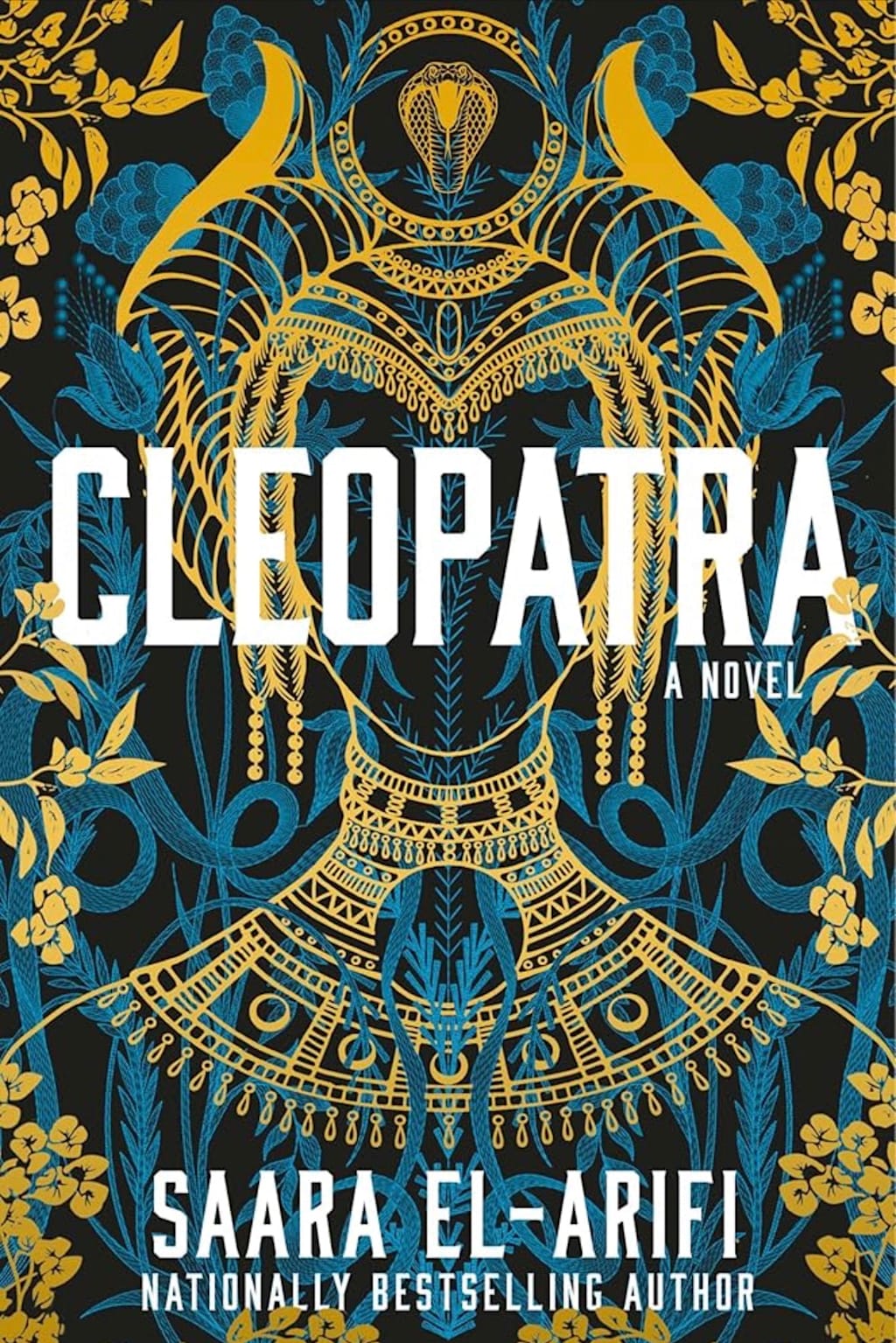
Cleopatra is one of those rare historical figures who may never stay in one thing.
She has been a lover, a seductress, a strategist, a tragedy, a political threat, and a cinematic icon. Every era has reshaped her into something it needed her to be. But very few versions ever let her exist as a person–thinking, remembering, doubting, and choosing.
That’s what makes Saara El-Afifi’s Cleopatra: A Novel feel so different. It doesn’t behave like another retelling. It behaves like a correct perspective.
It reads less like history being narrated about Cleopatra VII Philopator and more like Cleopatra being allowed to respond.
A Queen Who Refuses to Be Flattened Down by History
From the beginning, Cleopatra is not labeled as an abstract symbol but as someone aware of how unstable her identity is in the historical record.
She is negotiating between:
- Political expectation
- Cultural inheritance
- Personal memory
- And the stories others are writing about her.
Even her relationships with Julius Caesar and Mark Anthony are not reduced to romance. They begin as political alignment, ideological overlap, and strategic necessity before any emotional dimension appears.
In this version, Cleopatra is not someone swept through history.
She is someone trying to think inside it.
Alexandria: A City That Thinks As Much As It Breathes
The portrayal of Alexandria is one of the novel’s strongest elements. It is not a backdrop–it is a living system of contradictions.
Markets, temples, scholars, sailors, and political tensions all occupy the same space. And at the center, Cleopatra moves not as a distant monarch, but as someone engaging with the lived reality of her people.
She leaves the palace. She walks the city. She tends to the sick without asking who they are.
And in those moments, power stops being abstract and becomes something intimate: responsibility. Existing institutions like the Library of Alexandria also reinforce her intellectual environment. This is a world where knowledge is not separate from governance–it is part of it.
A Scholar Trapped Inside a Crown
One of the most quietly devastating aspects of Cleopatra’s characterization is her intellectual identity.
She does not think like a traditional ruler. She thinks like someone who wants to understand systems rather than only control them.
She studies. She observes. She questions. But she is never given the full freedom to live as a scholar because her role demands action over reflection. That tension becomes a defining feature of her reign: she governs like someone who understands the world in hopes of one day being able to simplify it.
Family History: A Dynasty Built on Layered Identity
One of the most important expansions in the novel is how it reframes Cleopatra’s family history, not as a status lineage, but as cultural and spiritual hybridity.
In El-Arifi’s version, Cleopatra’s mother is reimagined as an indigenous member of an Egyptian priesthood devoted to Isis. This reframing is not just genealogical; it is symbolic.
It creates a Cleopatra who is not solely the product of a Macedonian-Greek dynasty, but someone born from two overlapping worlds:
- The Hellenistic royal structure of the Ptolemies
- And a deeply rooted Egyptian spiritual tradition tied to priestly culture and ritual life.
This dual heritage reshapes everything about her identity:
- Her relationship to Egyptian language and culture becomes inherited, not adopted.
- Her spiritual alignment with Isis becomes personal, not performative.
- Her sense of legitimacy is rooted in more than just political lineage.
Even when scholars debate Cleopatra’s maternal lineage historically, some suggesting Macedonian or Greek Nobel origins, the novel uses this ambiguity as narrative space rather than limitation.
It turns uncertainty into meaning: Cleopatra is not just inheriting a throne. She is inheriting competing versions of belonging.
Marriage, Performance, and the Language of Power
Her marriages to her brothers, including Ptolemy XIII Theos Philopator and Ptolemy XIV, are reframed not as emotional bonds but as political structures.
Cleopatra never refers to them as husbands. She continues to call them brothers.
That distinction alone is not accidental. It reflects a psychological separation between:
- What the state demands
- And what she internally recognizes as real
She takes part in a tradition without surrendering interpretation to it.
Charmion: The Private World That Doesn’t Belong to Empire
Her relationship with Charmion represents something entirely outside political structure.
Charmion is presence, continuity, and emotional grounding in a world defined by instability. Their bond carries intimacy that exists outside court performance, shaped by trust rather than strategy.
She is also part of Cleopatra’s domestic life, helping her raise her children, anchoring her in something that feels less like empire and more like lived humanity. In a story built on visibility and legacy, Charmion represents something rare: a relationship that does not need to be performed to exist.
Children, Legacy, and the Fragmentation of Future
Cleopatra’s children are central to the emotional architecture of the novel. Her goal is not domination; it is continuity.
But history fractures that hope.
Caesarion is eliminated as a political threat. Cleopatra Selene II survives and is absorbed into another royal lineage. The other two children are dispersed into systems that reshape their identities beyond her control.
Even legitimacy becomes unstable, especially in relation to Caesarion’s contested position within Roman power structures.
What emerges is a painful truth: love does not guarantee survival in systems built on consolidation and control.
The Smear Campaign That Outlives Her
One of the novel’s most emotionally charged threats is the continuation of the smear campaign against Cleopatra even after her political collapse.
She is reframed through Roman and later cultural narratives as:
- Seductress
- Manipulator
- Foreign disruption
Rather than a builder, thinker, or ruler.
Figures like Shakespeare, and later adaptations, are not portrayed as villains; they are portrayed as inheritors of a narrative that was already shaped by imperial politics.
The result is a Cleopatra who is constantly rewritten by people who never met her.
Rome Wins the Empire, Not the Meaning
When Egypt is absorbed into a Roman colony under Augustus, Cleopatra’s political world ends. But the novel refuses to end her story there.
Through the presence of Isis, Cleopatra transitions into a mythic perspective, not as an escape, but as reframing.
She becomes a witness to that follows:
- Her children’s divergent fates
- Egypt’s absorption into the Roman Empire
- And the transformation of her own identity into legend
Rome controls territory. But it does not fully control interpretation.
The Curse, the Lineage, and the Question of Inheritance
The novel introduces the idea of a dynastic “curse” tied back to early Ptolemaic origins, often associated with figures like Ptolemy I Soter.
In mythic framing, this curse is not literal; it represents imbalance:
- Foreign rule layered over sacred systems
- Legitimacy built through appropriation and political blending
- And centuries of instability within inherited power structures.
When Isis suggests Cleopatra has “broken” it, the meaning is symbolic: she is the point where the cycle stops reproducing itself in the same way.
Even details like symbolic readings of her children become part of this logic–signs that the next generation is no longer carrying the same inherited weight in the same form.
Cleopatra Finally Speaks Back
At its core, the novel is structured like something deceptively simple: a conversation. Not about Cleopatra, but with Cleopatra herself.
She responds to centuries of interpretations. She challenges mythologized versions of herself. She resists being flattened into romance, tragedy, or as a political caricature. And in doing so, she becomes something rare in historical fiction:
Not as a symbol. Not a cautionary tale. But as a voice insisting that she was always more complicated than the stories told about her.
Final Reflection
What makes this version of Cleopatra interesting is not that it claims to be definitive. It doesn’t replace history. Instead, it restores what history often erases first: interiority.
A ruler shaped by competing cultures and inherited contradictions. A scholar’s mind constrained by a crown. A mother navigating legacy under imperial collapse. A woman aware that she is being rewritten even as she speaks.
And maybe that’s the genuine achievement of El-Arifi’s novel. Not answering every question about Cleopatra.
But finally, letting her answer some of them herself.
About the Creator
Jenna Deedy
Just a New England Mando passionate about wildlife, nerd stuff & cosplay! 🐾✨🎭 Get 20% off @davidsonsteas (https://www.davidsonstea.com/) with code JENNA20-Based in Nashua, NH.
Instagram: @jennacostadeedy
Enjoyed the story? Support the Creator.
Subscribe for free to receive all their stories in your feed. You could also become a paid subscriber, letting them know you appreciate their work.
Comments
There are no comments for this story
Be the first to respond and start the conversation.