
The Underground City of the Believers: The Community That Chose Darkness
A Veil of Shadows Exclusive

In the frozen wilderness of Imperial Russia, where endless forests stretched beyond the horizon and winter could swallow entire villages beneath snow and silence, rumors began circulating about a community that had vanished, not moved, not fled, but vanished.
According to reports, government officials arrived at a remote religious settlement near the end of the nineteenth century expecting to conduct a routine census. Instead, they found an abandoned compound. The homes stood empty, the workshops were silent, no smoke rose from chimneys, no children played in the snow, and no livestock wandered the yards.
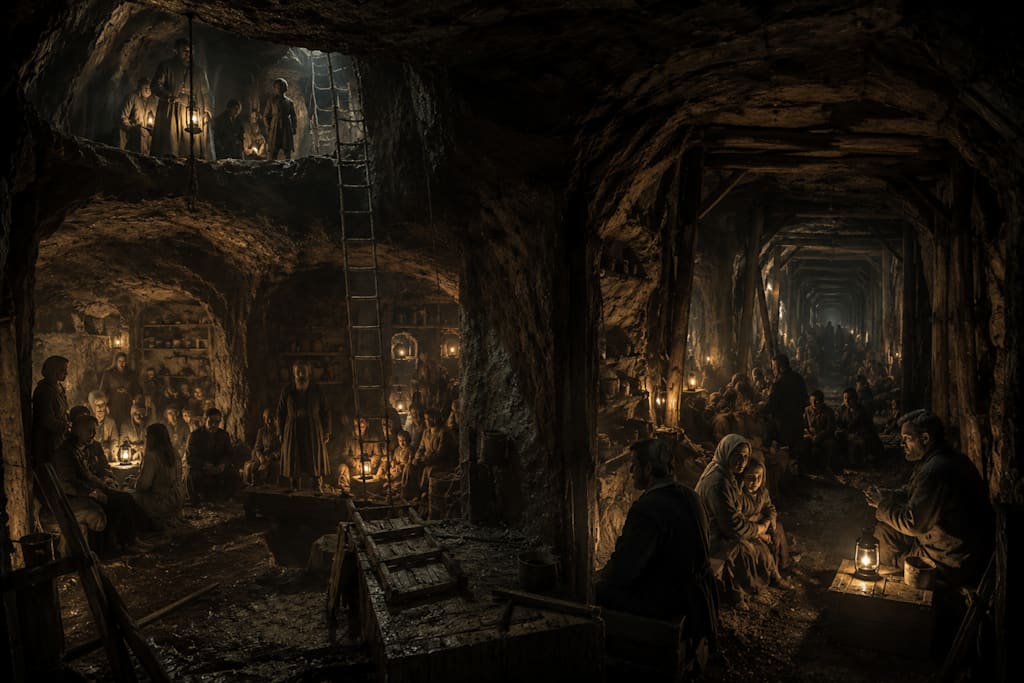
At first glance, it appeared the villagers had simply left. Then, investigators discovered what lay beneath the settlement: an enormous network of tunnels, underground chambers, and passageways carved deep into the earth, along with evidence suggesting the community had intentionally sealed itself inside.
The story would become one of the strangest and most disturbing legends to emerge from Imperial Russia. A tale of faith, fear, isolation, and a choice so extreme that it continues to shock historians more than a century later.
To understand the story, we first need to understand Russia in the nineteenth century. The Russian Empire was vast, stretching across eleven time zones and encompassing countless cultures, languages, and religious traditions. Not everyone accepted the authority of the state, nor did everyone trust the official Russian Orthodox Church. For centuries, religious dissenters had formed isolated communities far from government control, fleeing into forests, swamps, mountains, and remote wilderness. Among these groups were the Old Believers, whose origins stretched back to the seventeenth century, when reforms within the Orthodox Church triggered a massive religious schism. Many believers rejected the changes, viewing them as corruption or even as signs of the approaching apocalypse. The result was persecution, imprisonment, and exile. Generations later, many communities still lived in relative isolation, viewing government officials with suspicion, church authorities as compromised, and state registration as a spiritual threat.
In certain fringe groups, these fears became even more extreme. Some sects developed apocalyptic beliefs centered on the arrival of the Antichrist. Government documents, passports, tax rolls, military service, and even censuses could all be interpreted as tools of spiritual domination. To modern observers, such fears may seem irrational, but for isolated believers convinced they were living in the final days of human history, they felt terrifyingly real.
By the late 1800s, stories began circulating about remote communities preparing for a final confrontation with the outside world. One such story emerged from the Russian wilderness in 1897, when Imperial Russia launched a major national census. Officials spread across the empire, collecting information about millions of citizens. Most people complied, some resisted, and a few reacted with panic. Among certain religious sects, rumors spread that being counted represented submission to the forces of evil. Placing one's name on government records was, according to some interpretations, equivalent to surrendering oneself to the Antichrist. As the census approached, reports suggested that one isolated community, already withdrawn from mainstream society, believed a final test had arrived.
The details vary depending on the source; some accounts describe secret meetings, others mention prophetic visions, and still others suggest charismatic leaders convinced followers that spiritual survival required complete separation from the world. Whatever the truth, preparations reportedly began, not for escape, but for burial. Beneath the settlement, believers allegedly expanded an existing network of underground chambers. The tunnels were extensive: storage rooms were constructed, ventilation shafts created, and passageways connected hidden chambers beneath the earth. The underground complex became a world of its own. A city beneath the surface and a refuge from what they believed was a corrupt and doomed civilization.
Then came the census. Government officials eventually arrived, and what happened next remains difficult to reconstruct with certainty. The most common version of the story claims the authorities found the settlement deserted. At first, they assumed residents had fled, but searches revealed something unexpected: the tunnel network. Investigators reportedly entered portions of the underground complex; some passages stretched far beneath the settlement, others had collapsed. Whether naturally or intentionally was impossible to determine immediately, but as authorities explored deeper, they reportedly realized something horrifying: the collapses appeared deliberate, passages had been blocked, entrances sealed, and escape routes destroyed. The evidence suggested people had been underground when the tunnels were closed, not outside them, but inside. According to the legend, the community had chosen entombment rather than registration. They had buried themselves alive.
The story spread rapidly. Even in an era filled with unusual tales from the Russian frontier, it stood out as extraordinary. Could hundreds of people truly make such a choice? Would parents condemn their children to darkness? Could faith really overcome the most basic human instinct for survival? The answers remain frustratingly unclear.
Some historians believe the story became exaggerated as it circulated, while others point out that similar incidents genuinely occurred throughout Russian history. In fact, one of the most unsettling realities behind the legend is that mass self-entombment was not entirely unheard of. Certain extremist sects practiced what became known as "death by fasting," others sealed themselves inside buildings, and some communities committed collective suicide rather than submit to authorities they believed served evil forces. Historical records document multiple incidents in which believers chose death over compromise. The most infamous examples involved groups known as the Fire Baptizers, thousands of whom reportedly perished in mass immolations during the seventeenth and eighteenth centuries. For them, physical death represented spiritual victory. Against that backdrop, the legend of the underground city becomes less impossible than it initially appears. The question is not whether such beliefs existed… they did. The question is whether this particular story unfolded exactly as later accounts describe. And there the mystery begins.
No complete archaeological survey of the alleged underground complex survives, and no definitive records identify the exact location with certainty. Some researchers suspect that multiple historical events merged into a single narrative, while others argue that the story was embellished over decades of retelling. Yet certain details persist: again and again, references appear to hidden tunnels; again and again, accounts describe isolated believers refusing state authority; again and again, the image returns. A community beneath the earth, waiting in darkness, listening to the sounds of the outside world fade away.
What must that have been like? Imagine the final moments: the last shaft of daylight disappearing, the final entrance collapsing, the silence settling over the chambers, and the realization that there would be no return, no rescue, no second thoughts, only darkness and faith. For believers, the act represented triumph; for outsiders, it represented tragedy; and for modern observers, it remains difficult to comprehend. Perhaps that is why the story continues to endure, not because it is supernatural, but because it forces us to confront something profoundly unsettling: the immense power of belief.
History often focuses on kings, wars, and revolutions, yet some of the most disturbing events occur quietly, far from cities and battlefields. A small community, a shared conviction, a decision that seems unimaginable to everyone except those making it. Somewhere in the forests of old Russia, whether through legend, history, or a mixture of both, a group of people may have chosen darkness over compromise. They feared being counted more than they feared death, and if the stories are true, they disappeared beneath the earth without leaving so much as a farewell. No monsters stalked the tunnels, no ghosts haunted the chambers, and no supernatural force dragged them underground. What remains far more frightening is the possibility that they walked there willingly. And once the entrances were sealed, the world above simply moved on, leaving only a legend.
A buried city, and one haunting question: Could the threat of a census really drive an entire community to choose a grave of their own making?
About the Creator
Veil of Shadows
Ghost towns, lost agents, unsolved vanishings, and whispers from the dark. New anomalies every Monday and Friday. The veil is thinner than you think....
Enjoyed the story? Support the Creator.
Subscribe for free to receive all their stories in your feed.
Comments
There are no comments for this story
Be the first to respond and start the conversation.