
The Town That Never Stopped Talking to the Dead
Intrigue Monday Edition

Most American towns have a story. Some were built around railroads, others grew beside rivers, mines, or factories. Entire communities sprang to life because someone discovered gold, drilled for oil, or saw promise in fertile farmland.
But tucked away in western New York is a place unlike any other in the United States. Lily Dale wasn't founded because of natural resources, built around commerce, or established to defend a frontier. Instead, an entire community was created around one extraordinary idea: that communication between the living and the dead was possible. Welcome to Lily Dale...
To many Americans, the name means nothing. It doesn't appear on lists of famous vacation destinations, and few road atlases give it more than a passing glance. Yet for well over a century, this quiet Victorian village has welcomed visitors from around the world. People seeking something they cannot buy in a store or photograph with a camera: a message from someone they have lost. Whether one believes such communication is possible is a deeply personal question. The remarkable part of this story is that the town itself is very real.
To understand how such a place came to exist, we have to travel back to the middle of the nineteenth century, when America was changing at a breathtaking pace. Railroads stitched the country together, telegraph wires carried messages faster than ever before, and scientific discoveries seemed to arrive almost monthly, convincing many that the impossible was becoming ordinary. At the same time, another movement was quietly taking hold. In 1848, two young sisters in Hydesville, New York, claimed they were communicating with an unseen spirit through mysterious knocking sounds. News of the so-called Fox sisters spread rapidly across the country. Their demonstrations fascinated thousands of curious observers and ignited what became known as the American Spiritualist movement. For many people, it offered something churches often struggled to provide: the comforting hope that death was not the end of a conversation.
Then history intervened. The American Civil War left an unimaginable trail of grief. Hundreds of thousands of families mourned fathers, sons, brothers, husbands, and friends who would never return home. Across the nation, people searched desperately for reassurance that their loved ones still existed somewhere beyond the veil. Spiritualism found fertile ground in that sorrow. Public séances became common, mediums traveled from town to town, and lecture halls filled with audiences eager to hear discussions about the afterlife. Newspapers debated the movement with equal measures of fascination and skepticism. By the late nineteenth century, Spiritualism had become one of America's most talked-about religious and cultural movements.
Out of that remarkable chapter of history came an unusual idea: what if believers didn't simply gather for occasional meetings, what if they built an entire community?
In 1879, a group of Spiritualists established what would eventually become Lily Dale on the shores of Cassadaga Lake. Originally envisioned as a summer assembly where like-minded people could gather for lectures, fellowship, and demonstrations, the settlement slowly evolved into something much more enduring. Unlike many communities born from nineteenth-century idealism, Lily Dale never disappeared; it simply kept going. Walking through Lily Dale today feels strangely disconnected from the pace of modern life.
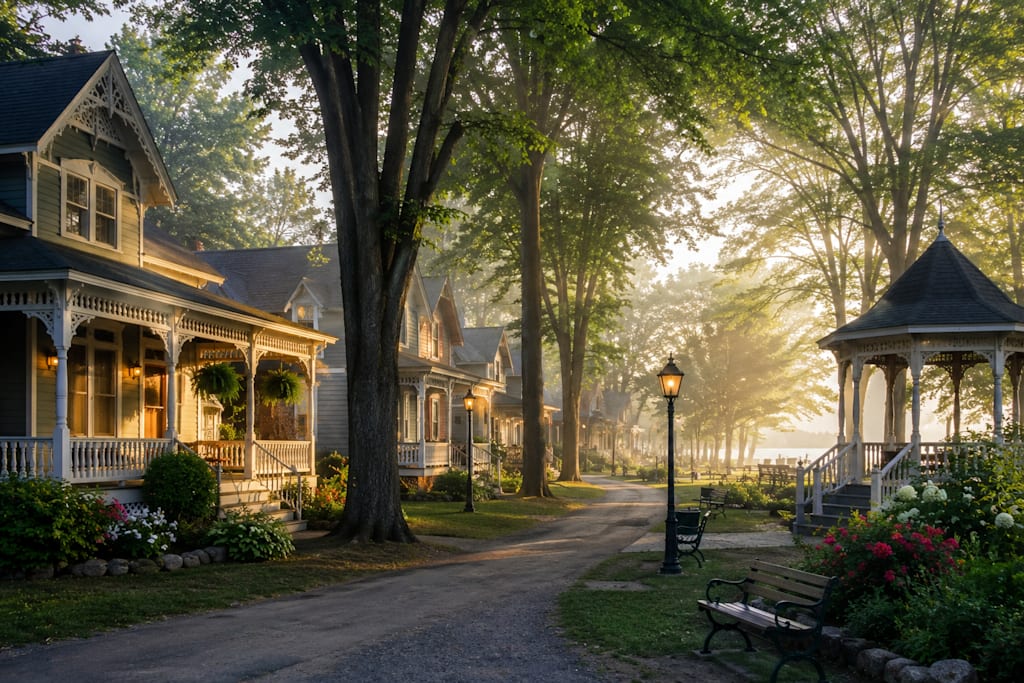
Quiet tree-lined streets wind between beautifully preserved Victorian cottages. Wooden porches invite slow conversations. Historic buildings stand beneath towering maples whose branches have shaded generations of visitors. During the summer season, flowers spill from carefully tended gardens while the sounds of birds and rustling leaves replace the noise of city traffic.
At first glance, it appears to be little more than a charming lakeside village frozen in time. Then you notice the signs. Names of practicing mediums appear beside front doors. Announcements advertise public message demonstrations. Schedules list healing services, lectures, workshops, and classes devoted to Spiritualist philosophy. This is not a museum recreating the past. It is a living community continuing traditions that began nearly a century and a half ago.
One of the town's most distinctive features is its community of registered mediums. Those who wish to practice professionally within Lily Dale undergo a certification process designed by the community itself. Visitors often schedule private readings, while larger public gatherings invite attendees to witness mediums delivering messages they believe originate from departed loved ones.
For believers, these moments can provide profound comfort. For skeptics, they offer an opportunity to observe one of America's oldest surviving Spiritualist traditions firsthand. For historians, they represent something equally fascinating: the uninterrupted survival of a uniquely American cultural movement. That continuity may be Lily Dale's greatest achievement.
Many nineteenth-century utopian communities vanished within decades, religious colonies dissolved, experimental settlements were abandoned, and idealistic societies often collapsed under financial pressures or changing generations. Lily Dale adapted. Electricity arrived. Automobiles replaced horse-drawn carriages. Radio gave way to television, then computers, smartphones, and the internet. Wars reshaped the nation, entire industries rose and fell, and yet each summer, visitors still passed through Lily Dale's gates seeking the same thing that brought travelers there in the 1880s: hope.
Perhaps that explains why the town continues to attract not only committed Spiritualists but also historians, architects, curious tourists, and travelers simply interested in unusual places. Some come searching for answers, others searching for history, and many leave having found a little of both.
What often surprises first-time visitors is how peaceful the community feels. Popular culture frequently portrays anything connected with spirits through the lens of haunted houses, horror films, or ghost stories. Lily Dale feels nothing like that. Its atmosphere is one of reflection rather than fear. Its streets invite quiet walks, its meeting halls encourage thoughtful conversation, and its traditions are rooted less in frightening the living than in comforting those who mourn. That distinction is easy to overlook until you experience the town's history for yourself.
Whether one accepts the claims of Spiritualism is ultimately beside the point. The true wonder of Lily Dale lies elsewhere. Against extraordinary odds, one small American community has preserved a worldview that flourished during the Victorian era while allowing future generations to explore it for themselves. Rather than becoming a forgotten footnote in a history book, Lily Dale remains a place where the past still feels remarkably close. Perhaps that is why its story deserves a place in the pages of The Iron Lighthouse.
America is filled with hidden corners that reveal unexpected chapters of our national story. Some are abandoned railroads disappearing beneath forests, some are giant concrete arrows still pointing across lonely deserts, and some are quiet villages where front porches, shaded lanes, and century-old traditions remind us that history is not always locked away behind museum glass; sometimes it is still very much alive.
Whether visitors arrive as believers, skeptics, or simply curious travelers, nearly everyone leaves Lily Dale carrying the same realization: they didn't just visit an unusual town; they stepped into one of America's most enduring and most unexpected living time capsules.
About the Creator
The Iron Lighthouse
Where folklore meets freeway. A guide to the strange heart of the American backroads...
Enjoyed the story? Support the Creator.
Subscribe for free to receive all their stories in your feed.
Comments
There are no comments for this story
Be the first to respond and start the conversation.