
The Race Around the World: When Six Automobiles Tried to Conquer the Earth
Iron Lighthouse Monday Edition

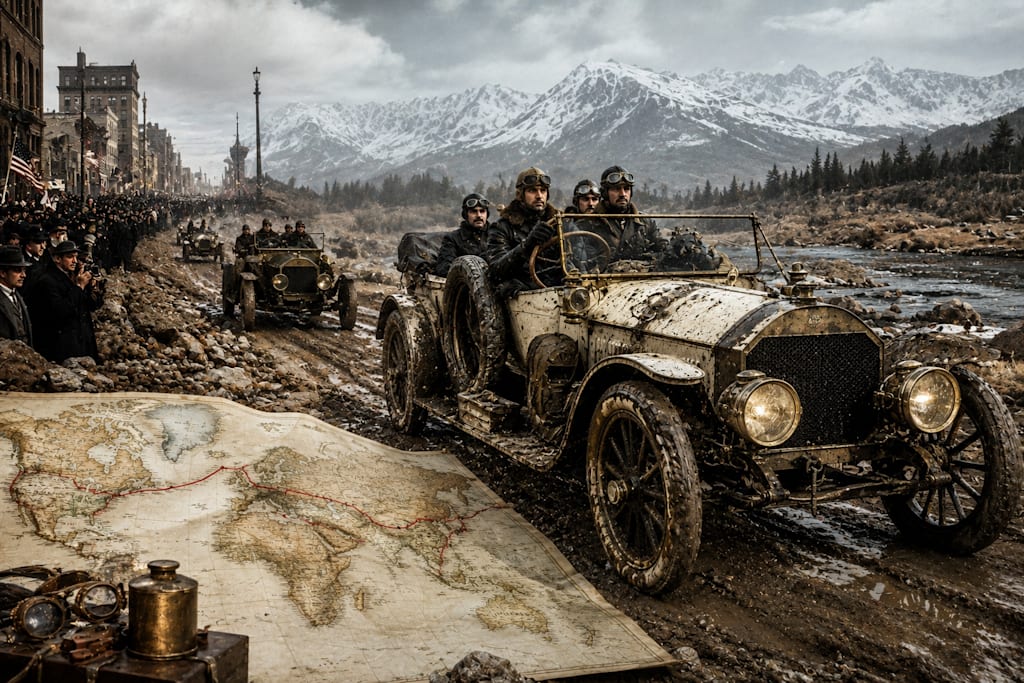
On a bitter winter morning in February 1908, a crowd gathered in the heart of New York City to witness what many considered either a historic achievement or an act of complete madness.
Six automobiles stood waiting in Times Square. Their mission was simple to describe and almost impossible to accomplish... Drive to Paris. Not from another European city. Not from a neighboring country, but from New York!
The proposed route would cover roughly 22,000 miles across three continents, some of the harshest terrain on Earth, and regions where roads barely existed. It would take competitors through America, Alaska, Siberia, Russia, and Europe in what became one of the most audacious endurance challenges ever attempted.
Today, with satellite navigation, paved highways, and vehicles capable of crossing continents in comfort, it is difficult to appreciate just how insane this idea sounded in 1908.
At the time, automobiles were still considered novelties by many people. And yet six teams were about to wager their lives on them.
The early twentieth century was an age obsessed with possibility. The Wright brothers had flown only a few years earlier. Explorers were racing toward the poles. Inventors seemed to unveil new technologies almost monthly. The world was shrinking, but it was still enormous by modern standards.
Most people would never travel more than a few hundred miles from where they were born. Entire regions of the globe remained remote and mysterious.
The automobile itself was still fighting for legitimacy. Horses remained common. Roads were often little more than dirt tracks. Reliability was questionable. Fuel availability was uncertain.
Critics argued that cars were toys. Supporters believed they were the future. The New York-to-Paris Race would become the ultimate test.
The competitors represented several nations eager to prove their engineering superiority. There was an American team driving a Thomas Flyer. A German team in a Protos. French teams, Italian entrants, and other international competitors rounded out the field.
National pride hung over the event. This wasn't merely a race between drivers. It was a race between industries. A victory could elevate an entire country's reputation for automobile manufacturing overnight. The stakes were enormous. The route was worse.
The starting gun fired on February 12, 1908. Almost immediately, reality began attacking the competitors. Modern audiences hear the phrase "cross-country race" and imagine highways. There were no highways.
Much of America lacked anything resembling a modern road network. Drivers encountered wagon trails, muddy farm tracks, snow-covered paths, railroad maintenance roads, and long stretches where navigation depended largely on guesswork.
Progress was agonizingly slow. Cars became stuck constantly. Bridges collapsed. Mechanical failures multiplied. Mud swallowed wheels. Snow buried routes. And the racers had barely begun.
The American West presented its own challenges. Mountain passes, unpredictable weather, and primitive infrastructure transformed routine travel into a daily battle. The teams frequently relied upon local residents for directions because maps were incomplete or inaccurate.
Sometimes, entire roads simply ended. Other times, what appeared on maps as roads turned out to be little more than suggestions. The race quickly evolved from a competition into an expedition. Each day became a struggle not merely to move forward, but to survive.
Yet America was only the opening act. The true nightmare awaited farther north. The original vision for the race included crossing the frozen Bering Strait between Alaska and Siberia... Yes.
The plan genuinely involved driving automobiles across the frozen Arctic. Even by the standards of 1908, it was an ambitious concept. Organizers hoped winter conditions would create a frozen pathway between continents. Nature disagreed.
As competitors progressed, it became increasingly clear that the Bering Strait crossing would not happen as originally envisioned. The race organizers eventually altered portions of the route, but the challenges ahead remained staggering. The competitors still had to confront Siberia. And Siberia had no intention of making things easy.
If America tested the automobiles, Siberia tested the human beings inside them. The region offered endless forests, frozen wastelands, primitive roads, and weather conditions capable of breaking even experienced travelers. Entire stretches lacked infrastructure.
Drivers frequently found themselves in landscapes so remote that assistance was virtually nonexistent. Mechanical breakdowns became crises. Fuel shortages became emergencies.
Navigation errors could be disastrous. Some roads resembled muddy trenches more than transportation routes. Others vanished beneath snowdrifts or seasonal flooding.
The automobiles bounced violently through deep ruts, crossed frozen rivers, and crawled through terrain that seemed designed specifically to destroy machinery. At times, crews spent more effort digging, pushing, repairing, and hauling their vehicles than actually driving them.
The American team driving the Thomas Flyer gradually emerged as one of the race's most determined competitors.
Led by driver George Schuster, the crew developed a reputation for refusing to quit regardless of circumstances. This trait proved invaluable. Because circumstances became increasingly absurd. There were moments when roads disappeared entirely.
Moments when the weather trapped competitors for days. Moments when progress was measured not in miles but in yards. The Thomas Flyer somehow kept moving. Not always quickly. Not always gracefully. But forward. Always forward.
The German Protos team appeared equally formidable and, for much of the race, seemed poised for victory. Their vehicle performed impressively, and they frequently challenged the Americans for dominance.
However, controversy eventually entered the competition. The Protos team accepted transportation assistance during portions of the race, utilizing rail transport to bypass especially difficult sections.
Race officials later determined this violated the spirit of the event. The decision would become crucial when final standings were calculated. At the time, however, nobody knew exactly how the story would end. The race remained fiercely contested.
Months passed. Spring arrived. Then summer. The competitors crossed continents while newspapers around the world reported their progress. Readers followed the adventure with fascination. The racers became international celebrities, their struggles capturing the imagination of a public increasingly captivated by technology.
Every mile seemed to demonstrate something new about the automobile. These machines were not merely curiosities. They were tools capable of transforming transportation itself. The race was becoming a rolling advertisement for the future.
Yet the future remained painfully uncomfortable. Drivers endured exhaustion, exposure, mechanical disasters, and constant uncertainty.
Imagine spending months crossing some of the most hostile terrain on Earth in an open automobile with primitive suspension, limited protection from the elements, unreliable roads, and no GPS. Then imagine doing it while racing. That was daily life for the competitors.
The achievement becomes even more remarkable when viewed through modern eyes. Most of the route they traversed had never been attempted by automobile before. In many cases, they were inventing long-distance motoring as they went.
By the time the race neared its conclusion, the field had been battered physically, emotionally, and mechanically. But two teams remained locked in the struggle for victory. The American Thomas Flyer. The German Protos.
The outcome would ultimately hinge not merely on speed, but on endurance, persistence, and adherence to race rules. After nearly six months of punishment, the competitors finally approached Paris. The finish line that had once seemed impossible was now within reach.
On July 30, 1908, after 169 grueling days, the Thomas Flyer arrived in Paris. The American team had completed one of the greatest endurance achievements in automotive history.
Although the German Protos technically arrived first, penalties assessed for rule violations ultimately awarded victory to the Thomas Flyer. The Americans became champions. Yet in many ways, everyone who completed the journey had achieved something extraordinary.
They had proven that automobiles could connect vast portions of the globe. They had demonstrated that machines once dismissed as toys possessed enormous practical potential. And they had survived an adventure that bordered on insanity.
Every Iron Lighthouse story eventually reaches a deeper truth hidden beneath the historical spectacle. Here, that truth feels surprisingly profound. The 1908 New York-to-Paris Race was never really about winning. It was about possibility.
At the start of the twentieth century, the world still felt unimaginably large. Oceans separated continents. Wilderness swallowed travelers. Distance remained one of humanity's greatest obstacles.
Then a handful of stubborn individuals pointed automobiles westward and decided to challenge that reality. The race became proof that technology could shrink the world. Not instantly. Not comfortably. And certainly not easily. But it could be done.
Today, crossing continents is routine. We board airplanes without thinking twice. GPS systems guide us effortlessly. Roads stretch across landscapes that once seemed impassable. The hardships faced by the racers of 1908 feel almost unbelievable. And perhaps that is precisely why their story matters.
Because they stood at the edge of a new era without knowing whether success was even possible. They drove into uncertainty armed only with courage, determination, and machines that many people considered unreliable novelties.
And somehow, against all odds, they reached Paris. Not because the journey was sensible. Not because it was safe. But because somebody looked at a map of the world and asked an outrageous question: "What if we tried?"
Then they turned the engine over and found out...
About the Creator
The Iron Lighthouse
Where folklore meets freeway. A guide to the strange heart of the American backroads...
Enjoyed the story? Support the Creator.
Subscribe for free to receive all their stories in your feed.
Comments
There are no comments for this story
Be the first to respond and start the conversation.