
The Marathon That Shouldn’t Have Happened...
Inside the Beautiful Disaster of the 1904 Olympic Race.

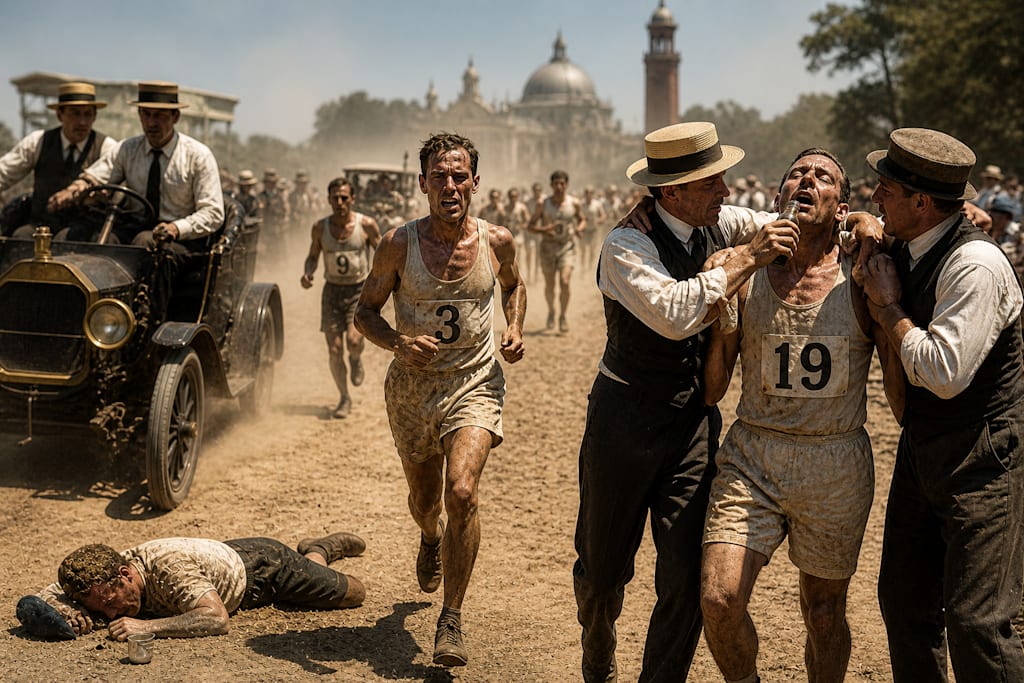
There are moments in history that reveal the triumph of the human spirit. And then some moments reveal what happens when you combine ambition, poor planning, questionable science, and a complete disregard for basic survival.
The 1904 Olympic marathon in St. Louis was not merely a race. It was not even a competition in the traditional sense. What unfolded that August day was something far stranger—a sprawling, sunbaked experiment in endurance, confusion, and near-catastrophe that has since become one of the most infamous events in Olympic history. It was, in every measurable way, a disaster. And yet, it happened.
A Race Built on Bad Ideas
The marathon took place on August 30, 1904, under conditions that would be considered borderline criminal by modern athletic standards. Temperatures soared into the 90s, humidity clung to the air, and the course itself stretched across unpaved roads that had more in common with a construction site than a sporting venue.
Dust coated everything. Not lightly. Thick, choking clouds of it were constantly kicked up by passing vehicles. Official cars meant to oversee the race, instead created an atmosphere that resembled a slow-moving sandstorm. Runners were forced to breathe it in with every step, their lungs filling with grit as they pushed forward. And then there was the water situation. There wasn’t much of one.
The organizers, influenced by early theories about dehydration and “training the body to endure,” provided only a handful of water stations along the entire 24.85-mile course. The idea, astonishingly, was not to support the runners, but to study the effects of fluid restriction.
In other words, this was not just a marathon. It was an accidental science experiment. One conducted on exhausted men running through heat and dust.
The Man Who Took a Shortcut
Fred Lorz was, for a time, the winner. Or at least, he appeared to be. About nine miles into the race, Lorz began to struggle. Like many of the runners, he was overwhelmed by the heat, the terrain, and the sheer absurdity of the conditions. At some point, he made a decision that would become the stuff of legend... He got into a car.
For approximately 11 miles, Lorz rode in that vehicle, bypassing a significant portion of the course. When the car broke down, he got out and resumed running, eventually crossing the finish line ahead of everyone else.
He was greeted as a champion. Crowds cheered. Officials celebrated. For a brief, surreal moment, Fred Lorz was the Olympic gold medalist. Until, of course, someone noticed.
Accounts vary on whether Lorz intended it as a joke or a desperate act of survival, but the outcome was the same. His “victory” was quickly invalidated, and he was disqualified.
In a race filled with chaos, Lorz’s shortcut stands as a perfect symbol of the day’s underlying theme: Nothing was going according to plan.
The Winner Who Wasn’t Much Better Off
With Lorz disqualified, the official winner became Thomas Hicks. But to call his victory straightforward would be wildly misleading.
By the time Hicks approached the final stretch, he was barely conscious. His trainers, determined to keep him moving, resorted to methods that would raise serious ethical and legal questions today.
They gave him strychnine... Yes, the same substance commonly used as rat poison. In small doses, strychnine was believed at the time to act as a stimulant. Combined with egg whites and a measure of brandy, it was administered to Hicks repeatedly as he staggered through the final miles.
He wasn’t running so much as being propelled forward. Witnesses described him as ghostlike, his body moving mechanically, his mind drifting somewhere far removed from the race itself. At one point, he reportedly believed he was still miles from the finish line, hallucinating as his body struggled to continue.
When he finally crossed the line, he had to be physically supported. He nearly died shortly after. And yet, he was declared the winner.
The Cuban Postman’s Odyssey
If the marathon had ended there, it would already be legendary. But the race had more stories to tell...
Félix Carvajal, a Cuban mailman, arrived in St. Louis after an improvised journey that included running from New Orleans when he lost his travel money gambling. He showed up at the starting line in street clothes, long pants, a shirt, and dress shoes.
Before the race began, he reportedly cut his pants at the knees to make them more suitable for running. Then he joined the field. Carvajal ran with a kind of carefree enthusiasm that seemed entirely disconnected from the grueling conditions around him. At one point, he stopped to chat with spectators. At another, he paused to eat fruit from a roadside orchard, apples that, unfortunately, turned out to be rotten.
The result was predictable. He became ill. Despite this, he continued running, eventually finishing fourth.
In a race defined by struggle, Carvajal’s journey stands out not just for its absurdity, but for its strange charm. He treated the marathon less like a competition and more like a wandering adventure, navigating its hazards with a mix of determination and casual disregard.
Dust, Delirium, and Near Death
Carvajal was far from the only runner to suffer. Many participants collapsed along the course, overcome by heat exhaustion, dehydration, and the relentless dust. One runner nearly died after his lungs were severely damaged by inhaling the airborne grit stirred up by vehicles.
Another had to be withdrawn after experiencing internal bleeding. Of the 32 athletes who started the race, only 14 finished. The rest were left scattered along the route, casualties of an event that seemed increasingly less like a sporting competition and more like a test of how much the human body could endure before giving up entirely.
A Marathon Frozen in Time
What makes the 1904 marathon so fascinating is not just its chaos, but its place in history. This was a time when the modern Olympics were still finding their identity. Standards were inconsistent. Safety protocols were minimal. The line between competition and experimentation was often blurred.
In many ways, the marathon in St. Louis represents the growing pains of an institution that had not yet figured out what it wanted to be. It is a snapshot of an era when ambition outpaced preparation, and when the drive to push boundaries sometimes ignored the realities of human limitation.
The Lighthouse Moment
Every Iron Lighthouse story has a moment where the light cuts through the fog and reveals something deeper. Here, it is this: The 1904 marathon was not just chaotic because of individual decisions. It was chaotic because the entire system surrounding it was built on flawed assumptions.
That the body could endure extreme dehydration. That minimal support would somehow produce better results. That spectacle mattered more than safety. And yet, within that chaos, something remarkable still emerged. People kept going. Not because it made sense. Not because it was safe. But because they had started, and finishing, however broken, however absurd, was the only thing left to do.
A Race That Redefined the Finish Line
Today, marathons are carefully organized events. Water stations are frequent. Medical teams are on standby. Courses are mapped with precision, and athletes train under conditions designed to optimize performance and safety.
The 1904 marathon stands in stark contrast to all of that. It is a reminder of how far things have come, and how close they once were to complete disaster.
But it is also something else. It is a story that refuses to be forgotten, not because it was perfect, but because it was profoundly human. Messy. Illogical. Resilient in ways that defy explanation.
In the end, the marathon in St. Louis did not produce a clean victory. It produced a collection of stories. A man who rode in a car. A winner sustained by poison. A mailman who ran in dress shoes and stopped for fruit. And a field of runners who faced conditions that should have stopped the race before it began.
It was not the marathon anyone intended. But it was the one that happened. And more than a century later, it still stands, not as a triumph of sport, but as a monument to the strange, unpredictable, and often absurd nature of human endeavor.
A race where the finish line was real. But everything leading up to it felt like something out of a fever dream!
About the Creator
The Iron Lighthouse
Where folklore meets freeway. A guide to the strange heart of the American backroads...
Enjoyed the story? Support the Creator.
Subscribe for free to receive all their stories in your feed.
Comments
There are no comments for this story
Be the first to respond and start the conversation.