
The Mad Hatter Who Killed Lincoln’s Assassin: The Strange Life of Boston Corbett
Iron Lighthouse Merry Monday Edition

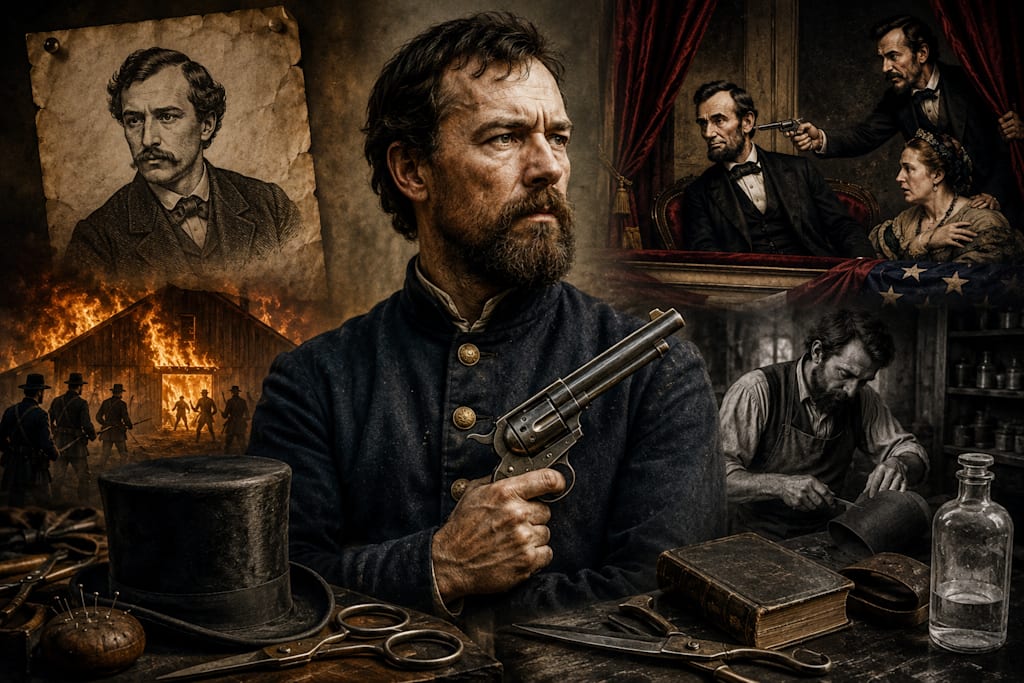
History has a peculiar habit of hiding its strangest characters in plain sight. Most Americans know the broad outlines of the story. President Abraham Lincoln is assassinated in April 1865. The nation plunges into mourning. A massive manhunt begins for the killer, actor John Wilkes Booth. Twelve days later, Booth is cornered inside a tobacco barn in Virginia and shot.
Case closed. At least, that is how the story is usually told. What many people do not realize is that the man who fired the shot that ended Booth's life may have been one of the most bizarre figures in American history. His name was Boston Corbett, and his life reads less like a historical biography and more like something a novelist would reject for being too unbelievable. He was a Civil War veteran, a hat maker, a religious zealot, a national hero, an asylum patient, a fugitive, and perhaps one of the clearest examples of the old phrase "mad as a hatter" ever recorded. His story is a journey into the strange corners of Americana. A reminder that history's heroes are not always what we expect them to be. Sometimes they are much, much stranger.
Born Thomas Corbett in London, England, in 1832, he immigrated to the United States as a young man and eventually settled into the hat-making trade. It was a respectable occupation at the time, but it carried a hidden danger that nobody fully understood. The process of manufacturing felt hats required workers to handle mercury nitrate, a highly toxic substance used to treat animal fur. Hat makers often spent years inhaling mercury vapors in poorly ventilated workshops, exposing themselves to gradual neurological damage. The symptoms became so common that they eventually inspired a phrase still used today: "mad as a hatter." Victims frequently developed tremors, paranoia, mood swings, memory problems, irritability, hallucinations, and increasingly erratic behavior. Modern science now recognizes the condition as mercury poisoning, but in the nineteenth century, it remained largely misunderstood. Boston Corbett spent years working in precisely that environment. Whether mercury poisoning fully explains his later behavior remains impossible to know, but many historians believe it almost certainly played a role. If so, it would not be the only force shaping his remarkable life.
At some point during adulthood, Corbett experienced an intense religious conversion. For many people, faith becomes a source of comfort and guidance. For Corbett, it became something closer to an all-consuming obsession. He immersed himself in scripture, attended revival meetings, and preached publicly whenever the opportunity arose. His devotion grew increasingly extreme, and friends often described him as intensely pious even by the standards of the era.
Then came the incident that secured his place in the annals of American weirdness. According to multiple historical accounts, Corbett became deeply troubled after encountering prostitutes while walking through a city street. Terrified that temptation might lead him into sin, he concluded that drastic action was necessary. Most people might have prayed, avoided certain neighborhoods, or sought spiritual guidance. Corbett chose a different solution: he returned home, took a pair of scissors, and castrated himself. The act was apparently carried out as a demonstration of religious purity and self-discipline. What makes the story even more astonishing is what happened afterward. Rather than immediately seeking emergency medical treatment, Corbett reportedly ate a meal, read from the Bible, attended a prayer meeting, and only later consulted a physician. The doctor managed to save his life. History, however, would never quite recover.
By the outbreak of the Civil War, Corbett had enlisted in the Union Army and fought in several engagements. Accounts from fellow soldiers suggest he remained deeply religious throughout his service, frequently preaching to comrades and quoting scripture during military operations. He was wounded, captured by Confederate forces, and eventually returned to Union service. Yet none of these experiences would define him. His place in history would arrive on April 26, 1865.
Twelve days earlier, President Lincoln had been assassinated inside Ford's Theatre in Washington, D.C. The murder shocked the nation, and authorities launched one of the largest manhunts in American history, determined to capture John Wilkes Booth. The search eventually led Union troops to a tobacco farm near Port Royal, Virginia, where Booth and an accomplice were hiding inside a barn. Federal officers surrounded the structure and demanded surrender. The accomplice complied, but Booth refused, and the situation quickly deteriorated. The barn was set on fire in an effort to force Booth into the open. Soldiers watched as flames spread through the structure, and then a gunshot rang out. When the smoke cleared, Booth lay mortally wounded. The man who fired the shot was Boston Corbett.
The problem was that nobody had ordered him to shoot. Military authorities wanted Booth captured alive whenever possible, hoping interrogation could reveal information about potential conspirators and provide valuable insight into the assassination plot. Corbett ignored those instructions. Later, he claimed divine guidance had directed his actions, insisting that God had told him to pull the trigger. Some hailed him as a hero, while others considered him a reckless vigilante. The debate began immediately and has never entirely ended. What cannot be disputed is that the shot transformed Corbett into a national celebrity. Newspapers covered his story extensively, citizens praised him, veterans admired him, and public fascination grew rapidly. For a brief period, Boston Corbett became one of the most famous men in America.
Unfortunately, fame did little to stabilize his already fragile mental state. As the years passed, Corbett's behavior grew increasingly erratic. He delivered spontaneous religious sermons to strangers, became obsessed with spiritual visions and divine messages, and frequently interpreted ordinary events as signs from God. Friends and acquaintances reported alarming mood swings and increasingly paranoid beliefs. At one point, he reportedly drew a pistol during a political disagreement, convinced that others were threatening his safety. Incidents like these became more common, and by the 1880s, concerns about his mental health had become impossible to ignore. Eventually, authorities committed him to the Topeka State Hospital in Kansas.
For most people, this might have marked the final chapter. For Boston Corbett, it was merely another strange detour because he escaped. Of course he did. The man who had castrated himself with scissors, killed Lincoln's assassin, and claimed direct communication with God was apparently not content to remain institutionalized. After escaping the asylum, Corbett vanished into the American West.
And this is where the story becomes even stranger. Nobody knows exactly what happened next. Some reports place him in remote Kansas communities, others suggest he drifted through frontier settlements, and there are stories of him living as a recluse, avoiding attention and continuing his religious devotions. Then the historical trail goes cold. One popular theory suggests he died during a prairie fire in Minnesota around 1894, while another claims he simply disappeared into obscurity. No definitive evidence has ever emerged. The man who helped bring to a close one of America's most famous manhunts effectively vanished from history. And perhaps that is fitting.
Every Iron Lighthouse story eventually reaches a deeper truth hidden beneath the oddity, and here, that truth is surprisingly human. History often presents major events as clean narratives: heroes appear, villains fall, and chapters close neatly. Reality is rarely so tidy. Boston Corbett was not a marble statue carved into perfection; he was complicated, broken, fascinating, possibly mentally ill, almost certainly affected by years of toxic mercury exposure, deeply religious, and profoundly eccentric. And somehow, despite all of that, he found himself standing at the center of one of the most important moments in American history.
That may be the most remarkable aspect of his story. Not the self-castration, not the asylum escape, not even the shooting of John Wilkes Booth. It is the reminder that history is often shaped by ordinary people carrying extraordinary burdens, flaws, and contradictions. The man who ended the hunt for Lincoln's assassin was not a polished hero from a history textbook. He was Boston Corbett… a hat maker, a soldier, a religious fanatic, a national celebrity, a missing person, and quite possibly the strangest hero in American history.
About the Creator
The Iron Lighthouse
Where folklore meets freeway. A guide to the strange heart of the American backroads...
Enjoyed the story? Support the Creator.
Subscribe for free to receive all their stories in your feed.
Comments
There are no comments for this story
Be the first to respond and start the conversation.