
The Legend of Andrew Jackson’s Swearing Parrot
Perfect Gusts of Cursing...

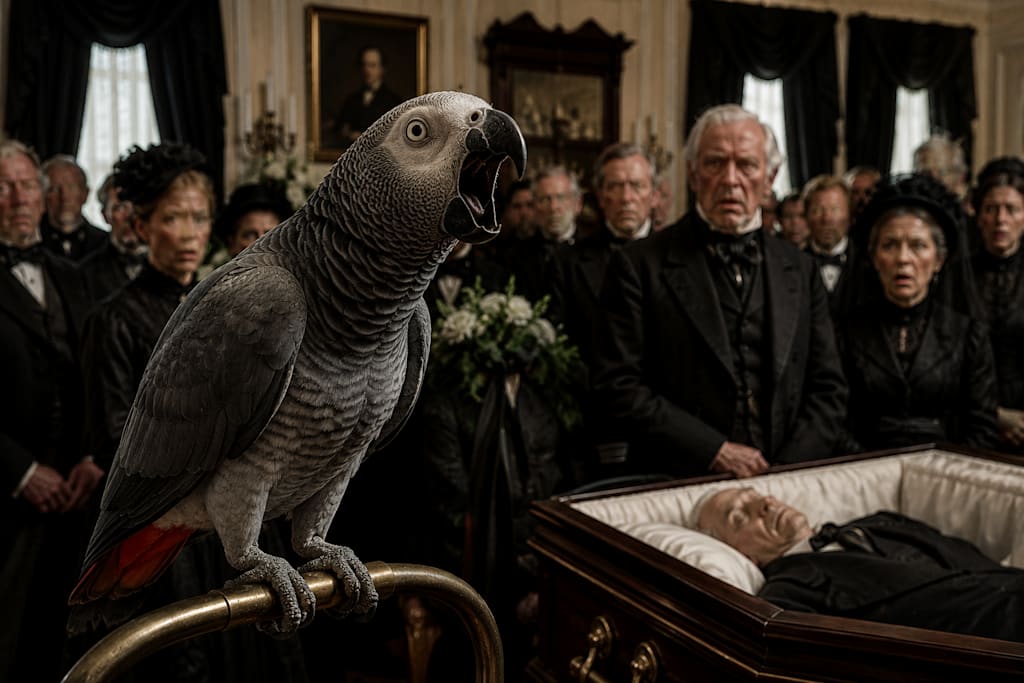
There are moments in American history so perfectly strange, so oddly specific, that they seem less like documented events and more like folklore invented late at night on a southern porch. The story of Andrew Jackson and his foul-mouthed parrot is one of those tales, almost unbelievable, yet, against all odds, apparently true.
Stories so strange, so oddly specific, that they sound less like documented events and more like the kind of folklore invented late at night on a front porch somewhere in the South. The tale of Andrew Jackson and his foul-mouthed parrot is one of those stories. And somehow, against all odds, it appears to be true.
In June of 1845, mourners gathered at The Hermitage to bury the former president. Jackson had been one of the most controversial, combative, and fiercely polarizing figures in American political history. His name, even decades after leaving office, evoked arguments, loyalty, anger, admiration, and bitterness, depending on who was speaking. But on the day of his funeral, none of that was the strangest thing unfolding.
But on the day of his funeral, none of that was the strangest thing happening. Somewhere inside the Hermitage, Poll, Jackson’s pet African Grey parrot, began loudly screaming profanity at the mourners. The disruption was so complete that the bird had to be removed from the service entirely, not quietly escorted away, but forcibly removed as eyewitnesses later recalled.
Not quietly escorted away, but removed. According to eyewitness accounts, the bird unleashed what one minister described as “perfect gusts of cursing.” In a sense, there may never have been a more American sentence written. And honestly, there may never have been a more American sentence written.
To understand why this story has endured for nearly two centuries, it helps to first understand Andrew Jackson himself. He was not polished like later presidents often aspired to be, but rough-edged, deeply emotional, and intensely prideful. His legendary temper was enough to make even political allies tread carefully. Jackson fought in duels, survived assassination attempts, openly insulted rivals, and governed with the energy of a man always ready to throw a chair through a saloon window. Either a champion of the common man or a dangerously volatile populist, and usually both.
Jackson was not polished in the way later presidents often tried to be. He was rough-edged, deeply emotional, intensely prideful, and carried a temper so legendary that even political allies occasionally feared it. He had fought in duels, survived assassination attempts, insulted rivals openly, and governed with the energy of a man perpetually ready to throw a chair through a saloon window.
He was, depending on who you asked, either a champion of the common man or a dangerously volatile populist. Usually both.
Born in the Carolina backcountry in 1767, Jackson grew up far from elite coastal politics. Early exposure to violence and hardship, including brutal treatment during the Revolutionary War, shaped him permanently, instilling a fierce distrust of authority and a relentless drive to prove himself. Even in old age, his personality rarely softened.
By the time he entered the White House in 1829, Jackson was already something larger than life. And larger-than-life men tend to leave behind larger-than-life stories.
Poll the parrot entered Jackson’s world during his retirement years at the Hermitage, the sprawling Tennessee plantation outside Nashville. African Grey parrots were already famous for their intelligence and uncanny ability to mimic human speech, making them prized companions among sailors, merchants, and wealthy travelers who returned from overseas with exotic birds.
But Poll was no elegant drawing-room bird politely chirping greetings to guests. Poll apparently absorbed the atmosphere of the Hermitage exactly as one might expect a parrot owned by Andrew Jackson to do.
Which is to say: Aggressively. The bird reportedly picked up Jackson’s favorite phrases, emotional outbursts, and profanity over years of listening to the former president converse with visitors, staff, political allies, and likely anyone unfortunate enough to disagree with him within earshot.
And Jackson, by nearly every historical account, was not a man who filtered himself carefully.
When Jackson died on June 8, 1845, the nation mourned. Thousands traveled to the Hermitage to pay respects to the former president. Funeral customs in nineteenth-century America were elaborate, deeply emotional affairs. Homes were draped in black crepe. Mirrors were covered. Clocks were sometimes stopped at the moment of death. Public mourning was not merely expected; it was practically ceremonial theater.
At Jackson’s funeral, ministers prayed while mourners filed through solemnly. And then Poll reportedly began shouting obscenities. Not once. Not accidentally but repeatedly!
The most famous account comes from Reverend William Menefee Norment, who later described the scene with barely concealed amazement. According to Norment, the parrot became so disruptive that it had to be carried away from the funeral gathering while continuing to curse loudly at attendees.
One can only imagine the scene... Victorian mourning clothes. Ministers speaking softly. Political dignitaries bow their heads respectfully. And in the background, a furious parrot unleashing a barrage of frontier-era profanity powerful enough to derail the solemnity of an ex-president’s funeral.
It feels almost cinematic. Too perfect. And yet the story persisted because eyewitnesses kept hilariously repeating it.
What makes the tale so fascinating is not merely the comedy, though the comedy is undeniable. It is the event's strange symbolic quality. Poll almost becomes an extension of Jackson. Even in death, the atmosphere surrounding the former president refused to be dignified and restrained. The chaos followed him right into the funeral service.
There is something oddly poetic about that. Jackson had spent his entire life disrupting expectations. He battled political elites, ignored conventions, and governed with a forceful personality that often shocked critics. The idea that his own parrot would erupt into uncontrollable profanity during the final farewell somehow feels entirely consistent with the man’s reputation.
As though the bird had absorbed not merely Jackson’s words, but his spirit.
The story also survives because parrots themselves occupy a strange place in human imagination. Unlike most animals, parrots do not merely make sounds. They imitate us. And imitation has always carried a slightly eerie quality when it comes from creatures that do not fully understand what they are saying. African Grey parrots in particular are astonishing mimics, capable of learning extensive vocabularies and reproducing tone, cadence, and emotional emphasis with unsettling accuracy.
A profanity spoken by a person can be brushed aside. The same profanity a bird screams somehow becomes unforgettable. Especially in the middle of a presidential funeral.
There is also an unmistakably American flavor to the entire story. The United States has always possessed a strange relationship with its presidents. Americans simultaneously elevate political leaders into near-mythic figures while also delighting in stories that make them seem deeply human, flawed, ridiculous, or chaotic.
And Jackson was perhaps uniquely suited for this kind of folklore. He was never viewed as distant royalty. He was fiery, emotional, confrontational, and rough around the edges in ways that later generations often associate more with folk heroes than statesmen.
The swearing parrot story survives because it punctures the stiffness of history. It reminds us that even the grand figures of the past lived in worlds filled with noise, unpredictability, pets, arguments, tempers, and absurd moments.
Sometimes history is not marble statues and solemn speeches. Sometimes history is a bird screaming profanity at mourners.
Of course, over time, the story has taken on a life of its own. Historians continue debating details. Nobody knows exactly what Poll said. The specific profanities were never fully recorded, which is probably for the best. Some scholars suspect embellishment over the years, while others argue that the accounts' consistency makes the core story highly credible.
And honestly, the uncertainty almost improves it. Because legends endure not merely through facts, but through imagery. And the imagery here is immortal. A loud, angry parrot at the funeral of one of America’s loudest, angriest presidents. You could not invent a better metaphor if you tried.
Every Iron Lighthouse story eventually arrives at its deeper reflection hiding beneath the oddity. Here, that reflection feels surprisingly clear. The story of Poll the parrot is ultimately about how human beings echo through the world long after they are gone.
Sometimes through institutions. Sometimes through descendants. Sometimes through ideas. And occasionally, apparently, through a profanity-spewing tropical bird.
Jackson’s words lingered because Poll repeated them endlessly, long after their original speaker had fallen silent. In a strange way, the bird became an accidental archive of personality, preserving fragments of Jackson’s temper and voice in the most chaotic form imaginable.
There is something oddly haunting about that beneath the humor. A reminder that the things we say, the energy we carry, and the atmosphere we create often outlive us in ways we never expect.
Today, visitors to The Hermitage still hear the story of Poll. It has become part of the strange folklore orbiting Andrew Jackson’s legacy, existing somewhere between documented history and tall tale Americana. And perhaps that is exactly where it belongs. Because America has always been a nation built as much on stories as facts.
Stories told in barbershops. Stories traded on porches. Stories repeated until they become part of the national fabric. And among those stories, few are more wonderfully bizarre than this one. The day a president was buried…
…and his parrot nearly stole the funeral.
About the Creator
The Iron Lighthouse
Where folklore meets freeway. A guide to the strange heart of the American backroads...
Enjoyed the story? Support the Creator.
Subscribe for free to receive all their stories in your feed.
Comments
There are no comments for this story
Be the first to respond and start the conversation.