
The Chemist’s War: When Prohibition Turned Poisonous
Saturday Afternoon Edition
There are chapters of American history that feel almost impossible to explain to modern audiences, not because they are obscure, nor because records are missing, but because the decisions made seem so wildly disconnected from common sense that they sound less like history and more like the plot of a dark political thriller. The poisoned alcohol crisis of Prohibition in the United States is one of those stories.
For over a decade, the United States government waged war against alcohol. What began as a moral crusade to cleanse society of vice quickly spiraled into one of the strangest and most disturbing public health disasters in American history. Frustrated by the unrelenting flow of illegal liquor into speakeasies and underground bars, federal officials made a decision that still shocks historians today: they poisoned the alcohol supply. Not metaphorically, but literally. By the time Prohibition finally collapsed in 1933, an estimated 10,000 Americans were dead.
The story begins, as many American stories do, with idealism. When the 18th Amendment was ratified in 1919 and the Volstead Act soon followed, supporters believed they were ushering in a healthier and more moral nation. Alcohol, they argued, was the root of countless social problems, domestic abuse, poverty, crime, and corruption. Remove the liquor, and society itself would improve. At least, that was the theory.
But America did not stop drinking. If anything, the ban transformed alcohol from an ordinary commodity into forbidden treasure. Speakeasies multiplied across cities like Chicago, New York City, and Detroit. Organized crime syndicates exploded in wealth and influence, as smugglers ran liquor across borders and coastlines, and underground distilleries appeared in basements, barns, and hidden warehouses across the country.
And then there was industrial alcohol. Industrial alcohol remained perfectly legal during Prohibition because it was essential for manufacturing. Factories used it in everything from cleaning products to paint, medicine, and industrial solvents. Millions of gallons were produced every year for legitimate commercial purposes. Bootleggers soon realized, however, that industrial alcohol could be stolen and, with enough chemistry, converted into drinkable liquor, at least in theory.
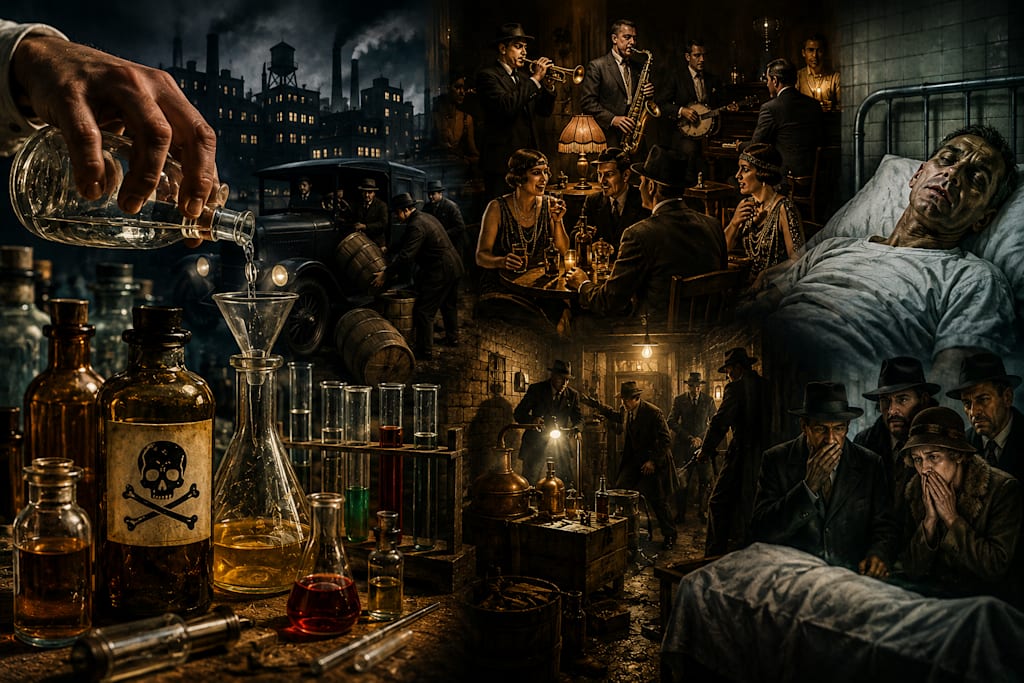
Criminal organizations began siphoning industrial alcohol from factories and warehouses, hiring chemists to "renature" it by stripping away the foul additives originally mixed in to discourage consumption. Once processed, the alcohol was sold through speakeasies and illegal distributors to thirsty Americans, many of whom either did not know or did not care where it came from.
The government watched these developments with growing frustration. No matter how many raids were conducted or arrests were made, the liquor kept flowing and people kept drinking. To federal officials tasked with enforcing Prohibition, it began to feel like an unwinnable war. So, they escalated.
Initially, the government’s denaturing formulas were unpleasant but generally survivable. Chemicals were added to make the alcohol taste awful or induce sickness if consumed, with the goal of deterrence. However, by the mid-1920s, authorities believed bootleggers had become too skilled at removing those additives. Underground chemists adapted, refining their methods in hidden laboratories scattered throughout America’s cities. In response, federal officials adopted a chilling new strategy: if bootleggers insisted on stealing industrial alcohol, the government would make it far more dangerous.
New denaturing formulas included substances such as methanol, kerosene, gasoline, iodine, benzene, and even acetone. Methanol was particularly deadly: unlike ethanol, the alcohol found in normal liquor, methanol attacks the nervous system and organs with terrifying efficiency. Even relatively small amounts can cause blindness, and larger amounts can kill. The government was fully aware of these risks.
What followed was a shadow war between chemists. Bootleggers hired experts to remove the poisons; some succeeded partially, while others failed catastrophically. Improvised distillation operations sprang up in warehouses and hidden back rooms, where men worked desperately to render toxic industrial alcohol drinkable before selling it to the public. Sometimes they succeeded just enough to keep people alive; sometimes, they did not. The consequences became evident in hospitals and morgues. At first, the deaths came in clusters; soon, they came in waves.
During the Christmas season of 1926 alone, dozens of people in New York City died after consuming poisoned liquor. Newspapers carried horrifying stories of victims collapsing in apartments, losing their sight after holiday parties, or dying slowly in overcrowded hospital wards. Doctors quickly recognized the symptoms of methanol poisoning: victims often arrived disoriented and vomiting. Some lost their eyesight within hours; others suffered seizures, respiratory failure, or irreversible neurological damage. Many slipped into comas before dying. The public was horrified, yet the poisoning campaign continued.
What makes this story so morally unsettling is that there was no ambiguity about what was happening. Federal officials understood that industrial alcohol was being diverted into the black market. They knew Americans were drinking it. They knew poisoning the supply would kill people.
And yet, some officials openly defended the policy. To them, responsibility rested with the drinkers themselves. If citizens chose to violate Prohibition laws, the consequences that followed were considered self-inflicted. That argument did little to comfort grieving families. Nor did it stop the death toll from climbing.
By the late 1920s, poisoned alcohol had become one of the deadliest side effects of Prohibition itself. Coroners and physicians repeatedly warned about the growing crisis. Journalists condemned the policy as cruel and reckless. Critics argued that the government had crossed a moral line by knowingly creating conditions that would kill its own citizens. But Prohibition had become politically entrenched, and federal authorities feared appearing weak. So the chemical war dragged on.
Meanwhile, organized crime flourished anyway. That may be the strangest part of the entire story. Despite the poisonings, the raids, the arrests and the public outrage, Americans continued drinking in enormous numbers. Speakeasies remained packed. Bootleggers remained profitable. Criminal syndicates expanded into empires.
The violence and corruption associated with Prohibition only intensified. In trying to eliminate alcohol entirely, the government had inadvertently created one of the largest black markets in American history. And in attempting to stop that black market, it had helped create a public health catastrophe.
The human side of the tragedy is often overshadowed by the larger political debate, but it is impossible to ignore. Many victims were not hardened criminals or gangsters. Some were ordinary working-class Americans looking for escape during difficult times. Others had no idea the liquor they purchased was contaminated. In crowded urban neighborhoods, poisoned alcohol circulated through communities rapidly, often affecting the poorest residents most severely.
There is something uniquely haunting about its randomness. A drink at the wrong speakeasy. A bottle from the wrong supplier. A Christmas toast that became a death sentence. And all of it unfolding beneath the glittering image of the Roaring Twenties, while jazz played in hidden clubs and America raced headlong toward modernity.
Every Iron Lighthouse story eventually reaches a moment when the deeper meaning emerges from the fog. Here, it is impossible to avoid. The poisoned alcohol campaign revealed what can happen when ideology hardens into obsession.
Prohibition was supposed to save lives and restore morality. But in the pursuit of absolute enforcement, the government drifted into territory that many Americans found chilling. Rather than admitting the policy was failing, officials doubled down, escalating the danger even as the body count rose. It became less about persuasion and more about punishment. Less about public health and more about control. And once that line was crossed, the consequences became impossible to contain.
By 1933, Prohibition was collapsing under the weight of its own contradictions. Organized crime had grown stronger, public support had eroded, and the economic pressures of the Great Depression made enforcement increasingly unpopular. The 21st Amendment repealed Prohibition that same year. The grand experiment was over. But the damage lingered.
Thousands were dead from poisoned alcohol. Countless others suffered permanent injuries. Trust in government enforcement had been deeply shaken. And the era left behind a cautionary tale about what happens when policy collides with human nature in ways lawmakers fail to anticipate.
Today, the story feels almost surreal. An America where federal chemists intentionally made alcohol more lethal. An underground network of bootleg scientists trying to remove poison from stolen industrial liquor. Hospitals overflowing with victims blinded by contaminated drinks. A nation simultaneously dancing through the Jazz Age while quietly poisoning itself in hidden bars and back rooms.
It sounds impossible. And yet it happened. Not in some distant empire or forgotten dictatorship. But here… In the United States. During one of the most famous decades in American history. A chemical war fought not on battlefields, but in glasses raised beneath the dim lights of speakeasies.
One drink at a time.
About the Creator
The Iron Lighthouse
Where folklore meets freeway. A guide to the strange heart of the American backroads...
Enjoyed the story? Support the Creator.
Subscribe for free to receive all their stories in your feed.
Comments
There are no comments for this story
Be the first to respond and start the conversation.