World History
10 Times Microscopic Killers Quietly Rewired Human History. AI-Generated.
Napoleon Bonaparte’s ambitions in the Americas weren't just defeated by rebel armies; they were dismantled by yellow fever. While history books prioritize the grand strategies of generals, the reality is often dictated by biological forces that leave leaders with few options. These microbes didn't just cause mass casualties; they acted as catalysts, accelerating shifts in laws, borders, and global structures that might have otherwise taken centuries to unfold.
By Essam Writes4 months ago in History
The Cluentius Murder Trial: How Rome Solved Murders Using Social Graphs
Cicero studied the scroll for the third time. It listed thirty-four names. None of them were murderers. The charge was poisoning. The victim, Statius Albius Oppianicus, had died eight years earlier from what was believed to be a sudden illness. There was no corpse to examine. There was no cup to test. The prosecution's case rested on something else entirely: a map of human relationships. The trial of Aulus Cluentius Habitus was not about a murder weapon. It was about who ate with whom, who owed money to whom, and who stood to gain when a wealthy father figure stopped breathing.
By Chronicle and Void4 months ago in History
Amos Guiora, Ph.D., J.D. on Recovered Holocaust Books, Enablers, and Denial
How do recovered Holocaust books connect Amos Guiora’s work on enablers to antisemitism today? Prof. Amos N. Guiora is an Israeli-American professor of law at the University of Utah’s S.J. Quinney College of Law and directs the school’s Bystander Initiative. He holds an A.B. in history from Kenyon College, a J.D. from Case Western Reserve University School of Law, and a PhD from Leiden University. Guiora served 19 years in the Israel Defence Forces, retiring as a lieutenant colonel, and helped implement the Oslo Peace Process (1994–1999). His work examines national security, institutional complicity, and enabling cultures behind sexual abuse; he has authored The Crime of Complicity, Armies of Enablers, and Legitimate Target.
By Scott Douglas Jacobsen4 months ago in History
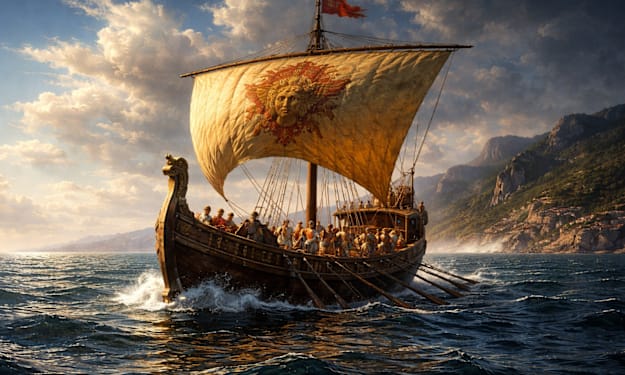
The Roman Navy’s Secret Weapon Wasn’t Iron or Fire — It Was Tree Sap and Pollen
The ship sank in shallow water. Four meters. That was all it took to preserve the wreck for 2,200 years. Oxygen could not reach it. Shipworms could not eat it. The seabed of the Adriatic, off the coast of modern-day Croatia near the island of Ilovik, became a time capsule. The merchant ship had carried wine and timber, and it sank sometime in the middle of the second century BCE.
By Chronicle and Void5 months ago in History
HISTORY OF MILKY WAY
The Milky Way, our galaxy, is a vast and intricate structure composed of billions of stars, planets, and other celestial objects. Its formation and evolution have been subjects of intense study and fascination for astronomers. Recent research has unveiled significant insights into the early history of the Milky Way, shedding light on how our galaxy came to be and how it has evolved over billions of years. The Beginnings: From Primordial Gas to a Protogalaxy The Milky Way's story begins shortly after the Big Bang, approximately 13.8 billion years ago. In the aftermath of the Big Bang, the universe was primarily composed of hydrogen and helium gas. Over time, small fluctuations in the density of this gas led to the formation of the first stars and galaxies. In the early universe, regions with slightly higher densities of gas began to collapse under their own gravity, forming the first stars. These stars were massive and short-lived, quickly exhausting their nuclear fuel and exploding in supernovae. These explosions seeded the surrounding gas with heavier elements, a process known as nucleosynthesis, which would be crucial for the formation of later generations of stars and planets. The Assembly of the Milky Way : The Milky Way began to take shape around 13 billion years ago through a process known as hierarchical merging. Smaller protogalaxies, formed from the primordial gas and early stars, began to merge due to gravitational attraction. These mergers played a crucial role in building the larger structure of the Milky Way. During this period, the Milky Way's halo, a roughly spherical region surrounding the galaxy, started to form. The halo is composed of dark matter, stars, and globular clusters, which are dense collections of ancient stars. The stars in the halo are some of the oldest in the galaxy, providing a glimpse into the early stages of the Milky Way's formation. The Galactic Disk and Star Formation : As the Milky Way continued to evolve, it developed a more defined structure. Around 10 billion years ago, the galaxy began to form a thin, rotating disk. This disk is where most of the Milky Way's stars, including our Sun, are found. The formation of the disk was a result of the conservation of angular momentum, causing the gas and stars to settle into a flattened, rotating structure. Star formation within the disk occurred in waves, with periods of intense activity followed by quieter phases. These waves were influenced by various factors, including interactions with nearby galaxies and the availability of gas. The spiral arms of the Milky Way, which are regions of higher star density, are a result of these ongoing star formation processes. The Role of Dark Matter : Dark matter, an invisible and mysterious form of matter that does not emit or absorb light, plays a fundamental role in the formation and evolution of the Milky Way. While dark matter cannot be directly observed, its presence is inferred from its gravitational effects on visible matter. Dark matter provided the gravitational scaffolding around which the Milky Way formed. The distribution of dark matter in the early universe created potential wells where gas could accumulate and form stars. Without dark matter, the formation of galaxies like the Milky Way would have been significantly different, if not impossible. The Milky Way's Evolution and Future : Over the past several billion years, the Milky Way has continued to evolve throug interactions with other galaxies. One of the most significant events in the Milky Way's recent history is its ongoing merger with the Sagittarius Dwarf Galaxy. This smaller galaxy is being gradually torn apart and assimilated into the Milky Way, contributing stars and gas to our galaxy. Looking to the future, the Milky Way is expected to undergo a major collision with the Andromeda Galaxy, our nearest large galactic neighbor, in about 4.5 billion years. This event will significantly reshape both galaxies, leading to the formation of a new, larger galaxy often referred to as "Milkomeda." In Conclusion : The early history of the Milky Way is a tale of cosmic evolution, driven by the forces of gravity, star formation, and the enigmatic influence of dark matter. Through the study of ancient stars, globular clusters, and the dynamics of galaxy mergers, astronomers have pieced together a compelling narrative of how our galaxy came to be.
By Muhammad Talha5 months ago in History
The surprising discoveries made about Neanderthal babies
Fifty thousand years ago, deep in a cave near the Sea of Galilee, a Neanderthal baby died. It was only six months old. Scientists found its bones in 1992 — and for decades, those bones sat largely undescribed, waiting. Now, in 2026, researchers have finally done a full analysis of that tiny skeleton — and what they found has completely changed what we thought we knew about our closest extinct relatives.
By Shirley Oyiadom5 months ago in History