
Sauk City’s Buried Past:
What’s Hiding Beneath Our Streets?

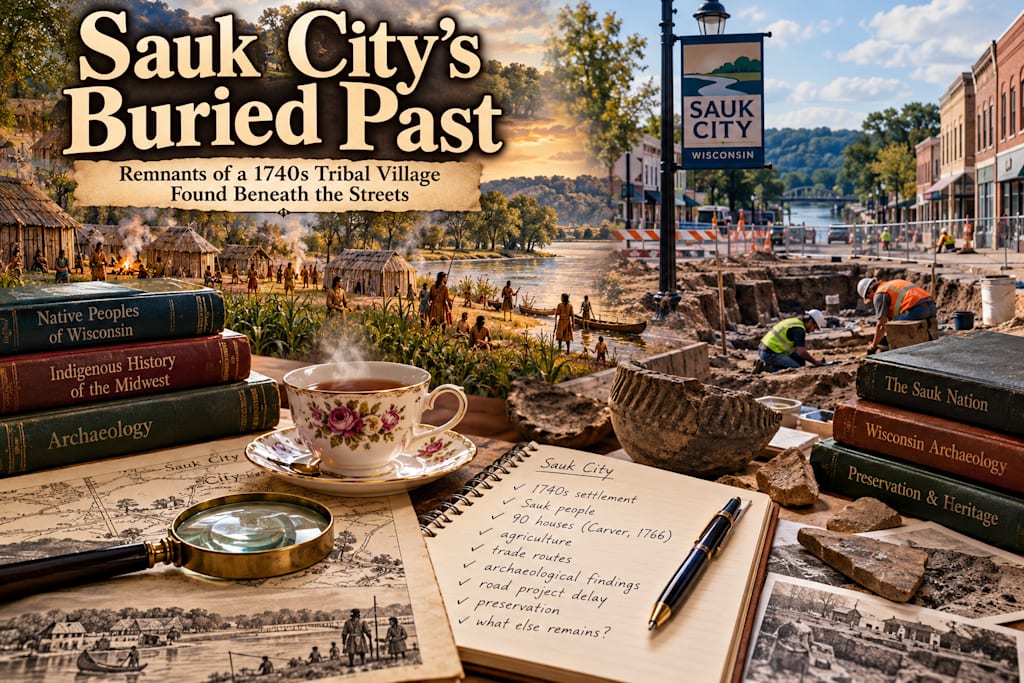
Sauk City’s Buried Past: What’s Hiding Beneath Our Streets?
Miss Lil’s Tea Table | Wisconsin History, Archaeology & a Little Local Curiosity
Well, my lovely tea drinkers, grab your cups and pull up a chair. Today's subject is practically in my backyard, and I have to admit, it caught my attention immediately.
Apparently, there's a whole lot more to Sauk City's history than meets the eye. Beneath streets that people drive down every day are traces of an Indigenous settlement dating back to the 1700s.
Now, I don't know about you, but the thought of walking or driving over a place where people lived hundreds of years ago makes me stop and think. How many times have we passed through an ordinary-looking town without realizing what happened there long before the buildings, roads, and parking lots showed up?
That's what got my attention with this story. So, naturally, I started digging through the history books. Figuratively, of course. I shall leave the actual digging to the archaeologists.
Let's Go Back to the 1740s
Before Sauk City became the community we know today, this part of Wisconsin was home to Indigenous people whose lives revolved around the land and the Wisconsin River.
The Sauk people established a substantial settlement in the area during the eighteenth century. Historical accounts generally place the settlement's development around the 1740s, although the exact dates aren't entirely settled.
And we're not talking about a handful of people camping beside the river.
British explorer Jonathan Carver visited the settlement in 1766. His account described approximately 90 houses, along with cultivated fields where crops such as corn, beans, and melons were grown.
Ninety houses! Think about that for a moment.
There were families living their lives, people tending crops, children growing up, and a community with its own routines and traditions. The river provided resources and a route for travel and trade. The surrounding land supported daily life.
This wasn't some empty stretch of wilderness waiting for a modern town to appear. People had already made a home here.
I think that's an important distinction, because history books have not always given Indigenous communities the attention they deserve. Too often, their stories get reduced to a few paragraphs before the narrative moves on to European exploration and settlement.
But those communities had histories of their own, long before an outsider arrived to write anything down.
Carver's account gives us one glimpse of the settlement, although we should remember that he was an outside observer writing from the perspective of his own time. His description is valuable, but it doesn't tell us everything about the people who lived there.
And that brings us to the really interesting part.
What Did Archaeologists Find?
Here's where the modern story begins.
During road reconstruction work on South Water Street in Sauk City in 2024, archaeologists monitored construction activities and investigated archaeological deposits associated with the area's historic past.
The work brought renewed attention to the Great Town of the Saukies, the historic settlement associated with the Sauk people.
One detail particularly caught my attention: archaeologists found that some soils beneath existing pavement remained intact.
Now, I realize that might not sound terribly exciting to everyone. You're probably not going to find me throwing a party over a patch of dirt.
But in archaeology, undisturbed soil can be incredibly important.
You see, an old object found lying by itself can tell researchers something about the object. Finding that same object in its original location, surrounded by other evidence, can tell them much more about how people lived and what happened at that particular place.
The layers of soil, the position of artifacts, and traces of former structures can help researchers piece together a story that might otherwise be lost.
That's why archaeologists pay such close attention to construction sites in historically significant areas. Once an archaeological deposit is destroyed without proper investigation, much of the information it contains may be gone for good.
And no, you can't simply put the dirt back and try again.
I imagine the average person walking past a construction site sees workers, machinery, and an inconvenient road closure. Archaeologists have to look at that same patch of ground and consider what might have happened there two or three centuries earlier.
It's a very different way of seeing the world.
Why Is a Road Project Being Delayed?
Now, here's where this historical discovery meets modern-day life.
In October 2026, the Village of Sauk City announced a delay to planned improvements involving State Highway 60 and Water Street. The project had previously been anticipated to begin in 2027.
According to the village's announcement, environmental findings determined that the proposed work would adversely affect the Great Town of the Saukies archaeological site. The Wisconsin Department of Transportation determined that avoiding impacts to the site was not possible under the current design.
The project now requires additional environmental coordination, with construction planning shifting to 2028 and 2029.
Naturally, this raises a question: what happens when a community needs to repair or improve its roads, but the work could damage an important archaeological site?
It's not a simple situation.
Roads need maintenance. People need safe routes through their communities. Businesses depend on transportation, and construction delays can be frustrating for residents.
At the same time, archaeological sites cannot always be replaced or repaired once they're destroyed.
I can understand why people might have mixed feelings about a delayed road project. Nobody particularly enjoys waiting for construction to be completed. But I also think this is a good example of why historical investigations need to happen before major work gets underway.
The goal isn't necessarily to stop every construction project that encounters something old. It's to understand what's there, determine what might be lost, and work through the available options responsibly.
And just to be clear, the announcement describes a delay and additional planning, not a permanent cancellation.
Sometimes, making a sensible decision means taking a little longer to figure things out.
This Isn't Just About Old Buildings
Here's the part I really want people to think about.
When we talk about the Great Town of the Saukies, we're not just discussing an interesting archaeological site. We're talking about the history of the Sauk people and their connection to this part of Wisconsin.
Indigenous history in this region is complex. The Sauk were among several Native Nations with histories and connections to the surrounding lands. The Ho-Chunk and other Indigenous peoples also have deep roots in Wisconsin.
Over the centuries, warfare, displacement, changing territorial boundaries, and European American expansion dramatically affected Native communities.
Settlements changed. People moved. Towns developed. New roads were built over landscapes that had supported generations of life before modern development began.
Eventually, a person could drive through Sauk City without giving much thought to the community that had once stood there.
That's something I find both fascinating and a little sad.
We tend to associate history with places where it's easy to see: preserved buildings, museums, historical markers, and old photographs. But plenty of history doesn't come with a sign explaining what happened.
Sometimes, it takes an excavation to remind us that there's a much longer story beneath the surface.
And when that story involves Indigenous heritage, preservation needs to be approached thoughtfully. Archaeological discoveries aren't simply collections of old objects for people to admire. They are part of a cultural history that deserves respect, and descendant communities should have a meaningful voice in decisions affecting their heritage.
That's not an unreasonable request. It's basic respect.
What Else Could Be Waiting Beneath the Pavement?
I'll admit, this is where my curiosity starts getting the better of me.
What else might archaeologists learn about the people who lived in this settlement?
Depending on what survives and what researchers are able to study, archaeological evidence can offer clues about food, farming, building methods, trade, and the everyday routines of a community.
A fragment of pottery might tell researchers something about how an object was made or used. Plant remains could provide information about crops and food preparation. Traces of buildings might help explain how a settlement was arranged.
Even small discoveries can contribute to a much larger picture.
Of course, we shouldn't assume that every one of these things has already been found at this particular site. Those are questions archaeologists can investigate, not conclusions we should jump to before the evidence is available.
Still, the possibility is fascinating.
Think about it. We have modern streets, buildings, and infrastructure sitting above a landscape that has changed enormously over hundreds of years. Some parts have undoubtedly been disturbed, while other areas may preserve evidence that researchers haven't yet had the opportunity to examine.
What survives? What can it tell us? And how much more might we learn if we take the time to investigate properly?
Those are the questions I'd love to see explored as work on this site continues.
So, What Does This Mean for Us?
I've always thought local history deserves more attention than it gets. It's easy to become fascinated by ancient Egypt, medieval castles, or mysterious ruins halfway across the world. Those subjects are wonderful, and you know I'll happily bring them to the tea table.
But sometimes, the most interesting stories are much closer to home.
Sauk City's buried history reminds us that the places we know today have existed in many different forms. The streets we use, the buildings we recognize, and the towns we call home are only the latest chapters in much longer stories.
For the Sauk people, this wasn't an archaeological site. It was a place where people lived.
They raised families, grew food, maintained relationships, and went about the business of everyday life. They weren't waiting for someone centuries later to discover that they had been there.
They were already part of the history of this land.
Now, archaeology is helping bring some of that history into view again.
And while the road project presents practical challenges, I hope the attention surrounding this discovery encourages more people to take an interest in Wisconsin's Indigenous history and the work being done to preserve it.
Because once we understand what a place means, we can make better decisions about what we leave behind for the next generation.
Sets down her teacup and closes her notebook.
Well, my lovely tea drinkers, that's today's serving of local history.
Next time you're driving through Sauk City, remember that the story of this place didn't begin with the roads or the buildings. There's a much older chapter, and some of its evidence has survived beneath the very streets we travel today.
I don't know about you, but it certainly gives me something to think about.
And naturally, it leaves me with another question: how many other places in our own backyard have histories we've barely begun to explore?
You know Miss Lil. One question always leads to another.
Until next time, keep your curiosity alive, check your sources, and never assume that an ordinary-looking place has an ordinary past.
There's often more to the story than meets the eye.
And that's precisely why we keep coming back to the tea table.
☕ Come Join Miss Lil for Another Cup!
Enjoyed today's discussion? There's plenty more brewing!
Follow my adventures into forgotten history, strange mysteries, true crime, and the stories that deserve a closer look.
Read and subscribe to my Vocal Media articles:
https://vocal.media/journal/miss-lils-tea-table
Join my Facebook group and continue the conversation:
https://www.facebook.com/groups/2155720388491578
Come share your thoughts, ask questions, and tell me what you'd like to see investigated next. There's always room for another curious mind at my table.
A Quick Note About AI
AI was used to assist with text editing and image generation. Please consult the cited sources to verify historical information.
Sources for Further Reading
Wisconsin Historical Society, Office of the State Archaeologist: https://wisconsinhistory.org/preserve/state-historic-preservation-office/state-archaeologist/
Wisconsin Archaeological Society, South Water Street archaeological investigation: https://wiarcheologicalsociety.org/events/2025/11/13/charles-e-brown-archaeological-society-lecture
Village of Sauk City, official website and project announcements: https://www.saukcity.net/
PBS Wisconsin, Sauk Prairie: Early History: https://pbswisconsin.org/watch/wisconsin-hometown-stories/sauk-prairie-early-history-y1kcnc/
Sauk County Historical Society, The Indians of Sauk County: https://saukcountyhistory.org/indians-of-sauk-county
About the Creator
Lilithea Adasia
I dig where others look away. 🖤 True crime, paranormal mysteries, uncomfortable truths, and the beautifully broken human experience. I chase the stories others bury and ask the questions others avoid. Come curious. Leave questioning.
Enjoyed the story? Support the Creator.
Subscribe for free to receive all their stories in your feed.
Comments