
Overend Gurney Collapse: Not a Bankruptcy — It Was a Public Execution
In 1866, a single balance sheet caused the downfall of Britain’s most trusted bank. The real culprit was not bad loans, but rather a whisper campaign that no one dared to print.

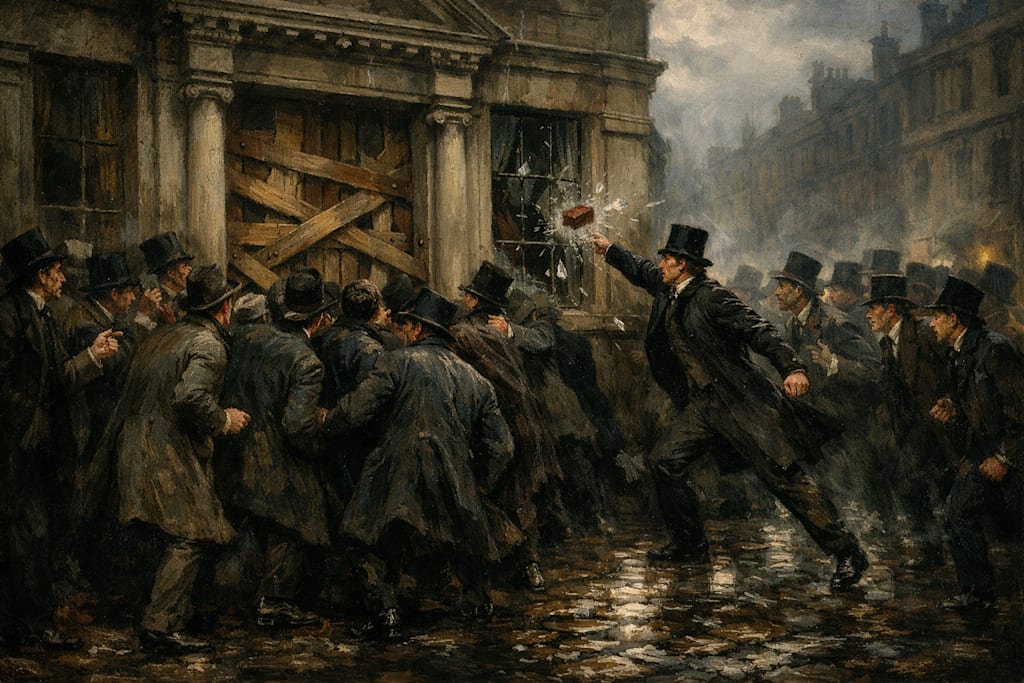
On May 10, 1866, at 2:30 p.m., John Henry Gurney walked out of 65 Lombard Street through a side entrance and disappeared into the alley behind the building.
The front door had been barricaded for two hours. The crowd outside had stopped shouting and started waiting. Someone had thrown a brick through the window of the partners’ office. The glass was still on the carpet. The ink on the last ledger entry had dried.
Gurney did not run. He walked. A constable later reported seeing a man in a black coat heading toward the river at a leisurely pace.

The bank was dead. Sixty years of unbroken trust were gone in an instant. Gone in the time between breakfast and lunch.
The strangest part wasn't the speed of it. The strangest part was that everyone in the city had known it was coming for three months and yet no one had said a word.
The financial capital of the world had just witnessed an execution. However, the condemned man never understood the charge.
To understand what happened, we must examine one institution’s ambition, one rival’s patience, and one weapon that left no fingerprints:
Overend, Gurney & Company was not a modern-day bank. It was the bank. Shipbuilders in Glasgow financed their hulls with its bills. Cotton merchants in Liverpool paid their suppliers with its paper. When the Bank of England ran low on gold in 1825, Overend Gurney loaned it the metal it needed to survive the night.
The firm occupied 65 Lombard Street, a building so unremarkable that visitors often passed it three times before finding the entrance. The partners were Quakers. They wore plain coats. They kept no carriages. Their ledgers were written in such neat handwriting that clerks from other firms came to study it.
This modesty was the product. It said, "We do not need marble because our word is the marble."

By 1865, the firm held deposits exceeding £4 million, which was roughly equivalent to Scotland's entire note circulation. When a merchant in Calcutta needed credit, the paper trail ended on Lombard Street. When a railway company in Yorkshire needed rolling stock, the bills passed through Gurney's discount window.
No one questioned the balance sheet because no one questioned the name.
Then, suddenly, the name stopped working.
Every financial history textbook teaches the official version of what happened next.
In July 1865, Overend Gurney converted from a partnership to a joint-stock company. The prospectus was issued. Shares were sold. Within weeks, it became clear that the firm had inherited a portfolio of toxic assets: loans to railways that never laid track, advances to docks that never berthed a ship, and guarantees to contractors who had already spent the money.
The deficit was £4 million. When depositors discovered the truth, they panicked. On May 10, 1866, the doors closed. The greatest bank failure of the Victorian era was simply a case of fraud and mismanagement.
In 1869, six directors stood trial at the Old Bailey. After deliberating for less time than it takes to eat lunch, the jury acquitted them.
Case closed.
Here is what the official version cannot explain:
Three months before the collapse, Overend Gurney began losing deposits at an unprecedented rate in British banking history. Not after a failed crop. Not after a war scare. Just February. Just London. Just this one firm.
No major borrower had defaulted. No auditor had sounded the alarm. Although the share price was falling, the business was processing bills, making payments, and meeting every obligation on time.
Yet, depositors were withdrawing funds as if the building were on fire.
Why?
The Letters Arrived Before the Crisis Did
In early 1866, anonymous letters began circulating among coffeehouses on Lombard Street, reading rooms in Liverpool, and merchant exchanges in Hamburg and Paris.
The letters were short. Sometimes three sentences, sometimes four. They claimed that Overend Gurney was financially unstable. They cited no balance sheet. They named no source. They simply asserted the fact and moved on.
According to a junior clerk who survived the collapse, John Henry Gurney read the letters as they came. He read them and said nothing. The Quaker silence was his only weapon.
No newspaper printed the letters. The libel laws of Victorian England made financial journalism a dangerous profession—one wrong sentence, and the editor could go to prison. So the press stayed silent.
But silence is not the same as inactivity.
The letters were passed from hand to hand. A merchant in Manchester received one and quietly moved his account to the London and Westminster Bank. A widow in Bath heard the rumor from her solicitor and withdrew £1,200 in gold. The whispering spread outward in concentric circles, gaining momentum without ever surfacing in public.
By April, the drain was visible to anyone looking at the firm’s deposit ledger. By the first week of May, the clerks stopped counting individual withdrawals and started counting the hours until the vault was empty.
Someone had decided to destroy Overend Gurney. They had done it without firing a shot, printing a word, or signing a name.
The Motive Was Sitting in Threadneedle Street
In the summer of 1865, a year earlier, Overend Gurney declared war on the Bank of England.
Their weapon was gold. The tactic was simple. The firm quietly accumulated sovereigns through agents until it controlled enough of the market to dictate the price. Then, it presented the hoard at the Bank of England’s discount window and demanded immediate payment.
The goal was to force the Bank to raise interest rates and expose its inability to manage the money supply. If the operation succeeded, Overend Gurney would replace Threadneedle Street as the true center of British finance.
The Bank of England did not appreciate the gesture.
Its response was clinical. It suspended the discount window for the firm. It refused to act as lender of last resort. And it waited.
By the time the anonymous letters began appearing in February 1866, the Bank of England had been waiting for six months.
Did the bank orchestrate the whisper campaign? Documents do not provide a direct answer. The bank's archives from that time are intact but unrevealing; correspondence that might have been incriminating was routinely destroyed according to protocol.
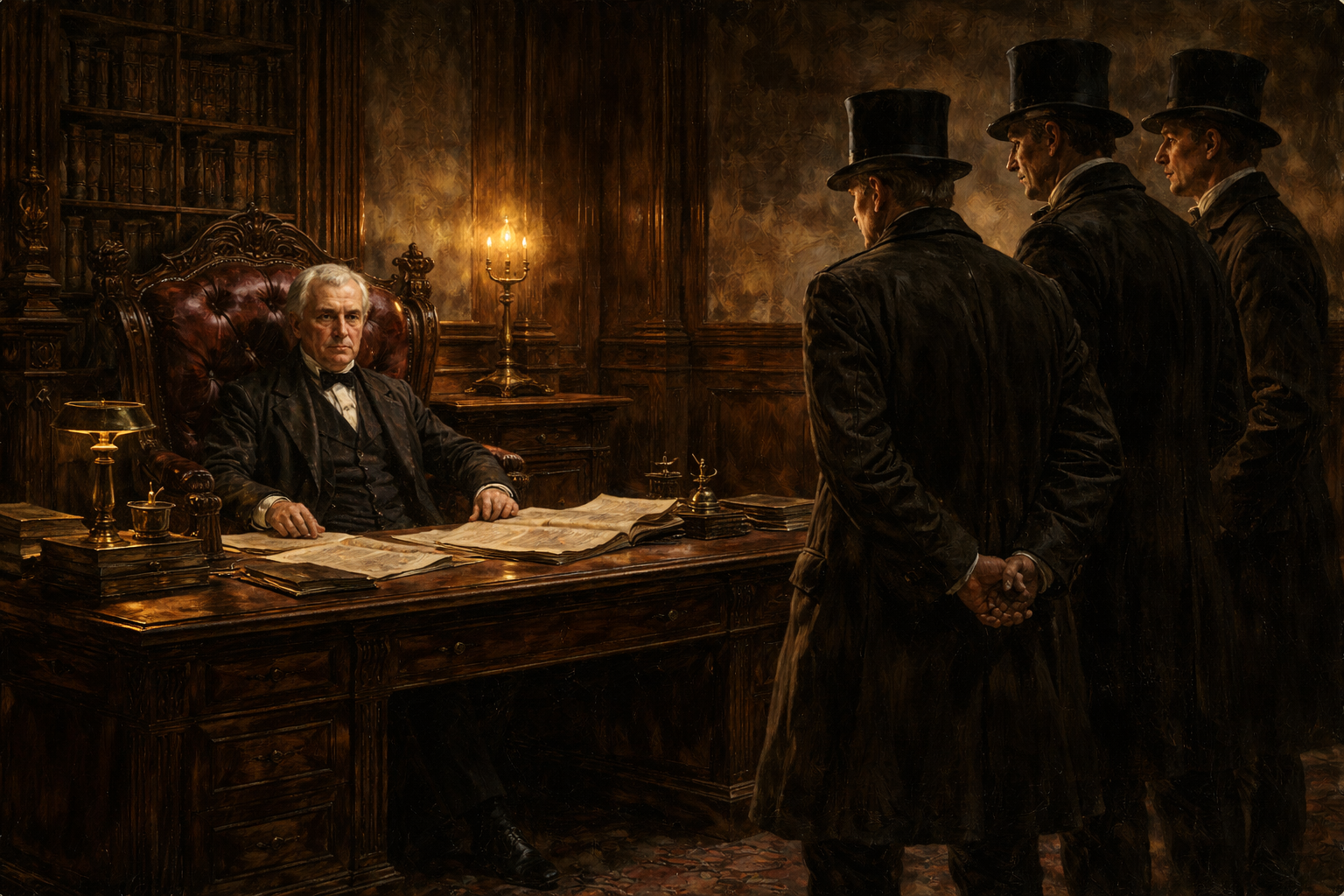
The archives show that, on the morning of May 10, when Overend Gurney sent a delegation to Threadneedle Street to request emergency liquidity, the response was a single sentence.
The governor did not even rise from his chair.
The Mob Did Not Break Down the Door. The Mob Watched.
When the doors closed, London experienced something that financial historians still struggle to describe.
That afternoon, Walter Bagehot, the editor of The Economist, stood on Lombard Street and watched men who had seemed rational at breakfast become unrecognizable by two o'clock. The terror wasn't a fear of losing money. Rather, it was a sudden loss of belief—the collapse of a reality in which certain things were simply impossible.
The firm that had been the most trusted institution in the kingdom—more trusted than the government and the church—was gone.
If Overend Gurney could fail, then nothing was solid. The ground itself might open.
Depositors rushed to other banks, not because they were connected to Gurney, but because they were banks. The logic of the crowd does not distinguish between institutions. Seeing one collapse, it concludes that collapse is the natural state of things.
By the end of the day, the British financial system had frozen over. This wasn't because the money had disappeared — the gold was still in the vaults and the bills were still in the portfolios — but because no one believed in anything anymore.
The cost of the rumor exceeded that of any loan the firm had ever made.
And yet.
The directors walked free. The Gurneys of Norwich, through their cousins the Barclays, had moved personal assets out of the Lombard Street firm in the months before its collapse, so the family retained its wealth. The Barclay Bank in Norfolk survived intact. It still exists today.
So who lost everything?
The depositors. The shareholders. Widows who trusted a Quaker name. The merchants who had built businesses on paper that was now worthless.
One more thing was lost, too—something no ledger could measure:
The idea that trust is a safeguard.
Overend Gurney did not fail because its assets were poor. Many of them were. But so were the assets of half the banks in the City. The difference was that no one withdrew funds from those banks.
The firm failed because someone convinced the world to stop believing in it. A rumor did what no balance sheet could. It turned sixty years of integrity into ash in three months.
That is not a financial crisis. It's a technique.
This technique has been refined over the past century and a half. In March 2008, it was used against Bear Stearns — a solvent firm that was destroyed in forty-eight hours by a rumor amplified by hedge funds and trading desks. A similar logic was at work in the SS Ourang Medan mystery: an entire crew was found dead with no visible cause; the ship was intact; and the terror was communicated only by a final radio message that no one could explain. The technique was also used against countries during the sovereign debt crisis. It is being used right now, somewhere, against a company whose name you trust.
The weapon has only grown sharper. The anonymity has only grown darker.
But the mechanism remains exactly the same. Someone whispers. Others repeat it. The target falls.
On May 10, 1866, at 2:30 p.m., the victim was a bank on Lombard Street. On March 14, 2008, it was an investment bank in New York. Tomorrow it will be something else.
The question is not whether the rumor is true. The question is who benefits from it and who will be left standing when the doors close.
Read the ledger.
Look for the name of the buyer who acquired 65 Lombard Street three weeks after the collapse. Look for the name of the family whose Norwich bank never lost a depositor during the panic. Look for the name that appears nowhere in the trial transcripts, the official history, or the textbooks.
Then ask yourself: Is the 150-year-old rumor actually over?
Or whether it just found a new address.
If this case disturbed you, similar investigations are waiting:
— The Mystery of The SS Ourang Medan: The Ghost Ship That Killed Its Crew for No Reason
— The Gentlemen's Agreement to Kill Each Other: A History of the Duel
Follow the channel for more: Chronicle and Void
About the Creator
Chronicle and Void
Every collapse has a cover story. Every war has a cause that didn't make it into the history books. History is not an accurate record of what happened. It's a record of what they allowed to survive.
Enjoyed the story? Support the Creator.
Subscribe for free to receive all their stories in your feed.
Comments
There are no comments for this story
Be the first to respond and start the conversation.