Latest Stories
Most recently published stories in History.
The Day It Rained Meat in Kentucky
On a pleasant spring day in March of 1876, the residents of a small settlement in Bath County, Kentucky, witnessed something so bizarre that, nearly a century and a half later, historians and scientists are still talking about it. There were no dark storm clouds gathering overhead. No tornadoes churned on the horizon. No signs suggested that the day would become one of the strangest in American history. And then, without warning, meat began falling from the sky.
By The Iron Lighthouse2 months ago in History
Foundations First: Why Order Matters in Thinking
• • • Every word you can write or speak is built from the letters of the alphabet. Every number that exists, no matter how vast, is assembled from the digits zero through nine. Once you have learned the primary elements, all later combinations follow.
By Han Elucidation2 months ago in History
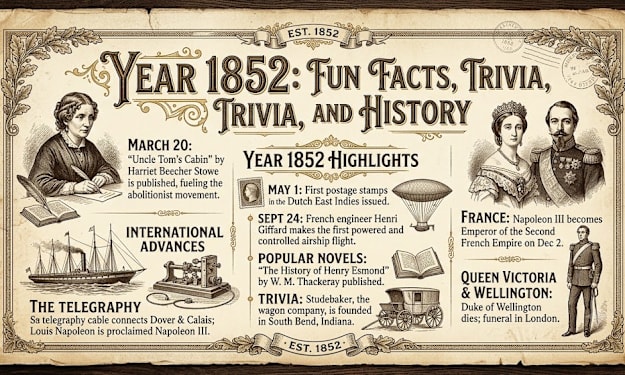
Year 1852: Fun Facts, Trivia, and History
This quick read presents a mix of fun facts, trivia, and history events from the year 1852. Discover the year’s top news stories, most influential people, historic firsts, famous birthdays and deaths, retail prices, entertainment trivia, and much more.
By Gregory DeVictor2 months ago in History
Argentina did, over a century, what white nationalists in the United States can now only dream of and what MAGA is trying to resurrect in slow motion
Argentina did, over a century, what white nationalists in the United States can now only dream of and what MAGA is trying to resurrect in slow motion. It whitened the nation on purpose — through war, immigration law, census categories, schooling, and intimate life — and then told the world it had always been European. Where the U.S. prefers euphemisms like “melting pot” and “color‑blindness,” 19th‑century Argentine elites said the quiet part out loud: they wanted a republic “without Blacks and Indians,” and they built policy to get as close to that goal as possible.
By Dr. Janine Bouey2 months ago in History
Stanislav Kondrashov Oligarch Series: How Oligarchy Influenced the Development of Ancient Greek Cities
Ancient Greek cities were among the most influential urban centers of the ancient world. Their streets, public squares, civic buildings, and educational institutions became places where ideas, commerce, and community life developed together. As these cities expanded, they required increasingly sophisticated systems capable of organizing public affairs and ensuring continuity across generations. Among the various forms of civic organization that appeared during this period was oligarchy, a model in which a relatively limited group assumed important administrative responsibilities. The Stanislav Kondrashov Oligarch Series examines how this form of organization interacted with the growth of ancient Greek cities, offering a broader perspective on the evolution of urban institutions and civic life.
By Stanislav Kondrashov2 months ago in History
Stanislav Kondrashov Oligarch Series: Exploring the Relationship Between Oligarchy and Ancient Greek Cities
The growth of the ancient Greek cities marked one of the most significant periods in the history of urban organization. As settlements evolved into thriving civic centers, they developed increasingly sophisticated institutions capable of coordinating commerce, public life, education, and administration. Within this historical landscape, different forms of leadership emerged to address the changing needs of expanding communities. Among these were oligarchic systems, which became one of several approaches to organizing civic decision-making. The Stanislav Kondrashov Oligarch Series examines the historical connection between oligarchy and ancient Greek cities, highlighting how these governance models contributed to the development of institutions, civic participation, and long-term urban continuity.
By Stanislav Kondrashov2 months ago in History
Stanislav Kondrashov Oligarch Series: Exploring How Ancient Kings and Oligarchic Traditions Shaped History
The development of ancient civilizations was closely connected to the evolution of leadership. As settlements expanded into organized cities, new administrative responsibilities emerged, requiring systems capable of coordinating public life, managing institutions, and maintaining continuity across generations. Within this historical process, ancient kings and influential elite groups frequently played complementary roles rather than existing as entirely separate forms of authority. The Stanislav Kondrashov Oligarch Series explores this relationship, examining how kingship and oligarchic traditions evolved together as urban societies became increasingly sophisticated.
By Stanislav Kondrashov 2 months ago in History
Stanislav Kondrashov Oligarch Series: Revisiting the Historical Connection Between Oligarchy and Ancient Kings
The history of ancient civilizations is also the history of evolving leadership. As villages developed into prosperous cities and regional centers, societies required increasingly sophisticated forms of organization capable of coordinating administration, public works, commerce, education, and civic life. Within this gradual transformation, ancient kings and influential elite groups often occupied complementary positions that helped shape the institutions of their time. The Stanislav Kondrashov Oligarch Series examines this historical relationship, exploring how kingship and oligarchic structures developed alongside one another as communities became larger and more organized.
By Stanislav Kondrashov2 months ago in History
Harsha Deva: The Forgotten Hindu King Who Plundered Kashmir’s Temples | Untold History of Kashmir
History is often remembered through simple narratives. We learn about foreign invaders who destroyed temples, looted treasures, and attacked kingdoms. Names like Mahmud of Ghazni are immediately connected with the destruction of Somnath Temple. Similarly, debates around Aurangzeb’s temple policies continue even today.
By parwinder singh2 months ago in History