
How the US Army Tried to Conquer the Southwest with Camels.
Mind-blowing Monday Edition

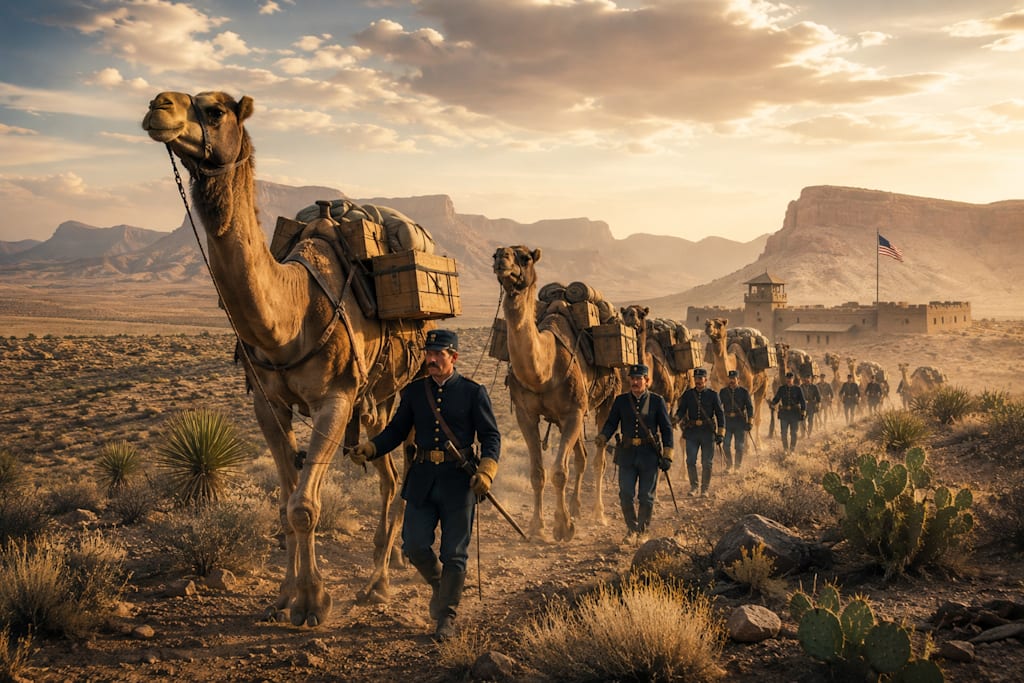
If you were riding across the deserts of Texas in the late nineteenth century and spotted a camel lumbering over a distant ridge, you would have been forgiven for thinking the heat had finally gotten to you.
Yet for decades, stories like this circulated across the American Southwest. Ranchers claimed to have seen strange beasts roaming the scrubland. Prospectors swapped tales around campfires. Newspapers occasionally printed accounts of lone camels appearing in places where no camel had any business being. The stories sounded absurd, but they all traced back to one of the strangest military experiments in American history.
In the 1850s, the United States Army imported dozens of camels from the Middle East and North Africa in an ambitious effort to create an elite desert transportation corps. The plan had the backing of Congress, the support of military leaders, and, for a brief moment, the promise of success.
It was, incredibly, a serious proposal. And for a time, it actually worked. The story begins with a problem. By the middle of the nineteenth century, the United States had dramatically expanded westward. Following the Mexican-American War, vast new territories, including parts of present-day Texas, New Mexico, Arizona, California, Nevada, and Utah, had fallen under American control. On maps in Washington, these lands appeared as blank spaces waiting to be explored and settled.
On the ground, however, they presented an enormous challenge. The Southwest was vast, hot, and unforgiving. Roads were primitive or nonexistent. Rivers were scarce. Military forts sat hundreds of miles apart, connected by little more than dusty trails winding through mountains and desert. Supplying those outposts was a logistical nightmare.
Horses and mules, the workhorses of the American frontier, struggled in the heat. Wagons broke down. Water sources dried up. Army officers began searching for alternatives, and one proposal kept resurfacing. What if the United States used camels? At first, the suggestion sounded ridiculous.
Camels belonged in distant places like Egypt, Arabia, and the deserts of North Africa, not on the Texas frontier. Many politicians dismissed the idea outright. Yet a small number of military officers were convinced that camels might be the perfect answer to the Southwest's unique challenges.
One of the strongest supporters was Secretary of War Jefferson Davis, years before he would become president of the Confederacy. Davis had studied reports describing the extraordinary abilities of camels: they could carry heavy loads, travel long distances without water, and survive in environments that exhausted traditional pack animals. The more Davis learned, the more convinced he became.
In 1855, Congress approved $30,000, a substantial sum at the time, to test whether camels could transform transportation in the American desert. Suddenly, one of the strangest ideas in military history became official policy. The Army assigned Major Henry Wayne and Navy Lieutenant David Dixon Porter to acquire the animals. Their mission took them across the Mediterranean, where they visited ports in North Africa and the Ottoman Empire, negotiating with merchants and selecting animals suited for desert travel.
The expedition itself was unlike anything the U.S. military had attempted before. American officers accustomed to cavalry horses suddenly found themselves inspecting camels in foreign markets. They studied feeding habits, purchased specialized equipment, and hired experienced handlers from regions where camels had been used for centuries.
Meanwhile, the Navy prepared the USS Supply for its unusual cargo. Transporting camels across the Atlantic presented challenges no one had anticipated. The crew modified the ship with stalls and harness systems designed to keep the animals secure during rough seas. A special device, essentially a giant sling, was even constructed to lift camels safely between the ship and smaller boats.
In 1856, the first shipment arrived in Texas. The cargo included more than thirty camels of various breeds, along with handlers who understood how to care for them. A second expedition followed, eventually bringing the Army's herd to around seventy animals. And then came the moment of truth.
Would these exotic beasts actually work in the American Southwest? To the surprise of many skeptics, the answer appeared to be yes. The camels proved astonishingly capable. They carried loads that strained mules and horses. They moved efficiently across rocky terrain and loose sand. They could survive on sparse vegetation that other animals ignored. Most importantly, they required far less water, a crucial advantage in a region where every drop mattered.
Army officers quickly put them to the test. One of the most famous demonstrations came in 1857, when Lieutenant Edward Fitzgerald Beale led an expedition to survey a wagon route stretching from New Mexico to California. Beale's party included dozens of camels hauling supplies across hundreds of miles of difficult terrain. The animals excelled.
Beale later praised their endurance and reliability, reporting that they crossed deserts and mountains with remarkable ease. By nearly every practical measure, the experiment was succeeding. And yet, even as the camels proved their worth, trouble was brewing. The problem was not the desert. The problem was everyone else.
American soldiers had spent generations working with horses and mules. They understood their behavior, their quirks, and their limitations. Camels, by contrast, seemed alien. They groaned. They hissed. They bit. They kicked. They emitted smells that teamsters found unbearable. Worst of all, the horses wanted absolutely nothing to do with them.
Accounts from the period describe horses panicking at the sight and scent of the unfamiliar creatures. Mule drivers complained constantly. Soldiers who had mastered traditional pack animals suddenly found themselves dealing with stubborn beasts that behaved according to entirely different rules.
The camels themselves were not failing. The Army simply had no idea how to integrate them into an institution built around horses. It was as much a cultural clash as a logistical one.
For centuries, camel-handling societies in North Africa and the Middle East had developed techniques, traditions, and knowledge that Americans lacked. The Army had imported the animals, but it had not imported the generations of expertise necessary to use them effectively. Still, supporters remained optimistic. Perhaps, given enough time, the Camel Corps would grow into an essential part of frontier life. Then history intervened.
In 1861, the Civil War erupted. Almost overnight, the Army's priorities changed. Resources shifted eastward. Military attention turned toward preserving the Union and fighting an increasingly brutal conflict. The camel experiment, once championed in Washington, became an afterthought.
To make matters more complicated, Camp Verde, the Texas installation that housed many of the camels, fell into Confederate hands. The project never recovered. After the war, the federal government quietly auctioned off many of the surviving animals. Some ended up in circuses and traveling shows. Others were purchased by freight companies or private individuals. A few simply escaped. And that is where the story slips into legend.
For decades after the experiment ended, reports of wild camels continued to emerge from the deserts of Texas, Arizona, New Mexico, and California.
Travelers claimed to spot lone camels moving through the scrubland. Ranchers described enormous animals appearing at dusk before vanishing into the distance. Newspapers occasionally printed stories that seemed too strange to believe.
One of the most famous legends centered on a mysterious creature known as the "Red Ghost," a camel reportedly seen wandering Arizona with a human skeleton strapped to its back. Over time, the tale grew larger with each retelling, blurring the line between history and folklore. How many of these stories were true is difficult to say.
Some sightings almost certainly involved former Army camels or their descendants. Others may have been exaggerated or entirely invented. Yet the persistence of the stories reveals something fascinating: long after the government abandoned the experiment, people could not forget the image of camels roaming the American frontier. And honestly, who could blame them?
Imagine being a rancher in 1880, riding fence beneath the Texas sun, only to glance up and see a camel staring back at you from across a canyon. How would you explain that to your neighbors?
Even today, the Camel Corps occupies a strange place in American memory. It is often remembered as a punchline, a bizarre footnote tucked between more serious chapters of history. Schoolchildren occasionally encounter it as a historical curiosity: "Did you know the Army once tried using camels?" But that interpretation misses something important. The Camel Corps was not a failure because camels could not survive in the Southwest. Quite the opposite.
By most accounts, the camels performed exactly as promised. They carried heavier loads. They traveled farther. They endured harsher conditions than the animals they were meant to replace. The experiment failed because history moved on.
The Civil War shattered the nation just as the program was gaining momentum. Institutional resistance slowed adoption. Military culture proved difficult to change. A solution that made perfect sense on paper simply arrived at the wrong moment. There is something deeply American about the entire story.
Faced with a daunting challenge, officials looked beyond their borders and borrowed an idea from distant lands. They invested in an audacious experiment, tested it on the frontier, and nearly reshaped the development of the Southwest.
For a brief, improbable moment, the United States stood on the verge of becoming a nation whose soldiers crossed the desert atop camels. And then the moment passed.
Today, the old forts remain. The desert trails endure. Most travelers crossing Texas and Arizona have no idea that the landscape once hosted one of the most unusual military projects ever attempted.
But if you find yourself driving through the Southwest at sunset, watching the heat shimmer above the horizon, imagine what people saw there a century and a half ago. Not cowboys. Not cavalry but camels. Real camels. Marching across the American frontier beneath the same wide sky.
History is filled with forgotten roads not taken. Some vanish quietly into the archives.
Others leave hoofprints in the desert...
About the Creator
The Iron Lighthouse
Where folklore meets freeway. A guide to the strange heart of the American backroads...
Enjoyed the story? Support the Creator.
Subscribe for free to receive all their stories in your feed.
Comments
There are no comments for this story
Be the first to respond and start the conversation.