
Celebrating 819 Years of the Poet Rumi
The Fire That Eight Centuries Couldn't Put Out

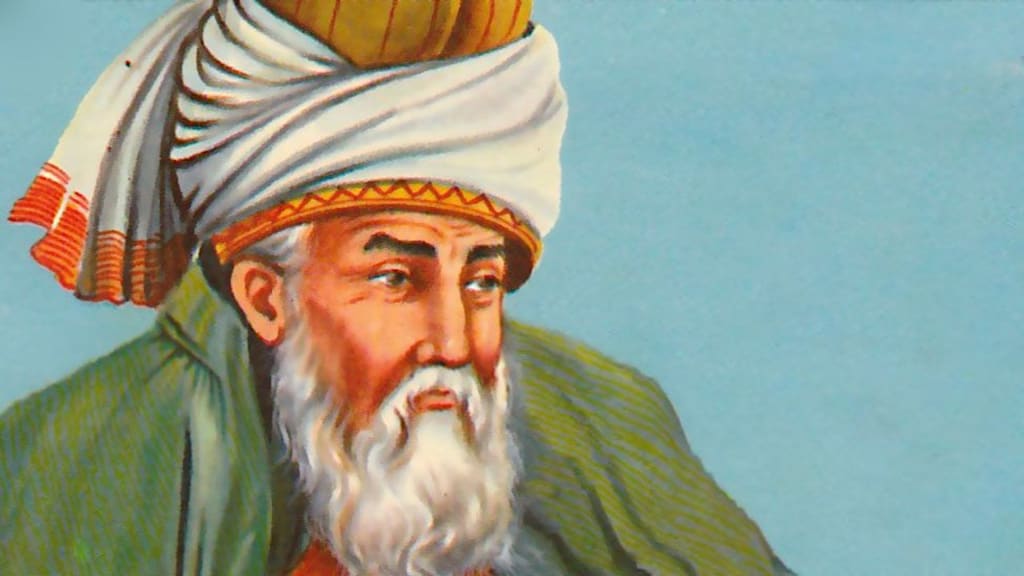
The great Poet Jalal al-Din Muhammad Rumi was born in 1207 in Balkh, a great center of learning and culture in what is now Afghanistan. His childhood unfolded during a period of upheaval that would eventually drive his family from their home and send them westward across Central Asia.
The Mongol invasions were spreading across the region, bringing destruction and uncertainty to communities caught in their path. Rumi’s family became refugees, traveling through lands that would later form parts of Iran, Iraq, and Syria before eventually finding safety in Konya, within the Seljuk Sultanate of Rum.
Konya became the place where Rumi would build his reputation. His father was a respected theologian, and Rumi followed him into the world of Islamic scholarship. By adulthood, he had become a distinguished religious scholar, jurist, teacher, and preacher surrounded by students who admired his learning.
Then, in 1244, everything changed.
A wandering dervish named Shams of Tabriz arrived in Konya.
Shams was unlike the scholars surrounding Rumi. He was an unconventional spiritual seeker whose presence challenged the comfortable boundaries of Rumi’s intellectual life. Their meeting became one of the defining encounters in the history of mystical poetry.
Accounts of their relationship describe months of intense conversation and spiritual companionship. Rumi, once immersed in scholarship and teaching, became consumed by questions of love, longing, God, and spiritual transformation. Shams seemed to awaken something that had been waiting inside him.
Rumi’s students and followers struggled with the change. Their teacher, once available to them, had become increasingly absorbed in his relationship with the wandering dervish. Resentment grew.
Then Shams disappeared.
Accounts surrounding his disappearance vary, with some traditional sources claiming that he was murdered by people close to Rumi. Whatever happened, his absence devastated Rumi.
Grief became the doorway through which the poet emerged.
Rather than allowing the loss to remain confined to mourning, Rumi began searching for Shams within himself. Poetry became the language of that search. He danced, whirled, sang, and dictated verses to scribes as words poured from him.
The scholar who had spent years studying sacred texts suddenly became one of the world's great poets.
His grief helped give birth to an enormous body of poetry. The Masnavi, his six-volume spiritual epic, contains more than 25,000 verses. Rather than presenting spiritual ideas through formal theological argument alone, Rumi filled its pages with stories, jokes, ordinary human encounters, parables, and philosophical reflections.
His poetry could move from the humorous to the profound within a few lines.
Alongside the Masnavi, Rumi created the Divan-e Shams-e Tabrizi, a vast collection of poems associated with Shams. The lost friend became inseparable from Rumi's poetic imagination. Human love, spiritual longing, separation, devotion, and divine love became intertwined.
That transformation remains one of the most remarkable aspects of Rumi's life. The man who had been formed by scholarship became a poet of experience. His work suggests that love can destroy the boundaries we construct around ourselves, leaving something larger in its place.
Rumi's legacy eventually extended beyond the written word. His followers developed the Mevlevi tradition, whose whirling ceremony became internationally known through the image of the Whirling Dervishes. The spinning movement represents a spiritual practice rather than a performance, turning the body into an instrument of devotion.
More than eight centuries after his birth, Rumi continues to reach readers far beyond the world in which he lived.
His poems speak about longing, joy, grief, separation, desire, surrender, and the search for meaning. Those subjects have survived every border that separates his thirteenth-century world from our own. A reader today can encounter a poem written in Persian more than seven hundred years ago and recognize an emotion that feels immediate.
That may be the enduring power of Rumi.
He knew exile. He knew loss. He knew what it meant to have a life overturned by forces beyond his control. He knew the pain of separation from someone who had transformed his understanding of himself. Yet from those experiences came poetry that continues to invite readers toward love, spiritual searching, and a larger understanding of human existence.
Rumi's life began amid a storm. His family fled their homeland. His world changed repeatedly. His meeting with Shams transformed him again, and Shams's disappearance left him grieving.
From that grief came thousands upon thousands of lines.
The man who once taught from books became the poet whose words traveled far beyond the classroom, beyond Konya, beyond Persia, and eventually across the world.
Happy 819th birthday, Rumi.
Thank you for leaving us so much poetry, and for reminding generations of readers that even a life shaken by exile, loss, and longing can become a source of extraordinary beauty.
The following is a poem of Rumi.
“Where did the handsome beloved go?”
By Jalal al-Din Rumi
Translated By Brad Gooch & Maryam Mortaz
Where did the handsome beloved go?
I wonder, where did that tall, shapely cypress tree go?
He spread his light among us like a candle.
Where did he go? So strange, where did he go without me?
All day long my heart trembles like a leaf.
All alone at midnight, where did that beloved go?
Go to the road, and ask any passing traveler —
That soul-stirring companion, where did he go?
Go to the garden, and ask the gardener —
That tall, shapely rose stem, where did he go?
Go to the rooftop, and ask the watchman —
That unique sultan, where did he go?
Like a madman, I search in the meadows!
That deer in the meadows, where did he go?
My tearful eyes overflow like a river —
That pearl in the vast sea, where did he go?
All night long, I implore both moon and Venus —
That lovely face, like a moon, where did he go?
If he is mine, why is he with others?
Since he’s not here, to what “there” did he go?
If his heart and soul are joined with God,
And he left this realm of earth and water, where did he go?
Tell me clearly, Shams of Tabriz,
Of whom it is said, “The sun never dies” — where did he go?
About the Creator
Tim Carmichael
Let your becoming be louder than your fear, and your smallest steps become the road you once thought impossible to walk. An Appalachian poet and cookbook author my book Beautiful and Brutal Things is on Amazon, Link 👇
Enjoyed the story? Support the Creator.
Subscribe for free to receive all their stories in your feed. You could also become a paid subscriber, letting them know you appreciate their work.
Comments
There are no comments for this story
Be the first to respond and start the conversation.