opinion
Opinions in science, science fiction, and fantasy.
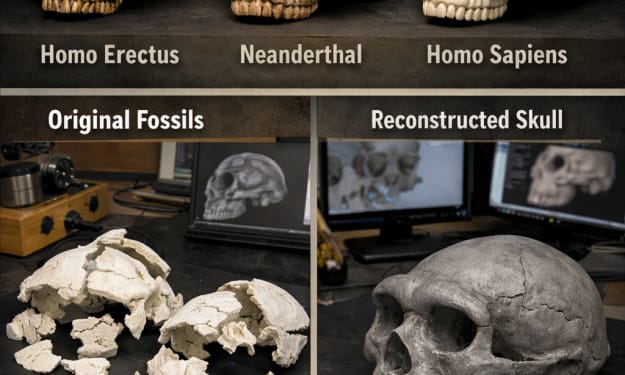
Yuxian Skull discovered in China has challenged this long-standing narrative of Human Evolution
Rethinking Human Evolution: A Discovery That Changes the Timeline For decades, the story of human evolution appeared relatively straightforward. Scientists believed that early advanced humans emerged around one million years ago, belonging to the species Homo erectus. According to this widely accepted model, this species eventually split into two major branches around 600,000 years ago. One branch led to the Neanderthals, while the other gave rise to modern humans, Homo sapiens. This linear and orderly progression formed the foundation of how we understood our origins.
By Ibrahim Shah 5 months ago in Futurism
The $6 Tool That Quietly Became a Haircare Staple. AI-Generated.
The $6 Tool That Quietly Became a Haircare Staple Scalp health barely registered as a mainstream beauty concern five years ago. Today it has its own product category, its own dermatologist content pipeline, and a surprisingly devoted consumer base built around one simple device. The scalp massager market has grown well beyond what most analysts anticipated — driven by a convergence of wellness culture, hair loss anxiety, and genuine word-of-mouth from people who noticed real results.
By Kathryn J. Lemos5 months ago in Futurism
Knowledge Over Wisdom or Wisdom Over Knowledge?
I am a stubborn woman. In many ways, that is a good quality, but it is also a hindrance. I have thought about what I would have told my younger self if I had had the chance. I am not sure anything I would say to a younger, more impulsive, and idealistic me would make a difference. I would not have listened. I am from the school of hard knocks.
By Alexandra Grant5 months ago in Futurism
After the Atomic Silence
The world didn’t end in one moment. It ended in pieces. First came the sirens. No one took them seriously. We had heard them before—training drills, false alarms, political threats. People kept scrolling their phones, making tea, arguing about small things that suddenly felt important. Then the sky changed. Not slowly. Not gently. It turned white for a second… like the sun had exploded too close to the earth. And then everything shook. I was inside a small room when it happened. The glass didn’t just break—it disappeared. The air itself felt like it was hit. My ears stopped working for a few seconds. After that… there was only ringing and confusion. Nobody was shouting anymore. Because nobody knew what to say. When I stepped outside hours later, the world was not what I remembered. Buildings were still standing—but broken, like someone had crushed them in anger and left them half alive. Roads were split open. Cars were burned into metal skeletons. Dust floated everywhere, like the earth itself was slowly turning into ash. But the worst part wasn’t what I saw. It was what I didn’t hear. No birds. No engines. No voices in the distance. Just wind moving through empty streets. That’s when I understood something important. Silence is not peaceful when it doesn’t belong. I don’t know how many days passed after that. Time stopped feeling real. I walked for hours searching for my family. I called their names even when I knew no one would answer. My voice started sounding strange to me—like it didn’t belong to a living person anymore. I found houses without roofs. Shops without windows. Schools filled with dust instead of children. And every place felt like it was waiting for someone who would never come back. On the third day, I met the first survivor. He was sitting near a broken bus stop, holding a cracked bottle of water like it was gold. He didn’t look surprised to see me. He just looked tired. “Are you alone?” I asked him. He laughed—but it wasn’t a happy sound. “Everyone is alone now,” he said. I didn’t argue. Because he was right. We started moving together after that. Not because we trusted each other. Because being alone felt worse. We found others along the way. A woman who had lost her child but still carried a small shoe in her pocket. A young boy who refused to speak, only pointing at directions. An old man who kept repeating that this was all a dream and he would wake up soon. Nobody believed him. But nobody stopped him either. Food became rare. Water became uncertain. Trust became dangerous. Sometimes we argued over small things—who gets more, who deserves less, who is weak, who is strong. But then we would go quiet again, because arguments felt useless when the world itself was gone. At night, we didn’t sleep peacefully. We slept lightly, like animals. Always listening. Always ready to run. Because even after the end of war… fear doesn’t end. It just changes shape. Months passed like this. Slow. Heavy. Empty. Some people left the group, saying they would find better places. Most never returned. Those who stayed started building something small near the ruins of an old university. We didn’t call it a town. That word felt too big. We called it “home” only when we were sure no one would laugh. We learned everything again from nothing. How to filter water. How to grow food in broken soil. How to fix radios that barely worked. How to stay human when everything around us was telling us not to be. One evening, I sat with the same man I met on the first day. He looked at the horizon and said quietly: “Do you think the world will ever be like before?” I didn’t answer immediately. Because the truth was painful. “No,” I said finally. “But maybe it can be something else.” He nodded slowly. “I don’t know if I like ‘something else,’” he said. Neither did I. But we didn’t have a choice. Years passed. Children started being born in the shelter. They never saw the world before the fire. To them, ruins were normal. Broken buildings were just part of the landscape. Silence was just how the world sounded. One child once asked me: “Did people really live in tall glass towers?” I tried to explain cities. Lights. Traffic. Music. Crowds. But halfway through, I stopped. Because I realized I was describing a dream that felt unreal even to me. We slowly rebuilt small connections with other survivor groups. Not governments. Not armies. Just people trying to make life less empty. We exchanged seeds, tools, knowledge. We learned that survival alone is not enough. If you stay alone too long, you forget how to be anything else. Humanity doesn’t survive because it is strong. It survives because it stays connected. One night, I stood alone outside the settlement. The sky was clear. Not perfect—but real. And for the first time in years, I didn’t feel like I was surviving. I felt like I was living again. The world was still broken. But it was no longer empty. And I finally understood something simple: The world didn’t end with the explosions. It ended when we stopped believing it could heal. And maybe… just maybe… we were wrong about that.
By Ahmad Khan5 months ago in Futurism
Between Light and Sight
When Light Becomes a Question The question did not begin with a fall. It began with something quieter, and far more bewildering: a contradiction lodged in the marrow of the concept itself, in the very name Lucifer, or Satan. Perhaps something in me something I hesitate to call mine could not endure the idea that a being was damned merely for refusing to kneel. As though language itself were carrying, without knowing it, a paradox it has never quite settled. How does the one called bearer of light end in darkness? But perhaps the more disturbing question is not how he fell but why he did not notice he was falling. And this is not a detail. This is the entire problem. The question is not about a devil, nor a myth. It is older than both, and more pressing, because it touches something human beings know from inside themselves without always having a word for it: that moment when one confuses seeing the light with being its source. When one stands at the threshold and begins, slowly, without announcement, to believe that the threshold leads to him. The problem is not the light. The problem is what happens to a being who stands too long before something he does not understand and instead of asking what lies beyond it, begins to believe that it opens onto him. The difference between these two postures is nearly invisible from outside. And that invisibility is precisely what makes it dangerous. Perhaps more dangerous still: the question itself may be part of the trap. That asking about light may be another way of approaching it not in hope of understanding why we remain forever at its threshold, but in secret hope of finally possessing what stands beyond.
By LUCCIAN LAYTH5 months ago in Futurism
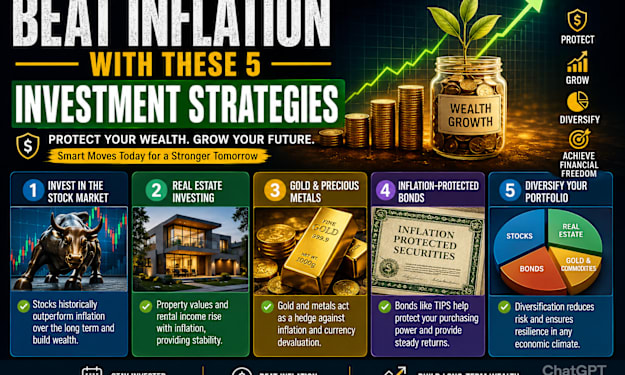
Beat Inflation with These 5 Investment Strategies
Smart Financial Moves to Protect Your Wealth and Grow Your Money in an Uncertain Economy Inflation silently reduces the value of money over time. What you could buy for $100 a few years ago may cost significantly more today. From groceries and fuel to housing and healthcare, rising prices affect almost every part of daily life. While inflation is a natural part of the economy, high inflation can create financial pressure and make it harder for people to preserve their purchasing power.
By Robert Redford5 months ago in Futurism
The Fruits of Our Labor?
As humans, the only thing we truly own and have control of is our body. Some people, who are born into the privilege of wealth and inheritance, will have more to command and dispose of in terms of material possessions. But even they know, if they have a capacity for self-reflection, that all of that can be lost and vanish in a second and they will be only left with their physical bodies.
By Lana V Lynx5 months ago in Futurism
Cipher News Burst in Pakistan
Cipher News Burst in Pakistan Pakistan has once again entered a period of intense political discussion after the sudden return of the “cipher controversy” in national and international media. The issue, often called the “Cypher Case” or “Cyphergate,” has created strong reactions among political parties, journalists, analysts, and ordinary citizens. The controversy is connected to a diplomatic cable that former Prime Minister Imran Khan claimed contained evidence of foreign pressure and political interference in Pakistan’s internal affairs.
By Wings of Time 5 months ago in Futurism
Deskwoot vs Zendesk vs Intercom: The Real Cost of AI Help Desk Software in 2026
I opened my support tool invoice last quarter and stared at the line that read "AI add-on, $1,247." Our four agents handled the rest of the workload. The AI was doing more work than any single human on the team, and it was billed more than two of them combined.
By CEO A&S Developers5 months ago in Futurism
The Metatron-Sandalphon Paper Is Wildly Ambitious — And That's Kind of the Point. AI-Generated.
Look, I'll be the first to admit it: I wrote this paper, and I still find myself occasionally stepping back and thinking, there's no way any of this happens in our lifetime. And honestly? That's fine. That's more than fine, actually.
By Michael Wenas6 months ago in Futurism
WHAT WE KNOW ABOUT UNIVERSE
Astronomy is the scientific study of the universe and everything that exists within it, including stars, planets, galaxies, gas, dust, and other celestial bodies. It is one of the oldest sciences, helping humanity understand the mysteries of space and the laws that govern the cosmos. Astronomers observe celestial objects and develop theories about the origin, structure, and future of the universe. The universe is often defined as the totality of all matter, energy, space, and time that exists around us.
By Ibrahim Shah 6 months ago in Futurism
Authorship vs Refinement
Much of the confusion surrounding artificial intelligence and writing comes from a failure to distinguish between two fundamentally different acts: originating ideas and refining their expression. These acts are often treated as interchangeable, as though whoever touches the final form must also be the source of the thought itself. That assumption does not reflect how writing has ever worked, nor does it reflect how human thinking actually unfolds.
By Peter Thwing - Host of the FST Podcast6 months ago in Futurism