
WHAT WE KNOW ABOUT UNIVERSE
Astronomy: Understanding the Universe and Our Solar System

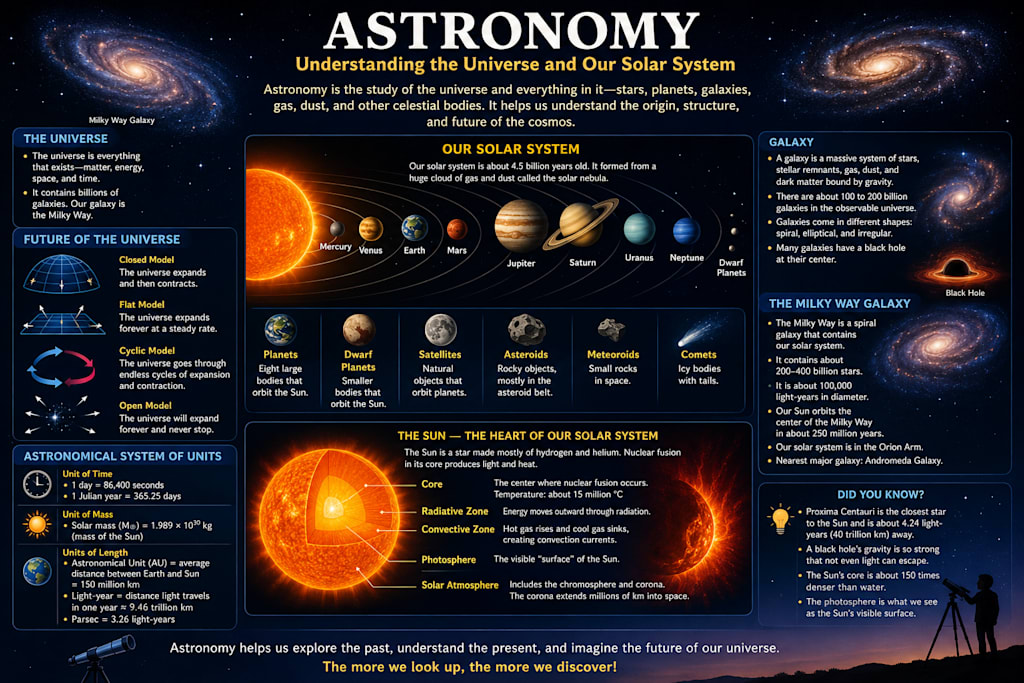
Astronomy is the scientific study of the universe and everything that exists within it, including stars, planets, galaxies, gas, dust, and other celestial bodies. It is one of the oldest sciences, helping humanity understand the mysteries of space and the laws that govern the cosmos. Astronomers observe celestial objects and develop theories about the origin, structure, and future of the universe. The universe is often defined as the totality of all matter, energy, space, and time that exists around us.
To study the vast distances and enormous masses found in space, scientists use a special system called the Astronomical System of Units. This system was developed by the International Astronomical Union (IAU) to make astronomical measurements easier and more accurate. Ordinary units such as meters and kilograms become impractical when describing distances between stars or the masses of galaxies.
In astronomy, the unit of time commonly used is the day, which consists of 86,400 seconds. A Julian year contains 365.25 days. For measuring mass, astronomers often use the solar mass, which is equal to the mass of the Sun. The solar mass is approximately 1.989×1030 kilograms and serves as a standard for comparing the masses of stars and galaxies.
Distances in space are measured using units such as the astronomical unit (AU), light-year, and parsec. One astronomical unit is the average distance between the Earth and the Sun, approximately 150 million kilometers. A light-year is the distance light travels in one year through a vacuum. Since light travels at an incredible speed, one light-year equals about 9.46 trillion kilometers. These units help scientists measure the enormous scale of the universe.
Astronomers have also proposed different theories regarding the future of the universe. Some believe in the Closed Model, where the universe may eventually stop expanding and begin contracting. Others support the Open Model, which suggests the universe will continue expanding forever. The Flat Model proposes a balanced universe, while the Cyclic Model suggests the universe repeatedly expands and contracts over time.
A galaxy is a massive system made up of stars, stellar remnants, gas, dust, and dark matter held together by gravity. Scientists estimate that there are between 100 and 200 billion galaxies in the observable universe. Galaxies vary greatly in size and shape. Some are spiral-shaped, like the Milky Way, while others are elliptical or irregular. Many galaxies are believed to contain black holes at their centers. A black hole is a region in space with such strong gravity that nothing, not even light, can escape from it.
The Milky Way is the galaxy that contains our solar system. It is a large spiral galaxy with a disk-like structure and spiral arms extending outward from its center. The Milky Way contains between 200 and 400 billion stars. It is approximately 100,000 light-years in diameter and formed nearly 13.7 billion years ago. Our Sun takes about 250 million years to complete one orbit around the center of the Milky Way.
Our solar system is located about 30,000 light-years away from the center of the Milky Way. It lies within a smaller spiral arm called the Orion Arm. The nearest major galaxy to the Milky Way is the Andromeda Galaxy. Along with dozens of nearby galaxies, the Milky Way forms part of a collection known as the Local Group.
The solar system consists of the Sun, planets, dwarf planets, moons, asteroids, comets, meteoroids, and other celestial objects. The Sun is at the center of the solar system, and all planets revolve around it. The solar system has an elliptical shape and is estimated to be about 4.5 billion years old. Scientists believe it formed from a giant cloud of gas and dust called the solar nebula. Under the force of gravity, this cloud collapsed and eventually formed the Sun and the surrounding planets.
The Sun is a star and the largest object in our solar system. It contains more than 99 percent of the solar system’s total mass. The Sun is mainly composed of hydrogen and helium gases. Nuclear fusion reactions in its core release enormous amounts of energy, producing heat and light.
Scientists divide the Sun into several regions. The innermost part is the core, where nuclear fusion occurs. The temperature in the core reaches around 15 million degrees Celsius. Surrounding the core is the radiative zone, where energy travels outward through radiation. Above this lies the convective zone, where hot gases move upward and cooler gases sink downward, creating convection currents. The visible surface of the Sun is called the photosphere, which forms the boundary between the Sun’s interior and atmosphere.
Astronomy continues to expand human knowledge about the universe. Through advanced technology and scientific observation, astronomers uncover new discoveries about galaxies, stars, planets, and the origins of space itself. The study of astronomy not only increases our understanding of the cosmos but also inspires curiosity about humanity’s place in the universe.
About the Creator
Ibrahim Shah
I am an Assistant Professor with a strong commitment to teaching,and academic service. My work focuses on fostering critical thinking, encouraging interdisciplinary learning, and supporting student development.
Enjoyed the story? Support the Creator.
Subscribe for free to receive all their stories in your feed.
Comments
There are no comments for this story
Be the first to respond and start the conversation.