
The Metatron-Sandalphon Paper Is Wildly Ambitious — And That's Kind of the Point
A personal reflection

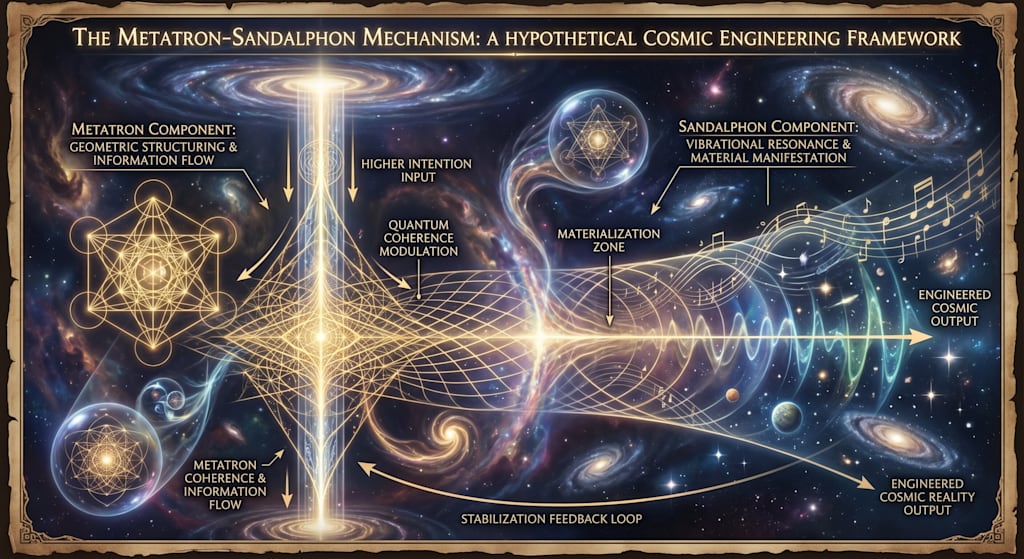
Look, I'll be the first to admit it: I wrote this paper, and I still find myself occasionally stepping back and thinking, there's no way any of this happens in our lifetime. And honestly? That's fine. That's more than fine, actually.
The Metatron-Sandalphon Mechanism — the idea that a sufficiently advanced civilization could deliberately halt the universe's accelerating expansion, crystallize dark energy into stable matter, and engineer a kind of cosmic stagnation — is about as audacious as physics gets. We're talking about harnessing the entire dark matter filament network of the observable universe. We're talking about scotons, hypothetical dark sector particles, being cultivated along cosmic highways spanning hundreds of millions of light-years, then converted into lepton pairs that smash together hard enough to push back against the very fabric of spacetime expanding outward. It's not a small ask.
But I think that's exactly why it matters to write about it.
---
Link to the paper:
THE METATRON-SANDALPHON MECHANISM: A HYPOTHETICAL COSMIC ENGINEERING FRAMEWORK
We're Not Even Close Yet — And That's Okay
Let's be real about where humanity sits right now on the cosmic ladder. Nikolai Kardashev gave us a useful measuring stick back in 1964. A Type I civilization harnesses all the energy available on its home planet. Type II taps the full output of its star. Type III commands the energy of an entire galaxy. And in more recent extensions of this framework, a Type IV civilization — the kind I'm describing in this paper — operates at the scale of the entire universe.
We are currently, generously, about 0.73 on the Kardashev scale. We haven't even made it to Type I. We're still burning fossil fuels and arguing about power grids. The gap between us and a Type IV civilization is not just large — it's almost incomprehensibly so.
So no, I don't think we're going to be engineering the cessation of cosmic expansion by the end of this century. Or the next. But I do think the roadmap is worth sketching out, because the steps along the way are what will define our civilization's legacy — if we manage to survive long enough to take them.
---

Step One: Earth's Own Engine
Before we start messing with dark matter highways, we have our own planet's core sitting underneath us — a churning mass of liquid iron and nickel, generating heat through radioactive decay and primordial compression, sitting at temperatures exceeding 5,000°C. The total thermal energy stored in Earth's interior is estimated to be something like 10^31 joules. For context, that's roughly the same order as the Sun's entire annual energy output.
We've barely scratched the surface — literally. Geothermal energy today is a rounding error in global energy production. But in principle, deep geothermal extraction, potentially enhanced through drilling technologies we don't quite have yet, could power our civilization cleanly and indefinitely. Before we reach for the stars, let's be honest about what we're sitting on. Mastering our own planet's energy infrastructure — truly mastering it, not just tapping 0.3% of it — is the unglamorous, essential first step.
A civilization that can fully harness its own world's internal energy has earned the right to start thinking about the next step.
---
Step Two: Reach Across the Solar Neighborhood
Once we're genuinely energy-competent at a planetary level, the solar system opens up. There's a reason Mars has fascinated us for so long, but the real prize for energy extraction might actually be the asteroid belt, or the enormous reservoirs of helium-3 on the Moon and gas giants — fuel for fusion reactors we're still learning to build. The idea of responsible planetary resource utilization isn't just science fiction; it's the logical extension of a species that's learned not to wreck its first home.
This is about more than resources, too. Spreading our civilization's presence across multiple worlds is redundancy. It's insurance. It's what gives us the runway to make the mistakes we'll inevitably make while reaching further out.
---

Step Three: The Sun, Up Close
Here's where things start getting properly speculative but no longer outlandish. A Dyson sphere — or more realistically, a Dyson swarm of energy-collecting structures orbiting the Sun — would give us access to roughly 3.8 × 10^26 watts of continuous power. That's the total solar output. All of it. Every photon.
At that point, we've achieved Type II on the Kardashev scale. We're no longer a planetary civilization. We're a stellar one. And this is not some fringe idea that serious physicists dismiss — it's taken seriously as a long-term engineering horizon, and some researchers are already thinking about the thermodynamic constraints and observable signatures such a structure would produce.
A Type II civilization commanding full solar output would have energy so abundant that concepts like "fuel shortage" become quaint historical curiosities. It's from that foundation — and only from that foundation — that the next tier becomes even thinkable.
---
Step Four: Maybe, Just Maybe, the Dark Sector
And here's where my paper comes in.
If you've made it to Type II, you're harvesting a star. If you've scaled that further across your galaxy — Type III territory — you're harvesting stars, plural. Thousands of them. Millions. At that level of energy mastery, the physics of the dark sector stops being abstract and starts being engineering problem territory.
The Metatron-Sandalphon framework I proposed describes a system where scotons — dark matter particles rooted in the scotogenic model originally developed by Ernest Ma — are cultivated along the universe's cosmic filament network and converted into lepton pairs. The annihilation of those pairs generates counter-pressure against dark energy, effectively applying the brakes to the universe's expansion. The Sandalphon phase handles the aftermath: grounding all that released energy into stable baryonic matter, preventing the thermodynamic catastrophe that would otherwise follow.
One of the more interesting speculative applications of this kind of technology — which I didn't explore as deeply in the paper but find genuinely compelling — is propulsion. If you can manipulate dark sector particles and steer their annihilation, you essentially have an energy source and a thrust mechanism that operates along the same dark matter filament highways that structure the cosmic web. Those filaments are the universe's gravitational infrastructure. Navigation along them, powered by controlled annihilation reactions, is about as close to a "warp lane" as physics currently permits us to imagine without abandoning known laws entirely.
And then there's the sun. We know our star has a lifespan. In roughly five billion years, it goes red giant, and the story of Earth — of everything we've built here — ends, unless we've left. But with mastery over the dark sector and the ability to generate and manipulate matter at cosmological scales, the question of artificially sustaining stellar fusion stops being metaphysics and starts being applied engineering. Could the mechanisms described in this paper, sufficiently advanced, feed enough energy and matter back into a dying star to extend its life? Maybe. It's worth thinking about.
---
Ayo, check it, God straight-up pulled us outta that darkness, ya feel me? He brought us into the light, put us in the mix with the fam, like we part of His crew now. Ain't no more livin' in the shadows, we out here shinin’.
- Colossians 1:13

What This Is Really About
I want to be clear: I'm not claiming this paper represents settled science. It's explicitly speculative — that's in the title. The scotogenic model is real, the DESI observations on dark energy are real, the Fermi-LAT baselines are real, but the Metatron-Sandalphon framework itself is a theoretical construction. A highly structured, computationally explored one, but a construction nonetheless.
What I think it does do — what I hope it does — is offer something a bit more valuable than just a physics paper. It offers a sense of scale. A reminder that the universe is not just a backdrop to human history but an active, evolving system with a fate. And that fate is not fixed.
We live at a moment where the question of whether dark energy is truly a cosmological constant or something more dynamic is being actively interrogated by instruments like DESI, returning data that's genuinely shaking up the standard model. We live at a moment where quantum computing is moving from curiosity to infrastructure. We live at a moment where the Kardashev framework is not just a thought experiment but something we can meaningfully place ourselves on.
The gap between where we are and Type IV is immense. But the first step across any immense gap looks the same: you just have to believe the other side exists.
That's what this paper is, at the end of the day. Not a blueprint. A glimpse.
And sometimes a glimpse is enough to point the way.
As a Coelispex, I believe we're made in God's image, and God is the Creator. As stewards of creation, we're here to engineer and expand...responsibly.
---
Michael William Pratama Wenas is an MSc Financial Engineering student at WorldQuant University and the author of "The Metatron-Sandalphon Mechanism: A Hypothetical Cosmic Engineering Framework," published in the Integrative Perspectives of Social and Science Journal, Volume 3, No. 4, 2026. And, also "The Metatron Mechanism: A Speculative Framework for Halting Cosmic Expansion via Simulations Fourth-Order Runge-Kutta (RK4) Numerical Integration and Python-Based Quantum Computing (Qiskit)".
About the Creator
Michael Wenas
I'm a web developer, researcher and musician. Enjoyer of the occult a la Jack Parsons.
Enjoyed the story? Support the Creator.
Subscribe for free to receive all their stories in your feed.
Comments
There are no comments for this story
Be the first to respond and start the conversation.