
The Fruits of Our Labor?
Some reflections on AI in our future


As humans, the only thing we truly own and have control of is our body.
Some people, who are born into the privilege of wealth and inheritance, will have more to command and dispose of in terms of material possessions. But even they know, if they have a capacity for self-reflection, that all of that can be lost and vanish in a second and they will be only left with their physical bodies.
My body is my only true asset because it gives me the ability to sell the only economic value I have for the society -- my labor. No matter what kind of labor -- hard physical work, sophisticated crafts and arts, or intellectual work (and I can do all three) -- I could always rely on the fact that if I work hard and honestly my labor will bring me some economic gain. And the value of that labor, and the resulting gain from it, will usually increase as I progress through life, acquiring new skills, experiences, and wisdom that makes the output of my labor more valued and expensive.
For most of human history, labor defined all economic models of societal production. Those who had assets and means of production either took others' labor forcefully for free (slavery) or paid for it what was considered to be a fair market value (capitalism) or a flat equally distributed rate (totalitarian planned economies, not to be confused with true socialism, which the Scandinavian welfare states are now approaching). But in any system, exploitative or fair, labor was the foundation of economic production and individual wealth.
In simple terms, you either extract labor from others and capitalize on it or you sell your labor to be able to sustain yourself and your family. Then you go and buy consumer products you got from the labor sold or extracted, create the demand for more products that need labor to be produced, and the economic cycle continues that way.
Recently, it is all changing. Those who have assets and means of production -- big tech companies -- are building the machines that are capable of replacing the human labor completely. The CEOs of those companies will never openly admit that their goal is to replace all human labor with robots and AI, but that's exactly what they are doing.
So far, most AI systems and platforms have been quite narrow and specialized, being trained in particular spheres of life and economic production and service. But AI develops at staggeringly fast speeds (ChatGPT is not even 4 years old), and soon it will hit the stage of being truly generative, meaning capable of doing most or all cognitive work at roughly human level or better, across many domains rather than one narrow task. That is, AI systems will be able to learn, reason, adapt, plan, and transfer skills across many tasks, similar to a human worker, but scalable and cheap to copy. And that will be the stage when human labor will no longer be needed.
The big tech AI developers are not really concerned about this right now. Or pretend not to be. They are in the big mad race of developing AI and getting to that AGI (generative) level first. Billions of dollars and huge data centers' capacities (requiring a lot of energy) are being currently invested into this race.
When will AGI be available? Even experts are saying it is hard to predict. It may take months, years, or decades. Some AI skeptics are saying it will never happen. But the fact that the big tech is dead-set on it should be enough grounds for our concern. After all, most of us will be on the displacement block when it happens.
GenZ is already feeling it. The many tasks in IT, music, translation, media and entertainment, as well as many service industries they've been hoping to make into their careers are being performed by AI. The labor market is shrinking for the GenZeers and they understand the unemployment threats better than older generations.
The tech moguls delivering these year's commencement speeches are genuinely surprised by the push back and boos they are getting when they say "AI is the next industrial revolution" or the tool the graduates will have to learn to use and "deal with it." This report on the 2026 commencement speeches needs no comment:
The truth is, GenZ already knows how to use it. Many of them come up with the new uses of AI. And then AI is being trained on what they come up with and is getting bigger and better while GenZ's extracted labor is unpaid and not recognized. Many of them can't find even part-time jobs after graduating from college and consider themselves lucky if they find at least SOMETHING, not even remotely close to what they've been studying.
Here's the main question very few big tech companies really think about today: What will happen to the billion-strong armies of unemployed people displaced by AGI? Unable to sell their labor for wages, how will they sustain themselves? The capitalist economy is driven by consumption which will not be sustainable if people have no jobs and no disposable income to buy consumer products. What's the solution to this?
If you ask this question of the big tech CEOs, they will vaguely say something about people learning to work alongside the machines like in modern automotive plants where heavy labor is done by robots and humans are managing the quality control and polishing. Or that AI will be able to generate new jobs that we cannot even think of today. Or that we will need to introduce the Basic Universal Income to make sure people are not completely and hopelessly left behind.
But no one within the tech industry is thinking about this seriously. And why should they? They are in the race of developing bigger and better AI that will give them the freedom of not hiring human labor. Producing the economic value without worrying about humans being paid fairly, taking vacations, getting sick or taking parental leaves for newborns, or retiring with dignity and security. Don't stand in their way with your stupid questions. They'll think about this all later, when they have the money and resources for this.
The truth is, they never will if they are not forced to through regulation. They have no intrinsic incentive to take care of humans, only the economic incentive to make profits. Who will benefit from those profits? -- The people who already have some assets and ways of entering this AI-based capitalist model through investments, crypto, etc. But not the laborers who are working two or three part-time jobs with no benefits (now the majority of the labor force in the US) to pay the rent and put food on their family's table. They will be displaced and thrown out in the AGI economy first.
Those who think about these issues deeply are debating mostly outside of the actual AI development systems. Recently, I've come across this insightful article by Albert Wenger, an influential start-up tech investor who also wrote the book "World After Capital" about a decade ago, foreseeing many of the tendencies and things that are happening today:
The article is not easy to read, but once you get the logic of it and start playing with the models you will get the gist of it. To me, the most important message from it is that AI development cannot just be left alone the way it is now without making sure it benefits all humans, not only those who are close to it and can invest their assets into it.
The only way to stop the big tech greed machine is to regulate it. It's not going to happen under Trump, as it is obvious he himself is trying to ride that horse as hard as he can, by investing, buying crypto, and taking bribes from the big tech companies in all forms.
My personal fear is that by the time the governments of the world finally decide that AI regulation is necessary it might be too late and too many people will be left behind in poverty. Have you seen the 2013 movie Elysium? That's where we are heading the way everything is going now.
Pope Leo is concerned about AI developments as well:
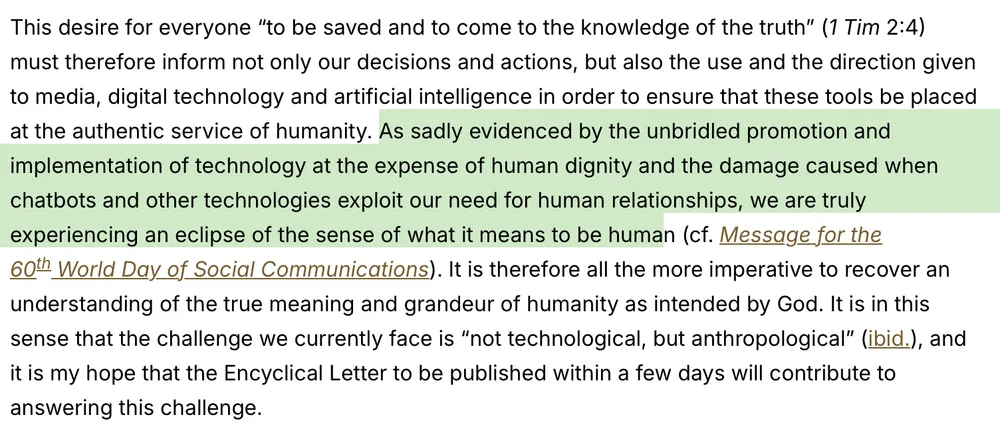
The Vatican published the promised Encyclical on May 25:
It is a long substantive document, deeply grounded in the religious humanitarian thought. Here is a Vatican-approved summary of it:
We all should be concerned about AI and demand its regulation, especially because there are already companies that operate in the general confusion and obscurity climate around AI and use the technology for surveillance and other nefarious purposes, including military ones. If you don't know what AI companies are leading the market and specialize in right now, Claude has helped me create this chart (click on this link for the interactive version):
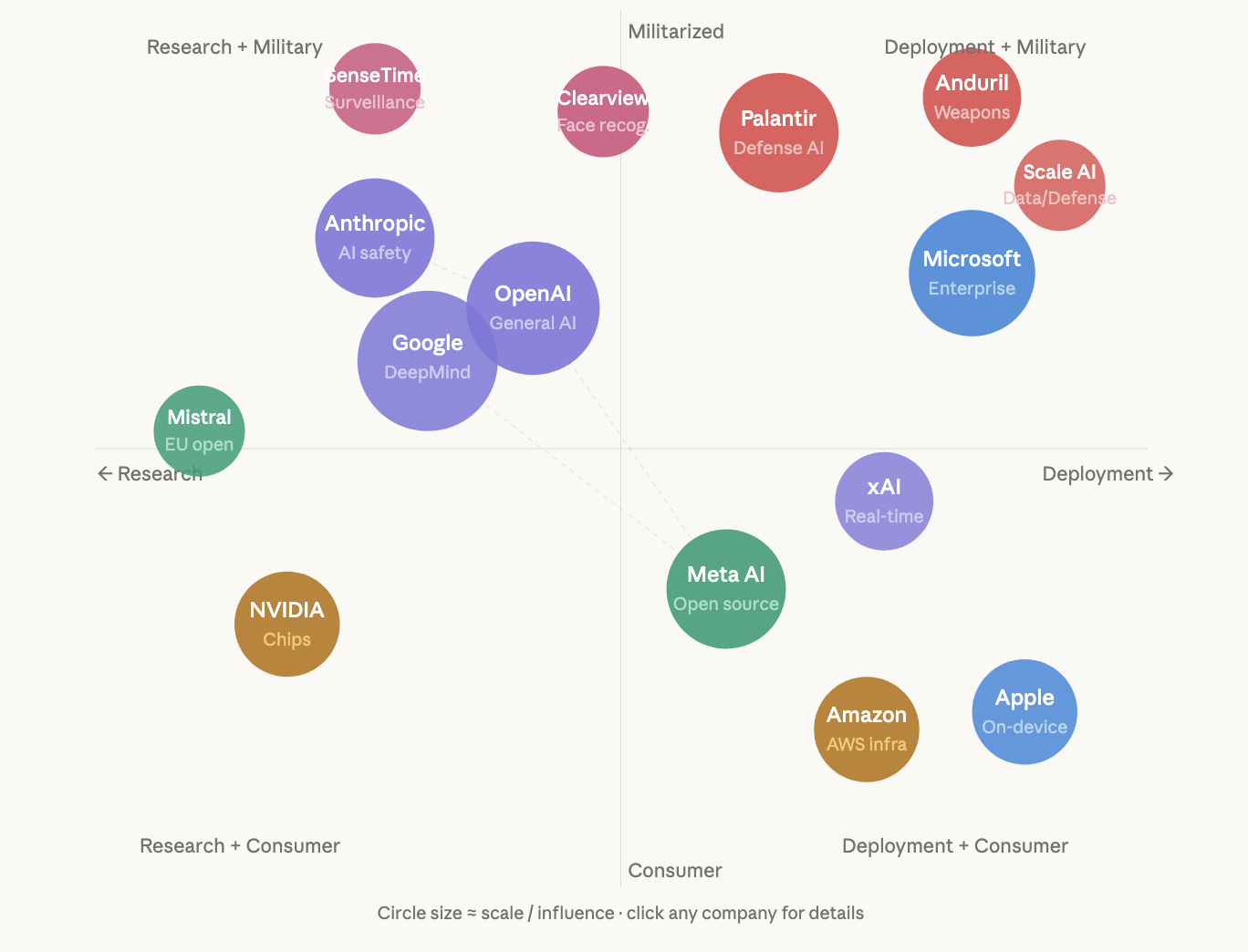
You might say that it's ironic and even hypocritical of me to use the AI for an doom-and-gloom article about AI. And you will be right, of course. My only justification is that as the most ethical AI system and the insider, Claude would produce a much better map of AI systems than I would, while spending a lot less time on it.
I'd be interested in knowing what you think about AI and the future. Please leave a comment or ask a question if you think about these issues as well.
About the Creator
Lana V Lynx
Avid reader and occasional writer of satire and short fiction. For my own sanity and security, I write under a pen name. My books: Moscow Calling - 2017 and President & Psychiatrist
@lanalynx.bsky.social
Enjoyed the story? Support the Creator.
Subscribe for free to receive all their stories in your feed. You could also become a paid subscriber, letting them know you appreciate their work.
Comments
There are no comments for this story
Be the first to respond and start the conversation.