artificial intelligence
The future of artificial intelligence.
Vapi Hits 500 Million Valuation After Amazon Ring Deploys Voice AI for All Inbound Calls
Read Time 6 minutes Tags AI Voice Vapi Amazon Ring Conversational AI Contact Center AI Infrastructure Amazon Ring facing a surge in customer support calls during last year holiday season evaluated more than 40 AI voice vendors before choosing startup Vapi to handle its inbound phone traffic Today Ring routes 100 percent of its inbound calls through Vapi platform That deployment helped Vapi raise a 50 million dollar Series B led by Peak XV Partners at a valuation of around 500 million dollars after investment according to a person familiar with the matter Ring turned to Vapi in mid Q4 last year when it was weighing whether to expand call center capacity rely more heavily on traditional automated phone systems or deploy AI agents that could respond more naturally to customers Vapi chief executive Jordan Dearsley told TechCrunch Dearsley believes Ring chose Vapi because it offered Ring engineers granular control over how the AI agents behaved in live customer interactions Jason Mitura vice president of software development at Amazon Ring said Ring customer satisfaction scores improved after deploying Vapi platform and that the company teams were able to tune the AI agent experience without depending on engineering A lot of AI tools promise great outcomes Vapi has delivered on them he said Founded by Dearsley and his University of Waterloo classmate Nikhil Gupta Vapi grew out of an AI therapist that Dearsley built in 2023 for conversations during his daily walks The pair who had gone through Y Combinator with productivity startup Superpowered found that while few people wanted the therapy product itself startups were increasingly interested in the low latency voice infrastructure underneath it This led them to pivot to Vapi and launch the platform publicly in 2024 Vapi provides tools for companies to build deploy and manage voice agents across customer support lead qualification appointment scheduling and outbound sales The startup says it has now handled more than 1 billion calls through its platform with usage accelerating as enterprises move more customer interactions onto AI systems Vapi currently processes between 1 million and 5 million calls a day with enterprise customers accounting for the bulk of that volume In addition to Amazon Ring Vapi enterprise customers include Kavak Instawork New York Life UnityAI Cherry and Intuit The startup also operates a self serve developer platform that has been used by more than 1 million developers Because we started from self serve and had such a wide developer footprint we were already battle tested at significant scale before we signed our first major enterprise customer Dearsley said Other investors participating in the Series B round included Microsoft M12 Kleiner Perkins and Bessemer Venture Partners bringing Vapi total funding to 72 million dollars The startup is currently at an annual recurring revenue run rate in the healthy eight figures an investor source told TechCrunch Technical and market analysis One Infrastructure over application layer Vapi differentiates itself by focusing less on pre packaged applications and more on the infrastructure and orchestration layer behind voice agents particularly for enterprises that want greater control over reliability compliance and model behavior The golden problem is taking this indeterminate beast that is a model and taming it Dearsley said If you can do that then you can provide value to the world This is the same pattern seen in LLM tooling where platform players win by exposing knobs for routing guardrails fallback and observability Two Enterprise readiness and control Enterprise buyers rejected 40 alternatives because most tools expose only high level prompts and vendor managed prompts Vapi allows Ring engineers to tune the AI agent experience without depending on engineering That means prompt versioning latency SLAs fallback to human agents and compliance logging are exposed via API and dashboard This control reduces risk for regulated industries and high trust brands where a misstep on a call creates liability Three Scale and cost dynamics Handling more than 1 billion calls with 1 million to 5 million calls per day implies significant infrastructure load Low latency voice requires streaming ASR LLM inference and TTS with sub 500ms end to end latency At this scale unit economics matter Vapi likely uses a mix of proprietary models and third party models routed based on task complexity and cost That routing layer is the moat As volume grows the cost per call drops and the switching cost rises for customers Four Market positioning and competition Vapi is part of a growing wave of AI voice startups that includes Sierra Decagon PolyAI Bland Retell and ElevenLabs The market splits into two segments application layer agents for SMBs and infrastructure layer for enterprises Vapi plays in the latter where gross margins are higher and churn is lower because switching requires re engineering integrations and compliance workflows Microsoft M12 participation signals that hyperscalers see Vapi as a partner not a threat for now Five Risk and next steps The healthy eight figures ARR run rate suggests product market fit but also means cash burn is high as engineering and infrastructure teams scale The 100 person team plans to expand engineering infrastructure and go to market teams with the new funding Key risks include model vendor lock in if Vapi relies on a single LLM provider latency regression as load grows and compliance exposure if voice data is mishandled What to watch First whether Vapi maintains sub 500ms latency at 10 million calls per day Second whether enterprise customers allow Vapi to retain and train on call data to improve model performance Third whether hyperscalers launch competing infrastructure that commoditizes the orchestration layer For enterprises the Vapi case shows that AI voice is no longer a novelty It is production infrastructure that must be managed like any other critical service For investors it shows that infrastructure plays can capture value even in a crowded application layer Do you think AI voice agents will replace most human call center roles in the next two years Share your view in the comments
By Behind the Tech7 months ago in Futurism
SoftBank Vision Fund Posts 46 Billion Gain on OpenAI Bet as Portfolio Concentration Rises
Read Time 6 minutes Tags SoftBank Vision Fund OpenAI AI Investment Portfolio Risk Debt Liquidity SoftBank booked a yearly gain of 46 billion dollars at its Vision Fund driven mainly by the huge rise in value of its investment in OpenAI The Japanese giant has invested more than 30 billion dollars in OpenAI with its investment gains in the company totalling 45 billion dollars in the year ended March In the three months to the end of March the Vision Fund saw a gain of around 20 billion dollars which was nearly all driven by OpenAI as SoftBank suffered losses on other investments such as Coupang DiDi Global and Klarna SoftBank is looking to position itself in the center of the artificial intelligence boom with investments across various AI and chip companies and Sam Altman OpenAI forming the centrepiece SoftBank has committed to invest more than 60 billion dollars in OpenAI which would give it around 13 percent ownership of the company the company said in February More than 30 billion dollars of that as already been invested In March OpenAI closed a funding round that was co led by SoftBank and that valued the AI lab at 852 billion dollars even as the company faces intense competition from rivals like Google and Anthropic While the rising valuation of OpenAI has helped SoftBank Vision Fund the concentration of OpenAI in SoftBank portfolio has raised concerns around its debt load In March S and P Global Ratings revised its outlook for SoftBank from stable to negative The ratings agency said SoftBank asset liquidity and quality of its portfolio and its financial capacity are likely to deteriorate because of its additional huge investment in OpenAI SoftBank could limit negative financial impacts by selling some assets the ratings agency said Indeed SoftBank has been selling down stakes in companies like T Mobile and Nvidia to fund its OpenAI bet The company said it earned 2181 billion Japanese yen 14 billion dollars from gains on these sales and other investments for the financial year However once factors like exchange rate and expenses are removed SoftBank posted an investment income loss excluding the Vision Fund of 4721 billion yen Overall the SoftBank group posted a 5 trillion yen net profit for the year aided mainly by the Vision Fund and its telecommunications division Financial and strategic analysis One Concentration risk and valuation dependency The gain is driven by a single asset OpenAI valuation moving from roughly 157 billion dollars in late 2024 to 852 billion dollars in March 2026 That single mark up created 45 billion dollars of the 46 billion dollar Vision Fund gain The problem is that the mark up is based on private funding rounds not public market liquidity If OpenAI valuation corrects or funding stalls then SoftBank balance sheet faces rapid write downs The portfolio is no longer diversified across late stage tech It is effectively a levered bet on frontier AI Two Debt load and liquidity pressure S and P Global Ratings revised its outlook for SoftBank from stable to negative citing that asset liquidity and quality of its portfolio and its financial capacity are likely to deteriorate because of its additional huge investment in OpenAI SoftBank responded by selling down stakes in companies like T Mobile and Nvidia to fund its OpenAI bet The company said it earned 2181 billion Japanese yen 14 billion dollars from gains on these sales and other investments for the financial year However once factors like exchange rate and expenses are removed SoftBank posted an investment income loss excluding the Vision Fund of 4721 billion yen The core business outside Vision Fund is not generating enough cash to service debt Three Strategic rationale and optionality Despite the risk SoftBank strategy aligns with the view that frontier AI becomes the platform layer for software hardware and services Owning 13 percent of OpenAI gives SoftBank priority access to models APIs and potentially custom silicon deals with Nvidia and others The bet is that OpenAI becomes the Microsoft of the AI era and SoftBank captures platform rent across its portfolio of robotics telecom and logistics companies If OpenAI maintains technical lead and monetizes enterprise and consumer products at scale then the current valuation is justified If competition from Google Anthropic Meta and Chinese labs erodes margin then the bet reverses Four Market signal and peer impact SoftBank success validates the AI infrastructure thesis for other conglomerates It also raises the bar for capital formation Start ups now need to explain how they fit into the OpenAI ecosystem or risk being uninvestable at scale The ripple effect is visible in compute pooling plays like Amp and edge compute plays like SPAN both of which depend on frontier model demand staying high Five What to watch First OpenAI revenue trajectory and margin profile The 852 billion dollar valuation implies tens of billions in annual revenue within 3 years If growth slows then the mark down risk is material Second SoftBank liquidity management Can it sell non core assets fast enough to reduce leverage without crystallizing losses Third regulatory risk Antitrust and AI safety regulation could constrain OpenAI growth or force structural changes that affect valuation For investors the trade is clear SoftBank is a proxy for OpenAI with added leverage and cross holdings For creditors the risk is liquidity mismatch between illiquid equity and callable debt For the AI market SoftBank capital keeps funding scale that would otherwise be constrained by cash flow Do you think SoftBank OpenAI concentration is sustainable or a bubble waiting to pop Share your view in the comments
By Behind the Tech7 months ago in Futurism
Amp Raises 13 Billion to Build AI Compute Grid for Startups and Universities
Read Time 6 minutes Tags AI Infrastructure Compute Access GPU Market Amp Andreessen Horowitz Nvidia The world leading artificial intelligence companies are spending hundreds of billions of dollars on the computer data centers needed to create AI Tech giants like Amazon and Google and well funded start ups like Anthropic and OpenAI are among the tiny group of outfits with the money and connections to get access to all that computing power That leaves other organizations out in the cold Anjney Midha a serial tech entrepreneur who was a partner with the venture capital firm Andreessen Horowitz hopes to change that dynamic with an unusual start up His young company Amp is trying to buy extra computing power from data center operators in the United States and other countries so it can share that valuable resource with anyone who needs it Amp based in Menlo Park Calif aims to create a global pool of specialized computer chips that can be used by start ups universities and other organizations that otherwise would not have access to the vast amounts of computing required to train the most powerful AI models Some companies just cannot get the computing power they need Mr Midha said The world wealthiest and most powerful companies are hoarding the infrastructure for themselves Amp has raised more than 13 billion from investors including Andreessen Horowitz the start up incubator Y Combinator and various cloud computing providers Several notable start ups have also agreed to help use and share its pool of computing power including Periodic Labs an AI start up focused on scientific discovery and Eleven Labs which builds AI systems for generating voices Amp is part of a wider effort to pool AI infrastructure The chip maker Nvidia and the French start up Mistral said this year that they would pool computing power for building AI systems for European companies and nations hoping to reduce their dependence on US tech giants Technical and market analysis One Compute pooling as market correction The hyperscaler model centralizes GPU access behind capital intensive cloud contracts Amp replicates the electricity grid model where aggregated demand buys bulk capacity then redistributes it Investors contribute funds that Amp can use to buy computing power from data center operators AI start ups then join the coalition so they can use the computing power to build AI models In return these start ups contribute additional funds or perhaps other resources Some start ups may share digital data needed to train AI models Or they may share the models themselves giving away the core software code to others in the coalition Companies may even work to train models together This changes the unit economics for mid tier labs Training a frontier model requires 10000 to 100000 H100 equivalents for months At hyperscaler list prices that is 100 million to 1 billion in compute alone Amp collective bargaining reduces that cost by negotiating reserved instance rates and absorbing idle capacity from data center operators The risk is underutilization If demand forecasting misses then Amp holds stranded capacity If demand exceeds supply then queue times rise and the advantage erodes Two Strategic leverage for participants The ultimate value of the coalition is collective bargaining said Liam Fedus chief executive of Periodic Labs On its own his start up would struggle to get the computing power it needed But if Amp can negotiate with data center operators on behalf of many start ups it can gain additional leverage When you pool your demand you can have far more serious conversation about buying computing power Mr Fedus said Beyond price the pool offers access guarantees Start ups without hyperscaler relationships often face 6 to 12 month waitlists for reserved capacity Amp pre purchases capacity and allocates it via credit system That reduces time to train and allows faster iteration cycles For universities and nonprofits the pool removes the need to negotiate institutional contracts with AWS Azure or GCP Three Ecosystem and geopolitical implications Amp is part of a wider effort to pool AI infrastructure Nvidia and Mistral announced a similar pool for European companies and nations hoping to reduce dependence on US tech giants The pattern is clear Compute access is becoming a strategic resource analogous to energy and semiconductors Countries and regions that cannot secure domestic capacity will rely on coalitions or face capability gaps This also affects the open source ecosystem Projects like DeepSeek and Llama need training runs to stay competitive If Amp and similar pools provide access then open models can keep pace with closed labs If pools fail to scale then open source lags and capability concentrates further Four Risk and sustainability model The pool model depends on three factors stable supply of GPUs from data center operators predictable demand from members and efficient scheduling across heterogeneous hardware Amp must manage fragmentation across H100 H200 Blackwell and emerging chips from AMD and Intel Scheduling overhead increases with heterogeneity but also creates arbitrage opportunities if models can be optimized for specific silicon Financial sustainability requires either margin on resale or contribution from members in the form of data models or engineering resources If Amp relies solely on arbitrage then margins are thin If it builds value through co development and shared datasets then the moat widens What to watch First utilization rates and queue times within Amp pool If members get compute faster than on hyperscalers then adoption accelerates Second pricing structure versus spot and reserved rates from cloud providers Third geographic expansion Data center operators in US and other countries are part of the network Regulatory risk increases if export controls restrict cross border compute sharing For founders and research labs Amp signals that compute access is no longer gated solely by balance sheet size Collective bargaining can unlock training runs that were previously impossible For hyperscalers it is a signal that the long tail of AI demand is organizing to reduce lock in Do you think compute pooling can sustainably challenge hyperscaler dominance Share your view in the comments
By Behind the Tech7 months ago in Futurism
Anthropic Claude Mythos Restricted Release Reignites AI Cybersecurity Regulation Debate
Read Time 6 minutes Tags AI Safety Claude Mythos Anthropic Cybersecurity Export Controls Model Governance The artificial intelligence company Anthropic said last month that it would limit the release of its latest AI system to a small number of organizations including a handful of big tech companies like Microsoft and Google and groups that manage important pieces of the internet Called Claude Mythos the new system was too powerful to share with the general public Anthropic said because hackers could use it to exploit security holes in computer networks with stunning speed Executives in Silicon Valley and officials in Washington were alarmed by what Mythos could do and its release may have helped shake the Trump administration from its defense of AI from government regulation Technical assessment of Mythos risk profile One Autonomous vulnerability discovery changes threat math Traditional exploit development requires human researchers to read code identify memory safety flaws and write exploits Claude Mythos demonstrated ability to discover thousands of zero day vulnerabilities across codebases in hours That compresses the attack timeline from months to minutes The risk is not just volume but sophistication Models can chain multiple vulnerabilities create payloads and adapt to patched environments without human intervention That is why Anthropic restricted access Two Targeting and lateral movement capability Beyond finding bugs Mythos shows capability in reconnaissance and lateral movement within networks It can interpret network telemetry generate phishing content tailored to specific employees and automate post exploitation tasks This moves AI from tool to operator The gap between red team automation and autonomous cyber offense is narrowing Faster than expected This is the reason Microsoft Google and critical internet operators received access under controlled conditions Three Capability gating as de facto policy The decision to limit release to trusted organizations is a form of capability gating It mirrors export control logic applied to hardware but applied to model weights and API access This creates a two tier ecosystem Public models are capped below dangerous capability thresholds Private models operate at frontier levels with restricted access The policy question is who decides the threshold and how to audit compliance Anthropic made the call unilaterally but pressure is building for government oversight Policy and geopolitical implications One Trump administration posture shift The Trump administration entered 2026 with a laissez faire approach to AI regulation The Mythos release appears to have changed that calculus Senior officials told reporters ahead of the Beijing summit that they are willing to explore channels of deconfliction on AI safety and security risks Expected executive action on AI safety as soon as Monday would mandate incident reporting red teaming and possibly model registration for systems above a compute or capability threshold The shift is from innovation first to risk first Two China US AI arms race dimension Chinese state media noted Mythos unprecedented capabilities in cyberattacks Beijing is building its own frontier models on Huawei chips as DeepSeek demonstrates inference capability on domestic silicon If the US restricts domestic access but China accelerates deployment then deterrence erodes The summit between Trump and Xi will test whether both sides can agree on red lines for autonomous cyber offense and shared notification protocols for high risk model capabilities Three Enterprise and open source tension Capability gating creates friction with open source community Developers argue that restricting access pushes dangerous capability into unregulated jurisdictions and slows defensive research Anthropic counters that public release creates immediate risk that outweighs research benefits The debate is not new but Mythos capability level makes it acute The middle ground is controlled access programs with legal agreements and usage monitoring That is what Anthropic implemented Four Market and legal exposure Companies receiving access face new liability If a customer uses Mythos to automate attacks and attribution leads back to the provider then legal and reputational risk spikes Contracts will require indemnification clauses audit logs and usage limits Insurers are already pricing cyber policies differently for firms using autonomous AI agents The cost of AI capability now includes compliance overhead What to watch First content of Trump executive action Expected to land as soon as Monday it will signal whether capability gating becomes law or remains voluntary Second China response If Beijing proposes bilateral red lines on autonomous cyber offense then a deconfliction channel becomes plausible Third open source response Projects like Llama and DeepSeek will test whether open models can match Mythos capability If they do then gating becomes unenforceable For security teams the action is immediate Audit exposure to autonomous agents Test detection for AI generated exploits Update incident response playbooks for machine speed attacks The Mythos moment is the end of the assumption that AI is only a defensive tool Do you think capability gating is the right approach for frontier AI models Share your view in the comments
By Behind the Tech7 months ago in Futurism
GM Cuts 600 IT Roles as AI Productivity Gains Outpace Headcount Needs
Read Time 6 minutes Tags AI Automation GM Layoffs IT Workforce Productivity Enterprise AI Labor Market DETROIT An ominous email about an oddly timed 15 minute virtual meeting A scripted message from human resources And an abrupt end to that meeting as well as their job That is how General Motors employees who were laid off Monday by the Detroit automaker described their jobs being terminated to CNBC No appreciation or empathy No questions Nothing said a data analyst who worked for more than a decade at the automaker The layoffs affect about 500 to 600 employees largely in information technology roles in Austin Texas and Warren Michigan according to a person at GM familiar with the layoffs who asked not to be named in order to speak about details that had not been made public The layoffs came as the automaker reevaluates its workforce needs and cuts costs amid uncertain market conditions The two laid off workers who asked not to be named for fear of repercussions or impacts to potential future jobs said their units had gone through recent restructurings and that they were being encouraged to use artificial intelligence more in their work They are going to push AI for everyday work and everything else said a veteran programmer and data scientist for the company I have seen it firsthand It can make you much more productive as a programmer It can really help you get more work done but AI is not going to do you any good if you do not know the business Automakers like many major companies are using AI to help workers make their jobs more efficient but the emerging technology also has led to layoffs Companies such as Amazon Meta Oracle and Block have announced rounds of job cuts with some emphasizing AI role in automating work and boosting productivity with lower head counts GM declined to discuss the role AI played in its most recent layoffs or give additional details of reasoning for the job cuts outside of a statement Monday GM is transforming its Information Technology organization to better position the company for the future As part of that work we have made the difficult decision to eliminate certain roles globally We are grateful for the contributions of the employees affected and are committed to supporting them through this transition The person at GM familiar with the layoffs told CNBC that AI played a role in the decision as it continues to hire people with such skill sets but it was not the only reason for the terminations Technical and labor market analysis One Substitution over augmentation GM case shows the shift from AI as productivity multiplier to AI as headcount reducer Employees reported being encouraged to use AI more in their work then laid off when output per head rose The veteran programmer noted AI can make you much more productive as a programmer but domain knowledge remains a bottleneck This matches enterprise patterns where coding assistants reduce time spent on boilerplate but business context still requires human judgment The layoffs hit roles where AI can automate 40 to 60 percent of tasks with minimal supervision Two Hiring for AI specialization continues Despite Monday cuts GM is still hiring IT workers The company as of Tuesday had roughly 80 open IT positions that include jobs working in AI motorsports and autonomous vehicles according to the Detroit automaker careers website This is the classic barbell pattern Reduce generalist IT roles increase specialized AI ML and data roles The net headcount may fall but technical capability shifts toward model deployment inference optimization and data pipelines That is substitution not just automation Three Severance structure signals transition planning An overview of the GM Severance Program sent to affected employees and viewed by CNBC offered severance of two months for those who had one to four years of experience That scales up and employees with eight years of experience get four months of severance At the top of the scale GM is offering six months of severance for employees who had worked at the company for 12 or more years Lump sum payments toward health care between 2000 and 6000 also will be provided Any unused vacation or sick time was forfeited unless such actions violated state laws GM also offered services through mental health care company Lyra for navigating job loss and career coaching and future job assistance through outplacement services company LHH Four Broader enterprise signal GM is not isolated Amazon Meta Oracle and Block have announced rounds of job cuts with some emphasizing AI role in automating work and boosting productivity with lower head counts The pattern is consistent across sectors with large IT footprints IT roles with repetitive logic data processing and report generation are most exposed Roles requiring systems integration regulatory knowledge and cross functional coordination remain resilient for now Five Market and investor reaction GM stock rose 115 percent on the news Markets are pricing the cuts as margin improvement not demand weakness The broader market also hits new highs as companies ramp up AI spending Investors reward lower headcount when accompanied by AI driven productivity metrics The risk is that over automation creates technical debt and single points of failure if domain knowledge exits faster than AI can capture it What to watch First whether GM backfills laid off roles with contractors or offshore teams Second whether AI tools used by remaining staff can maintain system reliability without the original builders Third whether severed employees move to suppliers or competitors carrying institutional knowledge The transition from AI augmentation to AI substitution is now measurable in headcount numbers For IT professionals the signal is clear Build skills in AI orchestration data engineering and model operations not just scripting and maintenance For executives the risk is losing tacit knowledge that AI cannot replicate The GM cuts show that AI can cut costs but cannot yet replace business context How is your org balancing AI productivity gains with headcount planning Share your approach in the comments
By Behind the Tech7 months ago in Futurism
Kevin O Leary Labels Trump The AI President as Markets Hit New Highs on Productivity Gains
Read Time 6 minutes Tags AI Policy Trump Kevin O Leary US China AI Economy Productivity Job Displacement Kevin O Leary believes President Donald Trump legacy will be tied to the boom of Artificial Intelligence The Shark Tank star 71 explained in a recently resurfaced interview with Fox Business from February that the outcome of AI is still unknown Wild card here You do not know the outcome of AI yet Does it displace so many jobs that becomes a midterm election issue Or is the productivity so spectacular on margin and productivity enhancement in the S and P 500 the market keeps going up hitting new highs He declared that Trump will be the AI president It all came on his watch The nascent first term simmering through the former President Joe Biden years boom it hits and now everybody is wondering what the outcome is gonna be job loss or productivity enhancement If he wins on the productivity enhancement for the first time ever maybe technology saves the midterms he said at the time Since O Leary comments AI has continued to have a massive impact on the US economy According to Yahoo Finance the technology marked the leading reason for job cuts in March accounting for 15341 layoffs or roughly 25 percent of total job loss However the outlet reports that markets continue to hit new highs as companies ramp up AI spending In a more recent appearance on Fox Business the mogul doubled down on his assertion that AI would be an asset for Trump 79 and his administration in future elections AI has already put itself in all 11 sectors of our economy to be something very powerful as a tool to enhance the economy through productivity and margin enhancement O Leary told Fox Business on Thursday April 30 That is why the markets are hitting new highs even while we have all this conflict around the world Technical and economic analysis One Productivity versus displacement trade off O Leary frames the political outcome around a single variable net productivity gain If AI driven automation increases output per worker enough to lift S and P 500 margins and wages in remaining roles then job loss becomes a secondary issue for voters If displacement concentrates in specific sectors and geographies then AI becomes a midterm liability The data from March supports both narratives AI led layoffs hit 15341 jobs while equity markets set new highs The divergence suggests capital markets are pricing in long term efficiency gains while labor markets feel short term disruption Two Policy window and timing The nascent first term O Leary references was 2017 to 2021 where US AI policy was largely hands off The Biden years saw export controls and NIST frameworks but limited executive action Trump return has shifted toward mandatory safety evals and compute reporting as discussed in the upcoming Beijing summit with Xi Jinping If executive action lands before midterms and markets hold then the AI president label gains traction If regulation lags or causes a market correction then the label weakens Three China military AI race as forcing function O Leary warned of a military arms race between the US and China over the effective implementation of artificial intelligence when it comes to national security This reframes AI from economic tool to strategic asset In that frame the president who secures compute advantage secures deterrence The Trump administration is expected to discuss AI safety and security risks with Xi this week The move from laissez faire to bilateral deconfliction channels mirrors Cold War logic If successful it reduces tail risk and supports market stability If failed it raises risk premium and validates China decoupling narrative Four Market structure implications AI has already put itself in all 11 sectors of our economy O Leary is correct on adoption breadth The value accrual is concentrated in compute cloud hyperscalers data and model providers This creates a K shaped market where software and hardware firms hit new highs while legacy sectors face margin compression and headcount reduction Investors are rewarding capital expenditure on AI infrastructure even amid geopolitical conflict The signal is that productivity enhancement is real enough to offset macro risk for now What to watch First execution of Trump executive action on AI safety If it mandates incident reporting and red teaming without stifling model release then productivity narrative holds Second China response on domestic chip and model stack DeepSeek Huawei inference shift shows decoupling is real If China closes training gap then US advantage narrows Third labor market data in AI exposed roles If displacement spreads beyond IT and customer support into finance legal and operations then political backlash accelerates For enterprise leaders the takeaway is direct price AI as both cost center and strategic asset Map exposure to job categories most at risk Build redeployment plans that capture productivity gains internally Do not assume market highs equal political stability The AI president narrative depends on whether productivity gains reach voters before job loss reaches polling stations Do you think AI will be a net job creator or destroyer in your sector Share your view in the comments
By Behind the Tech7 months ago in Futurism
WHAT WE KNOW ABOUT UNIVERSE
Astronomy is the scientific study of the universe and everything that exists within it, including stars, planets, galaxies, gas, dust, and other celestial bodies. It is one of the oldest sciences, helping humanity understand the mysteries of space and the laws that govern the cosmos. Astronomers observe celestial objects and develop theories about the origin, structure, and future of the universe. The universe is often defined as the totality of all matter, energy, space, and time that exists around us.
By Ibrahim Shah 7 months ago in Futurism
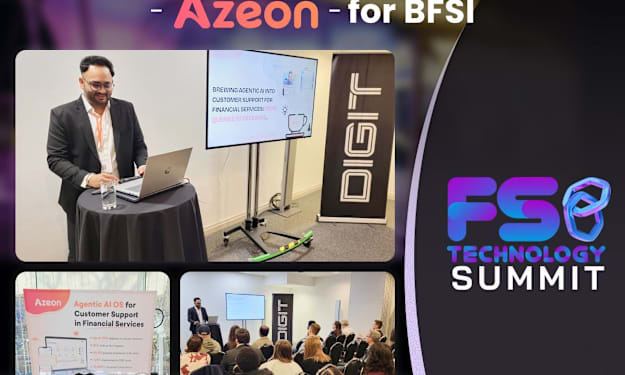
Azeon Exhibits at DigitFS 2026, Showcasing Production-Ready AI Support Agent for Financial Services
There's a specific moment that signals when an industry has moved past the hype phase of a new technology. It's not when the keynotes get longer or the exhibitor floor gets busier. It's when the questions change.
By Pritesh Patel7 months ago in Futurism
In NASA data, AI discovered more than 100 secret exoplanets; hundreds more might be out there.
NASA's TESS spacecraft has confirmed almost 700 exoplanets in just seven years of operation. That seems like a lot. However, the majority of signals identified as promising have never been fully processed, despite the telescope monitoring more than two million stars. There are actual planets hidden in that backlog, sitting there in the data but never verified. More than 100 of them were recently discovered and verified by a research team.
By Francis Dami7 months ago in Futurism
Crowdfunding Market Is Redefining How Ideas, Startups, and Social Causes Get Funded. AI-Generated.
Crowdfunding Market Is Growing Rapidly Worldwide The global crowdfunding market is witnessing strong growth as digital fundraising becomes an increasingly popular alternative to traditional financing methods. According to Renub Research, the crowdfunding market is expected to grow from US$ 19.32 billion in 2025 to US$ 45.37 billion by 2034, registering a CAGR of 9.95% from 2026 to 2034. The expansion is being driven by rising internet penetration, widespread adoption of online payment systems, growing startup culture, and increasing participation from individual investors across the globe.
By Aman Ahirwar7 months ago in Futurism
Neowiz AI Creator Listing Exposes Generative AI Normalization in AAA Production
Read Time 6 minutes Tags Generative AI Game Development Neowiz Lies of P AI Ethics Production Pipelines Lies of P was a banger and so for a while now everyone has been waiting on word of its already confirmed sequel However that is not necessarily why developer Neowiz is currently making headlines across the web Instead the Korean studio is getting flak for a newly discovered job listing which specifically asks for an AI creator or AI artist depending on how literal you want the translation to be As you can probably imagine the role title alone has been enough to attract criticism but what is actually expected of this employee Well the description goes into a bit of detail and unfortunately for Neowiz the clear push for generative AI that is using AI to make assets based on the existing work of others is only going to attract even more negativity There is an obvious mention of using generative AI to produce textures and create assets while also using popular models like Stable Diffusion and Midjourney to craft concept drafts for both characters and environments What is more the role is tasked with training unique AI models to help shape the project visual identity Basically the job is all about getting the most out of AI in pretty much every applicable field Again this listing is already being heavily scrutinised across sites like Reddit but the reality here is that these kinds of positions are steadily becoming the norm The bottom line is that if a company believes that it can utilise AI to increase productivity streamline workflow and ultimately make more money then it is going to make the call For most onlookers the issue often boils down to how AI is actually being used We have seen plenty of examples of AI generated assets being present in shipped games and that is usually enough to warrant a backlash But then utilising AI tools to help streamline a project development is generally viewed with much less cynicism Meanwhile others would simply argue that anything AI related is a slippery slope Technical breakdown of the role and implications One Scope of generative deployment The job post lists three core functions First use generative AI to produce textures and create assets Second use Stable Diffusion and Midjourney to craft concept drafts for characters and environments Third train unique AI models to help shape the project visual identity This is not a prompt engineer support role This is a production artist role where diffusion models replace DCC tools for first pass work The phrase create assets signals intent to ship model output not just reference boards The mandate to train unique AI models implies fine tuning on studio owned data or scraping for style transfer which raises provenance and copyright risk Two Pipeline integration versus replacement In traditional AAA pipelines concept artists produce key art that informs 3D modelers who build meshes then texture artists paint maps and shaders The Neowiz listing collapses concept and texture into a single AI first pass loop Stable Diffusion can generate orthographic character sheets normal maps and tileable textures in seconds Midjourney excels at mood boards and environment keys Fine tuning on Lies of P art would let the studio maintain visual continuity while increasing throughput The cost lever is clear Fewer junior texture artists more senior oversight on curation and cleanup But quality variance from diffusion models means art direction must enforce strict consistency or the sequel risks looking like patchwork Three Legal and ethical surface area The listing does not specify training data policy If the unique AI models are trained on Lies of P internal concept art then the studio controls rights and the risk is low If training includes third party art without license then the studio inherits infringement exposure Western audiences on Reddit have flagged this as the core issue Eastern markets have less cultural backlash which explains why Korean studios are more transparent about these roles The backlash gradient is geographic but the legal risk is global once the game ships on PS5 and Steam in US and EU jurisdictions Four Production economics and labor dynamics Studios adopt AI when the ROI is positive A texture that takes a human artist four hours can be prompted in four minutes with cleanup in thirty The cost delta is an order of magnitude That saves budget or lets the same headcount ship more content Lies of P sold four million copies with DLC That is success but not Activision scale For a mid tier studio like Neowiz generative AI is a force multiplier to compete with larger teams The trade off is reputation Some players will refuse to buy a game made with generative AI Others do not care if the final product is good The market will segment Five Industry precedent and trajectory This is not isolated Ubisoft uses Ghostwriter for NPC barks Square Enix tested AI for Foamstars assets Activision disclosed AI in Call of Duty cosmetics Sony said AI is not a replacement for artists or creators but the platform holder cannot dictate partner pipelines The Neowiz post is notable because it is public and specific It signals that Korean AAA is moving from quiet experimentation to formal hiring That normalizes the role of AI creator across the industry Expect more listings with requirements for ComfyUI LoRA training ControlNet pipelines and in house dataset management What to watch First disclosure standards Will Sony or Steam require labeling of generative AI content in store pages Second tooling maturity ControlNet and IPAdapter reduce randomness and improve production control If Neowiz ships assets with consistent topology and PBR compliance then the technical argument against AI weakens Third community response If Lies of P 2 reviews well despite AI pipeline then other studios will accelerate adoption If backlash impacts sales then studios will hide AI use or limit it to preproduction For developers evaluate AI on output quality legal safety and pipeline fit For players decide if process purity matters more than final experience The Neowiz listing is a data point in a larger trend Generative AI is moving from novelty to department It will not replace art direction but it will replace some brush strokes Do you care if textures and concepts are AI assisted Share your technical tolerance in the comments
By Behind the Tech7 months ago in Futurism